


In short ⚡
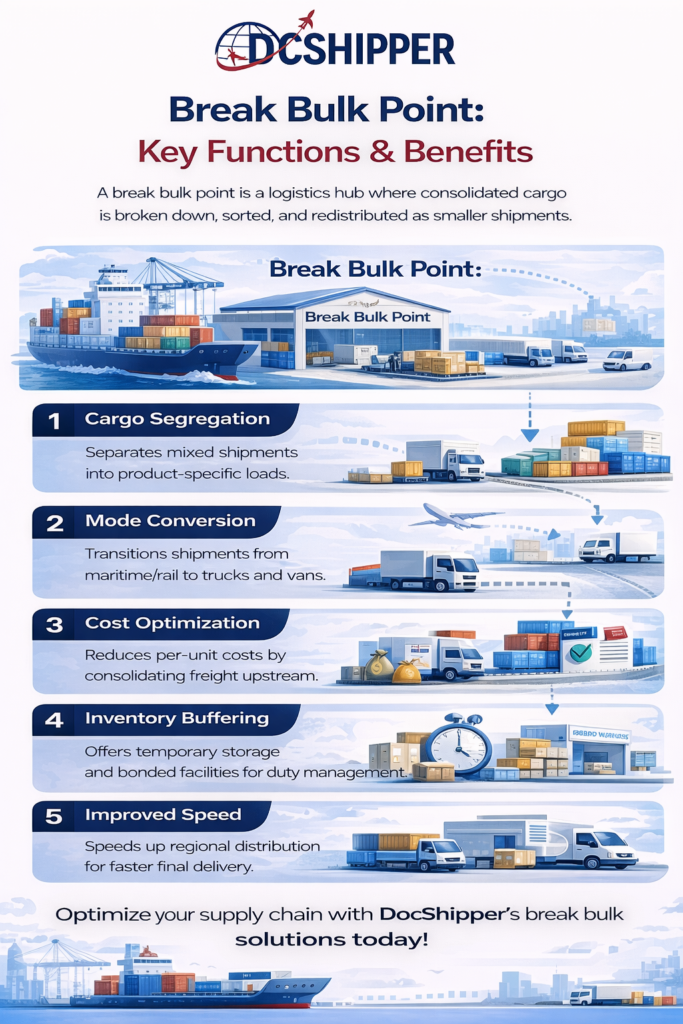
Break bulk point is a strategic logistics node where consolidated cargo is disassembled, sorted, and redistributed into smaller shipments for final delivery. This transshipment hub optimizes freight flows by bridging long-haul transportation modes with last-mile distribution networks, reducing costs and improving delivery efficiency.
Introduction
Many importers struggle with the transition between bulk ocean freight and fragmented inland distribution. The break bulk point solves this by acting as a deconsolidation center where large shipments are broken down for regional delivery.
In international trade, this facility plays a critical role in supply chain architecture. It connects container ports or rail terminals to warehouses, retail locations, or manufacturing sites requiring smaller, frequent deliveries.
- Cargo segregation: Separates mixed-commodity containers into product-specific batches
- Mode conversion: Transitions from maritime/rail to truck/van transport
- Customs clearance: Often integrated with bonded warehouse facilities for duty management
- Inventory buffering: Provides temporary storage to synchronize supply with demand fluctuations
- Cost optimization: Reduces per-unit transportation costs through load consolidation upstream
Operational Mechanisms & Strategic Implications
The break bulk point operates as a transshipment hub where inbound cargo undergoes systematic deconsolidation. Upon arrival, containers or palletized loads are unloaded, inspected, and sorted according to destination, customer, or product category.
Handling procedures vary based on cargo type. General merchandise follows standard palletization protocols, while project cargo (machinery, industrial equipment) requires specialized lifting equipment. Perishables demand temperature-controlled zones to maintain cold chain integrity during redistribution.
From a regulatory perspective, break bulk facilities often operate under bonded status, allowing duty-deferred storage. This enables importers to delay customs payments until cargo exits for final delivery. According to U.S. Customs and Border Protection, bonded warehouse procedures must comply with strict security and documentation standards.
Network positioning determines operational efficiency. Facilities located near major ports (Rotterdam, Los Angeles, Singapore) minimize drayage costs, while inland hubs serve regional distribution networks. The choice depends on freight volume, delivery radius, and transportation infrastructure.
Technology integration enhances throughput. Warehouse Management Systems (WMS) automate sorting, track inventory in real-time, and optimize space utilization. At DocShipper, we implement WMS solutions at break bulk facilities to ensure traceability and reduce handling errors during cargo redistribution.
Concrete Examples & Performance Data
Consider a European retailer importing 1,000 pallets of consumer electronics from China. The shipment arrives in a single 40-foot container at Hamburg port. At the break bulk point, cargo is deconsolidated into 50 separate truck loads destined for stores across Germany, Austria, and Switzerland.
| Logistics Stage | Transportation Mode | Cost per Pallet | Transit Time |
|---|---|---|---|
| Shanghai → Hamburg | Ocean freight (FCL) | €35 | 28 days |
| Hamburg break bulk | Deconsolidation + storage | €12 | 2 days |
| Hamburg → Final destinations | Regional trucking | €28 | 1–3 days |
Cost efficiency analysis: Without a break bulk point, direct container delivery to 50 locations would require 50 separate LCL shipments, increasing costs by approximately 40% and extending transit times by 7–10 days due to multiple handling stages.
Project cargo scenario: A wind turbine manufacturer imports components (blades, towers, nacelles) from multiple Asian suppliers. At the Rotterdam break bulk terminal, oversized cargo is unloaded using heavy-lift cranes, sorted by project site, and loaded onto specialized trailers. This centralized handling reduces coordination complexity and minimizes on-site storage requirements.
Performance metrics: Leading break bulk facilities achieve 95–98% on-time dispatch rates with average throughput of 500–1,200 pallets per day. Automated sorting systems reduce handling time by 30% compared to manual operations, while integrated customs processing cuts clearance delays by 2–3 days.
Industry benchmark: According to logistics data, break bulk operations reduce total landed costs by 15–25% for importers shipping 100+ pallets monthly to dispersed delivery points. The savings stem from consolidated ocean freight rates and optimized last-mile distribution.
Conclusion
The break bulk point is essential for importers managing high-volume, multi-destination shipments. It transforms bulk transportation into flexible distribution while maintaining cost control and delivery reliability.
Need assistance optimizing your break bulk logistics? Contact DocShipper for tailored transshipment solutions.
📚 Quiz
Test Your Knowledge: Break Bulk Point
Q1 — What is the primary function of a break bulk point in a supply chain?
Q2 — How does a break bulk point differ from cross-docking?
Q3 — A European retailer imports 1,000 pallets of electronics from China in a single container arriving at Hamburg. Which scenario correctly describes the role of the break bulk point?
🎯 Your Result
📞 Free Quote in 24hFAQ | Break Bulk Point: Definition, Operations & Concrete Examples
Oversized equipment, project cargo, bulk commodities, and consolidated retail shipments benefit most. Any freight requiring deconsolidation before final delivery uses break bulk services.
Break bulk involves cargo storage and sorting, while cross-docking transfers goods directly from inbound to outbound transport with minimal warehousing. Break bulk allows inventory holding; cross-docking prioritizes speed.
Yes, many operate as bonded facilities, allowing duty-deferred storage. Customs procedures are processed before cargo exits the terminal for final delivery.
Costs range from $8–$20 per pallet depending on location, cargo type, and services. Specialized handling (refrigerated, hazmat) incurs additional fees of 30–50%.
Standard dwell time is 1–5 days for general cargo. Project freight may remain 2–4 weeks awaiting specialized transport or final assembly coordination.
Yes, when combined with order management systems. High-volume importers use break bulk hubs to receive bulk shipments, then redistribute to regional fulfillment centers for last-mile delivery.
Bill of lading, packing lists, commercial invoices, and customs declarations. Bonded facilities require additional warehouse entry documentation and security bonds.
They provide inventory buffers, enable flexible routing during disruptions, and allow cargo redirection without returning to origin ports. This reduces dependency on single delivery routes.
Only at licensed facilities with proper segregation zones and safety certifications. Hazmat handling requires compliance with IMDG Code and local regulations.
Warehouse Management Systems (WMS), automated guided vehicles (AGVs), RFID tracking, and real-time inventory platforms reduce errors and accelerate throughput by 25–40%.
Facilities scale labor and storage capacity during peak seasons (retail holidays, harvest periods). Advanced booking and flexible contracts help manage volume surges without service degradation.
Cargo damage, delivery delays, inventory discrepancies, and customs penalties. Proper facility selection and oversight protocols mitigate these risks through quality control and insurance coverage.
Need Help with Logistics or Sourcing ?
First, we secure the right products from the right suppliers at the right price by managing the sourcing process from start to finish. Then, we simplify your shipping experience - from pickup to final delivery - ensuring any product, anywhere, is delivered at highly competitive prices.


Fill the Form
Prefer email? Send us your inquiry, and we’ll get back to you as soon as possible.
Contact us


