


In short ⚡
A Break Bulk Terminal is a specialized port facility designed to handle non-containerized cargo that cannot fit into standard shipping containers. These terminals manage oversized, heavy, or irregularly shaped goods such as machinery, steel beams, wind turbine components, and project cargo, requiring specialized equipment like cranes, forklifts, and roll-on/roll-off (RoRo) systems for efficient loading and unloading operations.
Introduction
Many shippers struggle to understand which port facility suits their oversized cargo needs. Choosing between container terminals and break bulk terminals can mean the difference between seamless delivery and costly delays.
Break bulk terminals play a critical role in global trade infrastructure. They handle specialized cargo that forms the backbone of industries like construction, energy, manufacturing, and heavy equipment.
Key characteristics of break bulk terminals include:
- Specialized handling equipment including mobile harbor cranes, gantry cranes, and heavy-lift machinery
- Open storage yards with reinforced surfaces to accommodate heavy loads
- Direct vessel access with deep-water berths for large cargo ships
- Customized securing methods using lashing, blocking, and bracing techniques
- Multimodal connectivity linking maritime transport with rail and road networks
Terminal Operations & Technical Expertise
Break bulk terminals operate under fundamentally different principles than container facilities. Each cargo piece requires individual handling plans, weight distribution calculations, and securing protocols.
Cargo handling methodology begins with pre-arrival planning. Terminal operators receive detailed specifications including dimensions, weight, center of gravity, and lifting points. This information determines crane selection, storage location, and discharge sequencing.
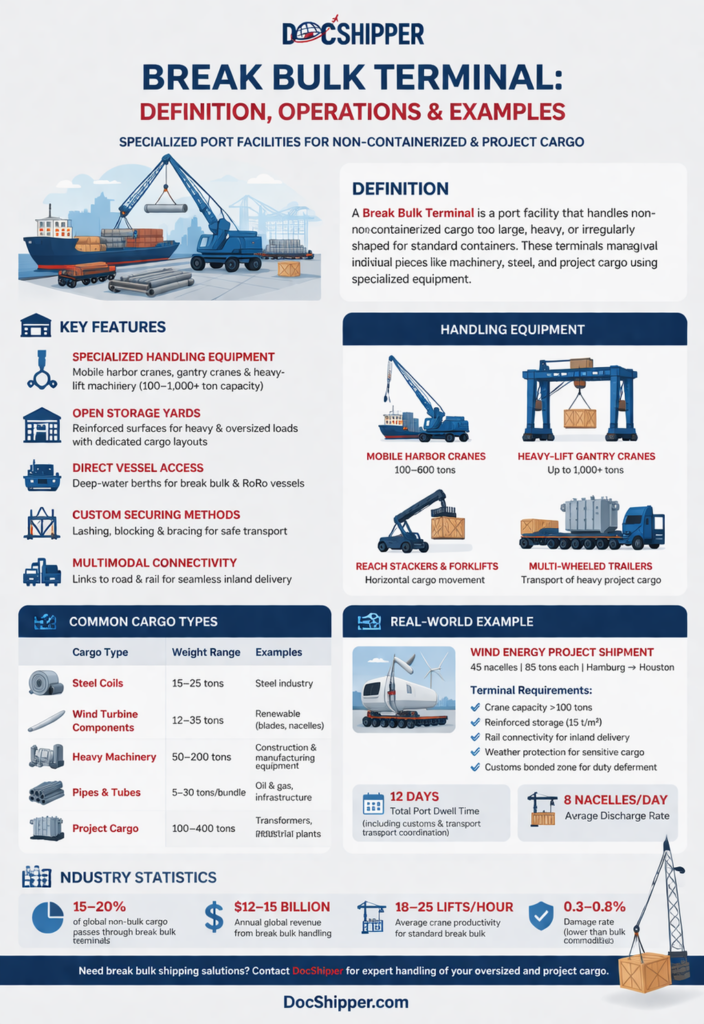
Equipment infrastructure varies significantly across terminals. Mobile harbor cranes typically handle 100 to 600 tons, while specialized heavy-lift cranes can manage loads exceeding 1,000 tons. Terminals also deploy reach stackers, side loaders, and multi-wheeled trailers for horizontal movement.
Storage configuration requires careful planning. Unlike standardized container stacking, break bulk cargo demands customized layouts. Steel products need corrosion prevention measures. Machinery requires weather protection. Project cargo often occupies dedicated zones with direct loading access.
Safety protocols govern every operation. Terminal personnel follow IMO safety standards for cargo securing and load testing. Risk assessments cover lifting operations, ground pressure limits, and personnel exclusion zones.
Documentation requirements include cargo manifests, packing lists, lifting plans, and customs declarations. Break bulk shipments generate more paperwork than containerized cargo due to individual piece tracking and specialized handling instructions.
At DocShipper, we coordinate directly with break bulk terminal operators to ensure your oversized cargo receives proper handling from vessel discharge through final delivery, eliminating communication gaps that often cause project delays.
Concrete Examples & Industry Data
Real-world applications demonstrate how break bulk terminals handle diverse cargo types across industries.
Comparative Terminal Capabilities
| Cargo Type | Typical Weight Range | Handling Equipment | Average Dwell Time |
|---|---|---|---|
| Steel Coils | 15-25 tons | Coil lifters, Mobile cranes | 5-7 days |
| Wind Turbine Blades | 12-35 tons | Specialized blade lifters | 3-5 days |
| Heavy Machinery | 50-200 tons | Heavy-lift cranes, SPMT trailers | 7-14 days |
| Pipes & Tubes | 5-30 tons per bundle | Sling lifts, Side loaders | 4-6 days |
| Project Cargo (Transformers) | 100-400 tons | Gantry cranes, Hydraulic trailers | 10-21 days |
Use Case: Wind Energy Project Shipment
A renewable energy company shipped 45 wind turbine nacelles from Hamburg to Houston. Each nacelle weighed 85 tons and measured 12 meters in length.
Terminal selection criteria:
- Crane capacity exceeding 100 tons
- Reinforced storage area supporting 15 tons per square meter
- Rail connection for inland transport to installation sites
- Weather protection facilities for sensitive electrical components
- Customs bonded zone for duty deferment
The break bulk terminal in Houston processed the shipment with an average discharge rate of 8 nacelles per day. Total port dwell time was 12 days, including customs clearance and onward transportation coordination.
Industry Statistics
According to maritime logistics data, break bulk terminals handle approximately 15-20% of global non-bulk cargo volume. The sector generates $12-15 billion annually in handling fees worldwide.
Key operational benchmarks include:
- Average crane productivity: 18-25 lifts per hour for standard break bulk
- Storage utilization: 60-75% capacity during peak seasons
- Damage rates: 0.3-0.8% of handled pieces (significantly lower than bulk commodities)
- Labor intensity: 3-5 times higher than container operations per ton handled
- Cost differential: Break bulk handling costs $45-120 per ton versus $8-15 per ton for containers
Conclusion
Break bulk terminals remain essential infrastructure for industries requiring specialized cargo handling. Understanding their capabilities, equipment, and operational requirements ensures successful project execution and cost-effective logistics planning.
Need expert guidance on break bulk shipping solutions? Contact DocShipper for comprehensive support from terminal selection through final delivery.
📚 Quizz
Test Your Knowledge: Break Bulk Terminal
Q1 — What is the primary purpose of a Break Bulk Terminal?
Q2 — A common misconception is that break bulk terminals operate the same way as container terminals. What is the key difference?
Q3 — A renewable energy company needs to ship 45 wind turbine nacelles, each weighing 85 tons and measuring 12 meters long, from Hamburg to Houston. Which facility should they use?
🎯 Your Result
📞 Free Quote in 24hFAQ | Break Bulk Terminal: Definition, Operations & Concrete Examples
Oversized machinery, steel structures, wind turbine components, transformers, locomotives, and any cargo exceeding standard container dimensions (20ft or 40ft) require break bulk handling. Items weighing over 30 tons or measuring beyond 12 meters typically cannot fit containerized shipping.
Break bulk handling typically costs $45-120 per ton compared to $8-15 per ton for containers. Higher costs reflect specialized equipment, individual piece handling, extended dwell times, and labor-intensive operations. However, for oversized cargo, break bulk remains the only viable option.
Standard equipment includes mobile harbor cranes (100-600 ton capacity), reach stackers, side loaders, multi-wheeled trailers, and lashing/securing materials. Advanced terminals feature heavy-lift cranes exceeding 1,000 tons, RoRo ramps, and specialized lifters for specific cargo types like coils or blades.
Average dwell time ranges from 5-14 days depending on cargo type, customs procedures, and onward transportation arrangements. Project cargo may remain 21+ days when requiring assembly, inspection, or specialized transport coordination. Container cargo typically clears within 3-5 days.
Required documents include detailed packing lists, cargo manifests with individual piece weights and dimensions, lifting plans with center of gravity calculations, customs declarations, certificates of origin, and specialized permits for oversized transport. Each piece requires separate documentation unlike containerized cargo.
Most break bulk terminals have designated zones for hazardous cargo following IMDG Code regulations. However, capabilities vary by terminal. Explosives, radioactive materials, and certain chemicals require specialized facilities with enhanced safety protocols, segregated storage, and certified handling personnel.
Break bulk shipping accommodates cargo exceeding container dimensions, eliminates disassembly requirements, reduces packaging costs for large items, allows direct loading onto specialized transport, and provides flexibility for irregular shapes. It's essential when containerization is physically impossible or economically impractical.
Weather significantly impacts operations. High winds (typically above 35 knots) halt crane operations. Rain requires additional cargo protection and slows handling. Extreme temperatures affect steel and machinery. Advanced terminals provide covered storage and weather monitoring systems to minimize disruptions.
Break bulk cargo requires specialized marine cargo insurance covering handling risks, storage exposure, and transit damage. Policies should specify individual piece values, include terminal-to-terminal coverage, address lifting operations, and cover weather-related risks. Premium rates are typically 0.3-1.2% of cargo value.
Ground pressure equals cargo weight divided by contact surface area. Terminals typically support 10-20 tons per square meter. Heavy cargo requires load distribution using timber mats, steel plates, or reinforced concrete pads. Engineers calculate pressure points before discharge to prevent surface damage and ensure stability.
Break bulk terminals serve as critical nodes in project cargo supply chains, providing specialized handling, temporary storage, customs clearance, and multimodal transfer capabilities. They coordinate with heavy transport companies, provide assembly areas, and manage complex documentation for infrastructure projects, energy installations, and industrial developments.
Terminals are investing in specialized equipment for wind turbine components, extending storage yards, reinforcing surfaces for heavier loads, and developing dedicated zones for renewable energy projects. Many now offer blade lifters, nacelle handling systems, and direct rail connections to installation sites, responding to growing offshore wind development.
Need Help with Logistics or Sourcing ?
First, we secure the right products from the right suppliers at the right price by managing the sourcing process from start to finish. Then, we simplify your shipping experience - from pickup to final delivery - ensuring any product, anywhere, is delivered at highly competitive prices.


Fill the Form
Prefer email? Send us your inquiry, and we’ll get back to you as soon as possible.
Contact us


