In short ⚡
The Bullwhip Effect is a supply chain phenomenon where small demand fluctuations at the retail level amplify progressively upstream, causing exaggerated inventory swings at manufacturers and suppliers. This distortion leads to inefficient production, excess stock, and increased logistics costs throughout the entire chain.
Introduction
Why does a 5% increase in consumer demand trigger a 40% surge in factory orders six months later? This paradox plagues international supply chains daily, creating unnecessary costs and operational chaos.
The Bullwhip Effect represents one of the most critical challenges in global logistics. As goods move from manufacturer to distributor to retailer, information distortion compounds at each stage. What appears as stable consumer demand transforms into volatile production schedules.
Key characteristics include:
- Demand amplification increasing exponentially upstream
- Information delays between supply chain partners
- Inventory oscillations causing stockouts and overstock simultaneously
- Forecasting errors multiplying across organizational boundaries
- Order batching creating artificial demand spikes
Root Causes & Mechanisms
The Bullwhip Effect stems from four primary drivers identified in supply chain research. Understanding these mechanisms enables companies to implement targeted mitigation strategies.
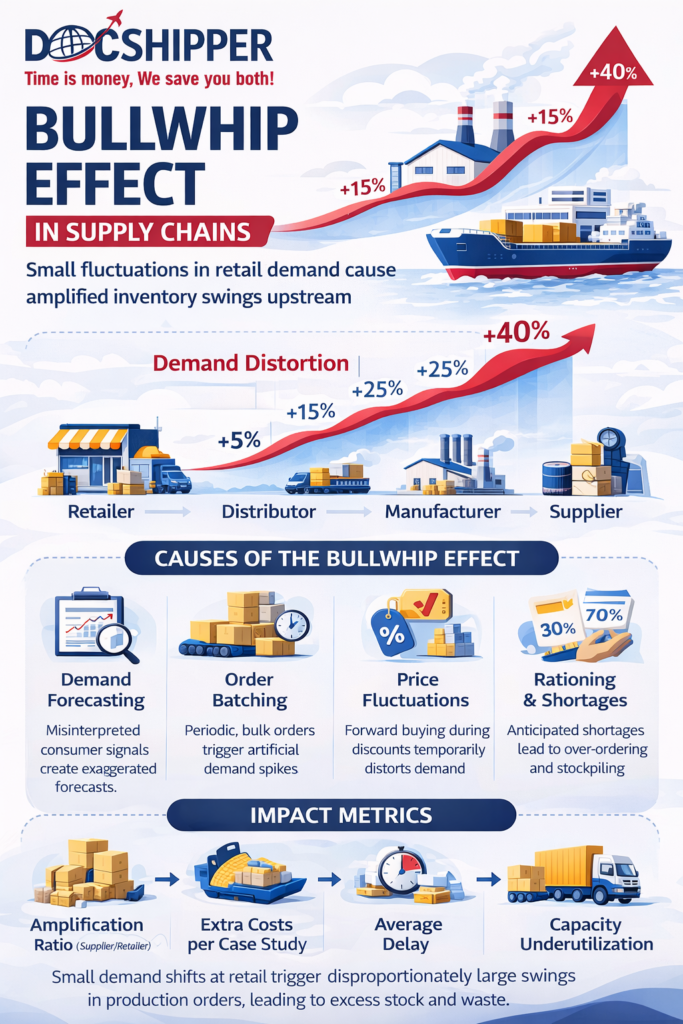
Demand signal processing occurs when each supply chain tier adjusts forecasts based on order history rather than actual consumer behavior. A retailer ordering 10% more units “just in case” prompts the distributor to order 15% more, and the manufacturer to increase production by 25%. This cascading overreaction creates phantom demand.
Order batching amplifies variability when companies place periodic bulk orders instead of continuous replenishment. Weekly or monthly ordering cycles create artificial demand peaks that suppliers interpret as genuine market shifts. Transportation economies of scale often drive this behavior, as companies wait to fill containers or trucks.
Price fluctuations trigger forward buying. When manufacturers offer promotional discounts or anticipate price increases, distributors stockpile inventory. This temporary demand spike distorts production planning, followed by a demand trough once inventories normalize. According to the U.S. Department of Commerce, promotional strategies account for 30-40% of Bullwhip variability in consumer goods sectors.
Rationing and shortage gaming emerges during capacity constraints. When suppliers allocate limited inventory based on order quantities, buyers inflate orders anticipating cuts. If a supplier fills 50% of orders, buyers request double their actual needs. Once supply normalizes, orders plummet, leaving suppliers with excess capacity.
Lead time variability compounds these effects. Longer transportation times in international shipping create information lags. A three-month ocean freight lead time from Asia to Europe means decisions made today reflect outdated market conditions. At DocShipper, we implement real-time tracking systems to minimize information delays and provide clients with accurate demand visibility across their global networks.
Concrete Examples & Data
Quantifying the Bullwhip Effect reveals its operational impact. Research shows demand variability increases by 200-300% from retail to manufacturing tiers in typical supply chains.
Case Study: Consumer Electronics
A European electronics retailer experienced 8% weekly demand variation for smartphones. Their distributor faced 22% variation, while the Asian manufacturer observed 47% fluctuation in component orders. This 6x amplification resulted in:
- €2.3 million in excess inventory costs
- 15% increase in expedited shipping expenses
- 12-day average stockout duration during peak demand
- 28% capacity underutilization during demand troughs
Comparative Impact Across Industries
| Industry | Retail Variability | Manufacturer Variability | Amplification Ratio |
|---|---|---|---|
| Automotive Parts | 12% | 51% | 4.25x |
| Apparel | 18% | 73% | 4.06x |
| Food & Beverage | 9% | 28% | 3.11x |
| Pharmaceuticals | 7% | 35% | 5.00x |
| Industrial Equipment | 15% | 68% | 4.53x |
DocShipper Platform
One platform. Your entire supply chain
Sourcing, freight, customs & documents — all centralised, all visible, 24/7.

Mitigation Strategies: Measured Impact
Companies implementing collaborative forecasting reduce Bullwhip amplification by 30-50%. Key interventions include:
- Information sharing platforms providing real-time POS data to suppliers
- Vendor-managed inventory (VMI) transferring replenishment decisions upstream
- Every-day-low-pricing (EDLP) eliminating promotional distortions
- Smaller, frequent orders enabled by consolidated shipping solutions
- Collaborative planning aligning forecasts across organizational boundaries
A textile importer reduced order variability from 42% to 18% by implementing weekly replenishment cycles and sharing retail sales data with Vietnamese manufacturers. This coordination decreased air freight costs by €180,000 annually while improving product availability by 23%.
Conclusion
The Bullwhip Effect transforms minor demand fluctuations into major supply chain disruptions, costing industries billions annually through excess inventory, expedited shipping, and lost sales. Addressing this requires transparency, coordination, and strategic information sharing across all supply chain partners.
Need expert guidance on optimizing your international supply chain and minimizing demand distortion? Contact DocShipper for tailored logistics solutions that enhance visibility and reduce operational volatility.
📚 Quiz
Test Your Knowledge: Bullwhip Effect
Q1 — What best describes the Bullwhip Effect in a supply chain?
Q2 — A common misconception about the Bullwhip Effect is that it only occurs when consumer demand is highly unstable. What does the article actually state?
Q3 — A textile importer wants to reduce order variability and lower air freight costs. Based on the article, which approach would be most effective?
🎯 Your Result
📞 Free Quote in 24hFAQ | Bullwhip Effect: Definition, Causes & Practical Examples
Information distortion and lack of demand visibility across supply chain tiers cause the Bullwhip Effect. Each partner makes decisions based on orders received rather than actual consumer demand, amplifying variability upstream.
It creates simultaneous overstock and stockout situations. Manufacturers hold excess safety stock while retailers experience shortages. Studies show inventory carrying costs increase 25-40% in supply chains experiencing significant Bullwhip amplification.
Technology reduces but cannot eliminate the effect entirely. Real-time data sharing, AI forecasting, and blockchain transparency minimize amplification by 40-60%, but human behavioral factors and market uncertainties persist.
Longer lead times and more intermediaries compound information delays. A domestic supply chain might have 2-3 tiers with weekly communication, while international chains involve 5-7 tiers with monthly interactions, multiplying distortion opportunities.
Promotions encourage forward buying, where distributors purchase excessive quantities at discounted prices. This creates artificial demand spikes followed by troughs, making it impossible for manufacturers to distinguish genuine market trends from promotional effects.
Batching concentrates orders into periodic intervals rather than continuous flow. When multiple retailers order weekly on Mondays, suppliers see massive Monday demand and zero demand other days, forcing them to maintain excess capacity.
VMI gives suppliers direct access to retailer inventory and sales data, allowing them to manage replenishment. This eliminates order signal distortion since suppliers respond to actual consumption rather than interpreted demand.
Fashion, consumer electronics, and automotive parts suffer most due to short product lifecycles, high demand volatility, and complex multi-tier supply networks. Pharmaceutical and food industries experience less amplification due to stable demand patterns.
Yes, when balanced with consolidation strategies. Frequent small orders reduce inventory holding costs and obsolescence risk. Consolidated shipping services can maintain transportation efficiency while enabling responsive replenishment cycles.
Shorter lead times decrease forecasting horizons, reducing uncertainty and safety stock requirements. A lead time reduction from 90 to 30 days can cut demand variability amplification by 35-45% according to supply chain research.
Key metrics include order variability coefficient, demand amplification ratio (upstream variability ÷ downstream variability), forecast accuracy at each tier, and inventory turnover rates. Ratios above 2.0x indicate significant Bullwhip presence.
Traditional planning uses historical order data within single organizations. Collaborative forecasting shares actual consumption data and market intelligence across partners, creating unified demand signals that reduce interpretation errors and amplification.
Need Help with
Logistics or Sourcing ?
First, we secure the right products from the right suppliers at the right price by managing the sourcing process from start to finish. Then, we simplify your shipping experience - from pickup to final delivery - ensuring any product, anywhere, is delivered at highly competitive prices.


Fill the Form
Prefer email? Send us your inquiry, and we’ll get back to you as soon as possible.
Contact us