Bundle: Definition & Strategy in Logistics for 2026

  • admin 7 Min
  • Published on March 12, 2026 Updated on March 12, 2026
img

In short ⚡

A bundle is a logistics and commercial strategy that groups multiple products or services into a single package, sold at a combined price. In international trade, bundling optimizes shipment consolidation, reduces per-unit costs, and simplifies customs documentation by treating multiple items as one cohesive unit.

Introduction

Many importers struggle with fragmented shipments, inflated freight costs, and complex customs procedures when handling multiple product lines. The bundle approach addresses these challenges by consolidating goods into unified shipments.

In international logistics, bundling transcends simple product packaging. It represents a strategic consolidation method that impacts freight rates, customs valuation, insurance premiums, and inventory management. Understanding bundle dynamics is essential for optimizing supply chain efficiency.

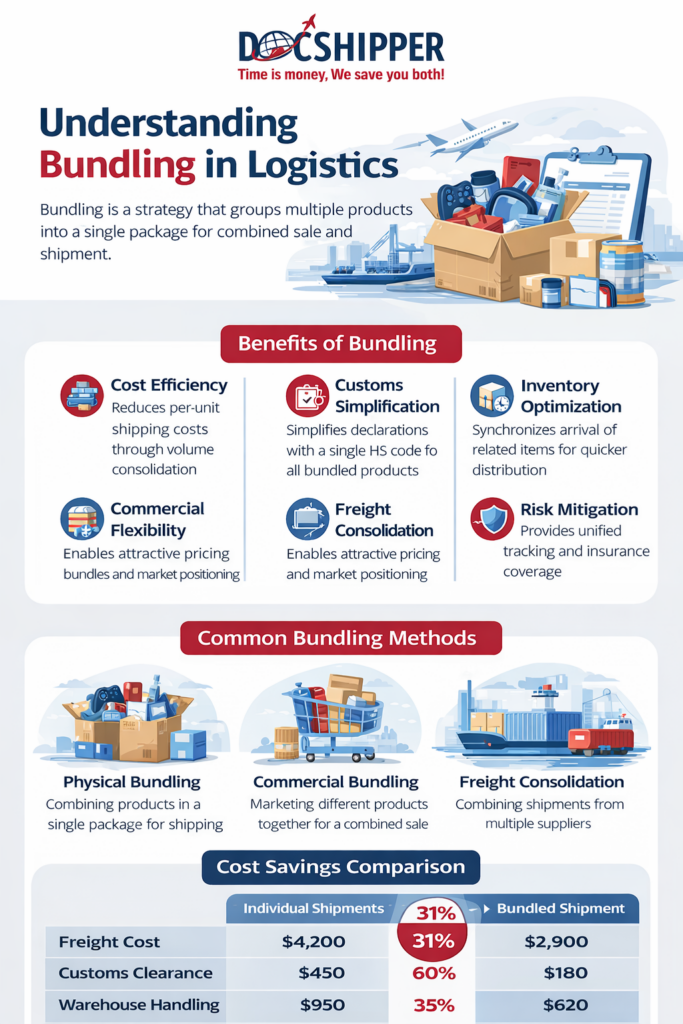
  • Cost efficiency: Reduced per-unit shipping and handling expenses through volume consolidation
  • Customs simplification: Single declaration covering multiple SKUs under one harmonized code
  • Inventory optimization: Synchronized arrival of complementary products for faster distribution
  • Commercial flexibility: Enhanced pricing strategies and market positioning
  • Risk mitigation: Unified insurance coverage and tracking for grouped items

Bundle Mechanisms & Strategic Applications

The bundle concept operates across three distinct logistics dimensions. Each application requires specific documentation and operational protocols.

Physical bundling involves consolidating separate items into a single shipping unit. Manufacturers often pre-package complementary products—such as electronics with accessories—before export. This reduces handling touchpoints and minimizes damage risk during transit.

Commercial bundling groups products for pricing purposes without physical consolidation. A furniture importer might bundle tables and chairs under a single purchase order while shipping them separately. This approach maintains flexibility while capturing volume discounts.

Customs bundling treats multiple items as one declarable unit. According to World Customs Organization guidelines, bundled goods must share functional complementarity and be sold together habitually. This classification impacts duty calculations and clearance timelines.

Freight consolidation combines shipments from multiple suppliers into one container. This Less-than-Container-Load (LCL) bundling reduces ocean freight costs by 30-50% compared to individual shipments. Warehouse operators coordinate timing to maximize container utilization.

Documentation requirements vary by bundle type. Physical bundles need detailed packing lists showing individual item quantities. Commercial bundles require pro forma invoices specifying the bundled pricing structure. At DocShipper, we structure bundle documentation to meet both customs compliance and client cost optimization objectives, ensuring smooth clearance across all jurisdictions.

Bundle

Practical Examples & Cost Analysis

Real-world bundling scenarios demonstrate measurable logistics advantages. The following comparisons illustrate cost differentials across shipping methods.

Shipping Method Individual Items (3 SKUs) Bundled Shipment Cost Reduction
Air Freight (China-US) $2,450 total $1,680 consolidated 31% savings
Ocean FCL (Vietnam-EU) $4,200 (3 separate bookings) $2,900 (single container) 31% savings
Customs Clearance $450 (3 declarations) $180 (single entry) 60% savings
Insurance Premium $320 (separate policies) $195 (bundled coverage) 39% savings

Case Study: A UK electronics retailer importing phone cases, screen protectors, and charging cables from Shenzhen implemented bundle logistics. By consolidating 15,000 units across three product lines into bi-weekly shipments, they achieved:

  • 42% reduction in annual freight spend ($78,000 savings)
  • 7-day faster customs clearance through simplified documentation
  • 18% improvement in inventory turnover via synchronized restocking
  • Single point of liability for insurance claims, reducing administrative overhead
  • Enhanced negotiating position with carriers through consistent volume commitments

Duty implications: When bundling items with different HS codes, customs authorities assess duties on the highest-rate component unless preferential trade agreements apply. A bundle containing textiles (12% duty) and metal accessories (4% duty) would incur 12% on the total declared value unless documented as separate line items.

Conclusion

Bundle strategies deliver quantifiable logistics advantages through cost consolidation, operational simplification, and enhanced supply chain visibility. Proper implementation requires alignment between commercial objectives and customs compliance frameworks.

Need expert guidance on optimizing your bundle logistics strategy? Contact DocShipper for tailored consolidation solutions that reduce costs while maintaining regulatory compliance.

📚 Quiz
Test Your Knowledge: Bundle

FAQ | Bundle: Definition, Strategy & Practical Examples in Logistics

A bundle groups separately functional items sold together, while a kit contains components designed for assembly into a single finished product. Kits typically receive unified HS codes; bundles may require multiple classifications depending on jurisdiction.

Ask us anything!

Need Help with Logistics or Sourcing ?

First, we secure the right products from the right suppliers at the right price by managing the sourcing process from start to finish. Then, we simplify your shipping experience - from pickup to final delivery - ensuring any product, anywhere, is delivered at highly competitive prices.

Live Chat

Get instant assistance from our team—just click and start chatting!

Live Chat Now
image

Fill the Form

Prefer email? Send us your inquiry, and we’ll get back to you as soon as possible.

Contact us
image

Call us

Reach out to us on WhatsApp for quick, convenient, and personal support.

Call us
image