In short ⚡
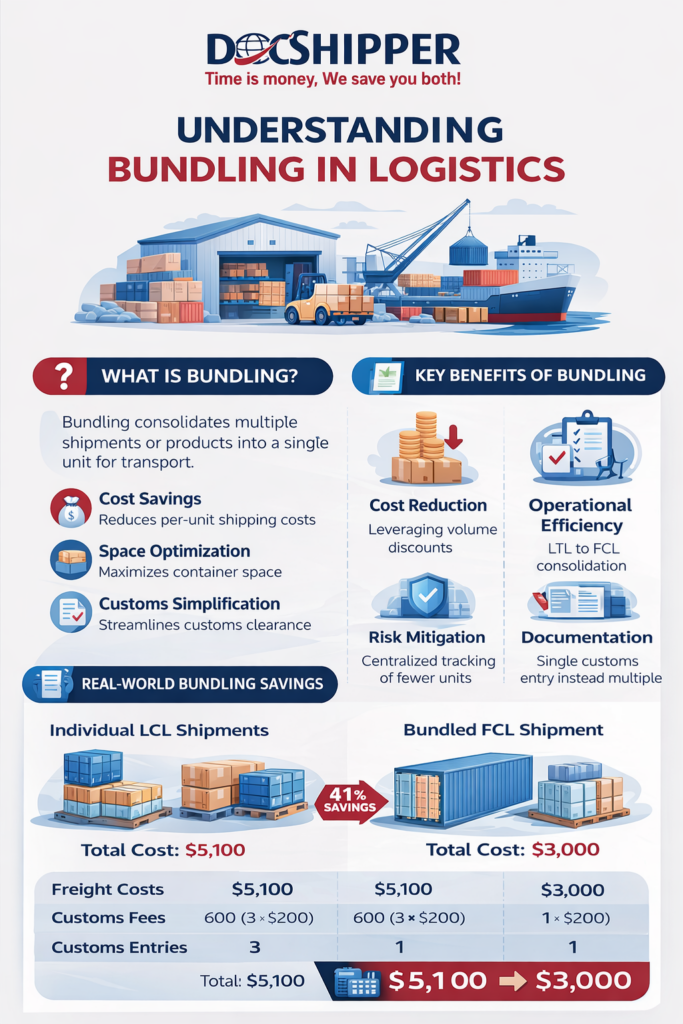
Bundling is a logistics strategy that combines multiple shipments or products into a single consolidated unit to reduce transportation costs, optimize space utilization, and streamline customs clearance. This method enhances supply chain efficiency by minimizing handling operations and reducing per-unit shipping expenses in international trade.
Introduction
Many importers struggle with fragmented shipments that generate excessive freight charges, multiple customs entries, and complex inventory management. Each separate shipment multiplies documentation requirements and increases the risk of delays.
Bundling addresses these challenges by consolidating goods strategically. This practice is fundamental in modern logistics, particularly for businesses managing diverse product portfolios across international borders.
Key characteristics include:
- Cost reduction: Consolidated shipments leverage volume discounts and reduce per-unit transportation expenses
- Operational efficiency: Single customs clearance instead of multiple entries streamlines border procedures
- Space optimization: Maximizes container or pallet utilization, reducing wasted cargo space
- Risk mitigation: Centralized tracking and fewer touchpoints decrease loss or damage probability
- Documentation simplification: One commercial invoice and bill of lading replace multiple documents
Technical Mechanisms & Strategic Implementation
Bundling operates through consolidation warehousing, where goods from different suppliers or production batches are aggregated before international shipment. This process requires precise coordination between procurement, warehousing, and transportation teams.
The customs classification aspect is critical. When bundling products with different HS codes, shippers must determine whether to declare items individually or under a single classification. According to World Customs Organization guidelines, mixed cargo requires detailed packing lists specifying each component’s value and classification.
Freight calculation methods vary significantly. For Less-than-Container-Load (LCL) shipments, bundling converts multiple small shipments into Full-Container-Load (FCL) status, dramatically reducing per-cubic-meter costs. The threshold calculation compares individual LCL rates against FCL rates divided by total volume.
The timing strategy determines bundling effectiveness. Companies must balance inventory holding costs against transportation savings. Just-in-time operations may find bundling counterproductive, while businesses with predictable demand cycles benefit substantially from scheduled consolidations.
Regulatory compliance requires attention to country-specific rules. The European Union’s Union Customs Code permits consolidated declarations under specific conditions, while U.S. Customs and Border Protection mandates detailed manifests for mixed cargo. At DocShipper, we systematically verify documentation requirements for each destination market to prevent clearance delays caused by improper bundling declarations.
Practical Examples & Cost Analysis
Consider a U.S. electronics retailer importing components from three Chinese suppliers. Without bundling, the scenario involves:
| Shipment Type | Volume (CBM) | Cost per CBM | Total Cost | Customs Entries |
|---|---|---|---|---|
| Individual LCL (3 shipments) | 18 CBM total | $85 | $1,530 | 3 × $150 = $450 |
| Bundled FCL (20ft container) | 28 CBM capacity | $50 (FCL rate) | $1,400 | 1 × $150 = $150 |
| Total Savings | $430 | 67% reduction |
This example demonstrates a 27% cost reduction on freight alone, plus 67% savings on customs processing fees. The bundled approach also fills the remaining 10 CBM container space with additional inventory, maximizing capital efficiency.
Pharmaceutical distribution presents another compelling case. A European distributor consolidates temperature-controlled shipments from India. Individual air freight costs $8.50/kg, while bundled air cargo reduces this to $5.20/kg for volumes exceeding 500kg. For a monthly volume of 1,200kg, annual savings reach $47,520.
Key performance indicators for bundling effectiveness:
- Consolidation ratio: Target minimum 75% container utilization to justify FCL conversion
- Dwell time reduction: Bundled shipments typically clear customs 40% faster than fragmented arrivals
- Damage rate: Consolidated packaging reduces handling incidents by approximately 30%
- Documentation accuracy: Single-entry systems decrease error rates from 8% to under 2%
- Carbon footprint: Optimized loads reduce per-unit CO2 emissions by 15-25% depending on mode
Conclusion
Bundling transforms fragmented logistics into streamlined operations, delivering measurable cost reductions and operational simplifications. Strategic implementation requires balancing inventory timing, regulatory compliance, and freight economics.
Need expert guidance on optimizing your consolidation strategy? Contact DocShipper for customized bundling solutions tailored to your supply chain requirements.
DocShipper Platform
Cut logistics costs. Not corners.
See exactly where your logistics costs are bleeding — and how to fix it. Book your expert demo.

📚 Quizz
Test Your Knowledge: Bundling
Q1 — What is the primary definition of "bundling" in logistics?
Q2 — A common misconception about bundling is that it reduces customs duties. What is the correct interpretation?
Q3 — A U.S. retailer imports 18 CBM of goods from three Chinese suppliers using separate LCL shipments at $85/CBM plus $150 per customs entry. They switch to a bundled FCL at $50/CBM with a single customs entry. What is the correct outcome?
🎯 Your Result
📞 Free Quote in 24hFAQ | Bundling: Definition, Calculation & Practical Examples
Generally, bundling becomes cost-effective when combined volume reaches 15-18 CBM for ocean freight or 300kg for air cargo. Calculate break-even points by comparing LCL rates against FCL costs divided by total volume.
Yes, but each item requires separate declaration on the commercial invoice and packing list. Customs authorities assess duties individually per classification, though physical consolidation remains permissible.
Consolidated shipments typically qualify for lower premium rates due to reduced handling risk. Ensure your cargo insurance policy covers mixed commodity loads and declares accurate total values.
Excessive bundling increases inventory holding costs and reduces supply chain flexibility. If one component faces quality issues, the entire shipment may be delayed during inspection or rework.
Limited applicability. While air freight bundling offers cost savings, waiting for consolidation volumes may negate time advantages. Best suited for predictable, non-urgent replenishment cycles.
Analyze your demand patterns and supplier lead times. Weekly or bi-weekly consolidations typically balance inventory costs against transportation savings for most businesses importing regularly.
No. Duties are calculated on individual product classifications regardless of consolidation. However, bundling may qualify for de minimis thresholds in some jurisdictions when total shipment value falls below exemption limits.
You'll need a master packing list detailing all items, a consolidated commercial invoice showing total value, and potentially a house bill of lading if using a freight forwarder's consolidation service.
Initial transit may increase by 3-7 days due to consolidation waiting periods. However, faster customs clearance and reduced port congestion often offset this, resulting in comparable or improved total lead times.
Yes. Hazardous materials, perishables with varying temperature requirements, and high-value items requiring separate security measures should not be bundled with standard cargo due to regulatory and risk management concerns.
Technically possible but operationally complex and costly. Unbundling requires warehouse handling, new documentation, and potentially additional customs procedures. Plan consolidations carefully to avoid this scenario.
Modern freight management systems provide item-level tracking within consolidated shipments. Ensure your forwarder offers granular visibility so you can monitor individual SKUs despite physical bundling.
Need Help with
Logistics or Sourcing ?
First, we secure the right products from the right suppliers at the right price by managing the sourcing process from start to finish. Then, we simplify your shipping experience - from pickup to final delivery - ensuring any product, anywhere, is delivered at highly competitive prices.


Fill the Form
Prefer email? Send us your inquiry, and we’ll get back to you as soon as possible.
Contact us