In short ⚡
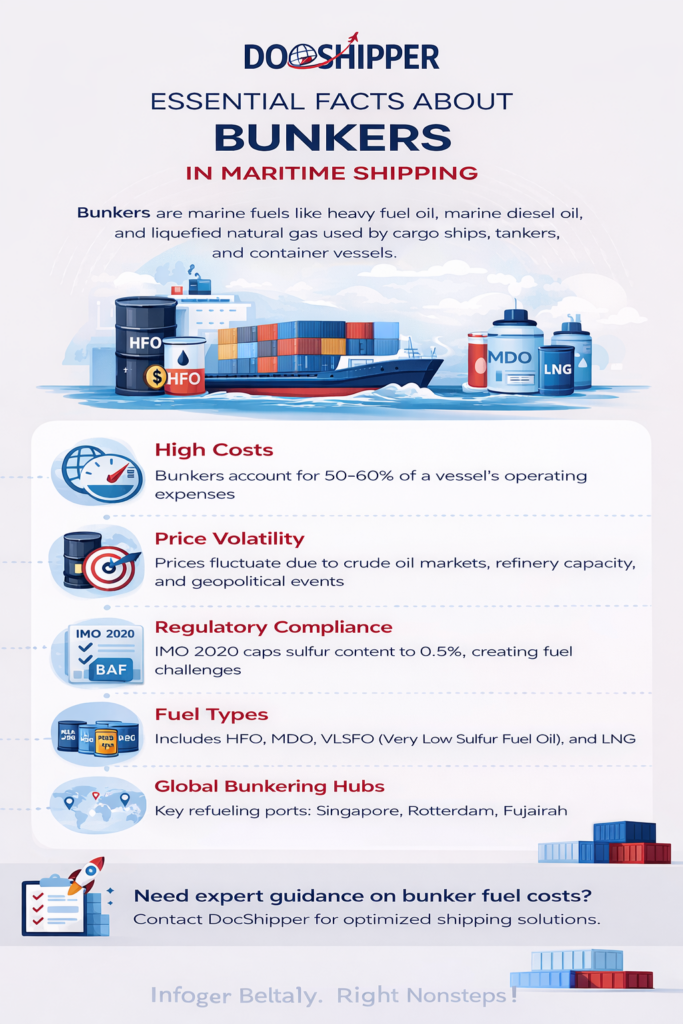
Bunkers are marine fuels supplied to vessels for propulsion and auxiliary operations during maritime transport. This term encompasses heavy fuel oil (HFO), marine diesel oil (MDO), and liquefied natural gas (LNG) used by cargo ships, tankers, and container vessels throughout international shipping routes.Introduction
Bunker fuel costs represent 50-60% of total vessel operating expenses, yet many shippers struggle to understand how these charges impact their freight rates. The maritime industry’s transition to low-sulfur fuels following IMO 2020 regulations has created significant pricing volatility and compliance challenges.
In international logistics, bunker surcharges directly affect shipping quotes, contract negotiations, and supply chain budgeting. Understanding bunker pricing mechanisms enables importers and exporters to anticipate cost fluctuations and negotiate more effectively with carriers.
- Price volatility: Bunker costs fluctuate daily based on crude oil markets, refinery capacity, and geopolitical events
- Regulatory compliance: IMO 2020 mandates 0.5% sulfur content maximum in marine fuels outside emission control areas
- Surcharge mechanisms: Carriers apply Bunker Adjustment Factors (BAF) or Fuel Adjustment Factors (FAF) to base freight rates
- Fuel quality variations: Different grades (IFO 380, VLSFO, MGO) have distinct calorific values and pricing structures
- Bunkering locations: Major hubs like Singapore, Rotterdam, and Fujairah offer competitive pricing due to economies of scale
Bunker Types & International Regulations
Marine fuel classification follows ISO 8217 standards, distinguishing between residual fuels (heavy fuel oil derivatives), distillate fuels (refined diesel products), and alternative fuels (LNG, methanol, biofuels). Each category presents different combustion characteristics, storage requirements, and environmental impacts.
The IMO 2020 sulfur cap revolutionized bunker markets by restricting sulfur content to 0.5% globally, down from the previous 3.5% limit. Vessels now choose between compliant low-sulfur fuel oil (LSFO), marine gas oil (MGO), or installing exhaust gas cleaning systems (scrubbers) to continue using high-sulfur fuel oil (HSFO). This regulation, enforced by port state control authorities worldwide, carries penalties including detention and fines up to $50,000 per violation.
Emission Control Areas (ECAs) impose even stricter 0.1% sulfur limits in designated zones including the Baltic Sea, North Sea, North American coastlines, and US Caribbean territories. Ships operating in these regions must switch fuels or employ scrubber technology, adding operational complexity and cost considerations.
The bunker delivery note (BDN) serves as the legal proof of fuel quality and quantity supplied. This document specifies fuel grade, density, viscosity, sulfur content, and flash point—critical parameters for engine performance and regulatory compliance. According to IMO MARPOL Annex VI, vessels must retain BDNs for three years and make them available for inspection.
At DocShipper, we monitor bunker surcharge applications across carrier contracts to ensure our clients aren’t overcharged during rate fluctuations. Our logistics experts verify that BAF calculations align with published fuel indices and contractual terms, protecting your shipping budget from unjustified increases.
Cost Calculation & Real-World Examples
Bunker consumption rates depend on vessel size, engine type, speed, and weather conditions. A typical 8,000 TEU container ship consumes 150-200 metric tons of fuel daily at 20 knots cruising speed, while slow steaming at 16 knots reduces consumption to 100-120 tons daily—a 30-40% fuel savings that carriers increasingly adopt during low-demand periods.
The Bunker Adjustment Factor formula varies by carrier but generally follows this structure: BAF = (Current Fuel Price – Base Fuel Price) × Fuel Consumption Factor × Distance. Carriers publish BAF tables quarterly or monthly, indexed to recognized benchmarks like the Singapore 380 CST price or Rotterdam VLSFO quotations.
| Fuel Type | Sulfur Content | Average Price (USD/MT)* | Typical Application |
|---|---|---|---|
| HSFO (IFO 380) | 3.5% | 450-500 | Scrubber-equipped vessels only |
| VLSFO (0.5%) | 0.5% | 600-650 | Standard ocean-going vessels |
| MGO/MDO | 0.1% | 750-850 | ECA zones, auxiliary engines |
| LNG | 0% | 500-600 (energy equivalent) | Dual-fuel newbuilds |
*Prices as of Q1 2024, Singapore bunker market. Actual prices fluctuate daily.
Real-world scenario: A shipment from Shanghai to Rotterdam (10,500 nautical miles) on a 14,000 TEU vessel operating at 19 knots requires approximately 18 days transit. With daily VLSFO consumption of 180 tons at $620/MT, total bunker cost reaches $2,008,800. If distributed across 12,000 loaded TEUs, the bunker component equals $167 per container—before applying carrier markup and BAF adjustments.
Bunker price volatility creates significant exposure for both carriers and shippers. A $100/MT price increase on the Shanghai-Rotterdam route adds $324,000 to voyage costs, potentially triggering emergency BAF surcharges. Forward bunker contracts and fuel hedging instruments help stabilize costs, though smaller carriers often lack access to these financial tools.
Key cost optimization strategies:
- Slow steaming reduces fuel consumption by 25-40% while extending transit times by 2-4 days
- Strategic bunkering at low-cost ports (Singapore, Fujairah) saves $20-50 per metric ton versus premium locations
- Scrubber-equipped vessels access cheaper HSFO, offering $150-200/MT savings over VLSFO
- Weather routing optimization can reduce fuel consumption by 3-8% through favorable currents and wave patterns
- Just-in-time arrival coordination minimizes port waiting time and unnecessary fuel burn at anchorage
Conclusion
Bunker costs remain the single largest variable expense in maritime logistics, directly impacting freight rates and supply chain profitability. Understanding fuel types, regulatory frameworks, and pricing mechanisms empowers shippers to negotiate better contracts and anticipate cost fluctuations.
Need expert guidance on managing bunker surcharges in your shipping contracts? Contact DocShipper for customized logistics solutions that optimize your international transport costs.
DocShipper Platform
Optimize Your Global Logistics with Cutting-Edge Solutions
Enhance efficiency, cut costs, and gain 24/7 visibility 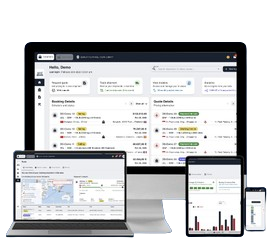 over your entire supply chain.
- Cut your shipping costs and maximize your margins
- Manage sourcing, freight, & customs on one platform
- Get real-time tracking and analytics
📚 Quiz
Test Your Knowledge: Bunkers
Q1 — What does the term "bunkers" refer to in maritime logistics?
Q2 — Under IMO 2020 regulations, what is the maximum sulfur content allowed in marine fuels for vessels operating outside Emission Control Areas (ECAs)?
Q3 — A carrier quotes you a freight rate from Shanghai to Rotterdam and mentions a BAF surcharge. What does this mean for your shipment cost?
🎯 Your Result
📞 Free Quote in 24hFAQ | Bunkers: Definition, Calculation & Concrete Examples
Bunkers are marine-grade fuels specifically formulated for ship engines, with higher viscosity and different combustion properties than automotive diesel. Marine fuels range from heavy residual oils to refined distillates, while road diesel meets EN 590 standards unsuitable for large vessel propulsion systems.
Bunker prices fluctuate daily based on crude oil markets, refinery output, and regional supply-demand dynamics. Major bunkering hubs publish spot prices every business day, while carriers typically adjust BAF surcharges monthly or quarterly using average price indices.
Bunker surcharges are contractually binding when specified in the bill of lading or service contract terms. However, shippers can negotiate BAF caps, fixed fuel components, or all-inclusive rates during contract negotiations to limit exposure to price volatility.
Using fuel exceeding IMO sulfur limits results in port state control violations, fines up to $50,000, vessel detention, and potential criminal charges against ship officers. Cargo delays from enforcement actions create liability exposure for carriers and shippers alike.
Exhaust gas cleaning systems allow vessels to burn cheaper high-sulfur fuel oil while meeting emissions standards. The $150-200 per ton fuel savings typically recovers scrubber installation costs ($2-5 million) within 1-3 years, though environmental concerns prompt some ports to ban scrubber discharge.
Singapore leads global bunker sales at 50 million tons annually, followed by Rotterdam (12 million tons), Fujairah (7 million tons), and Houston (6 million tons). These hubs offer competitive pricing, quality assurance, and efficient fueling infrastructure for international shipping routes.
Very Low Sulfur Fuel Oil (0.5% sulfur) became the standard marine fuel post-IMO 2020. Early stability issues, compatibility problems between different VLSFO blends, and higher costs compared to pre-2020 fuels created operational challenges and sparked debate about long-term sustainability.
BAF formulas multiply the difference between current and baseline fuel prices by a consumption factor and distance. Carriers reference published indices (Singapore 380, Rotterdam VLSFO) and update surcharges monthly or quarterly. Transparency varies significantly between shipping lines and service contracts.
LNG offers lower emissions and competitive energy-equivalent pricing ($500-600/MT) compared to VLSFO. However, limited bunkering infrastructure, higher vessel construction costs ($15-25 million premium), and methane slip concerns currently restrict LNG adoption to specific trade routes and newbuild programs.
The Bunker Delivery Note (BDN) certifies fuel quality and quantity, including sulfur content test results. Ships must maintain BDNs for three years and present them during port state inspections. Fuel samples are retained onboard and ashore for independent verification if disputes arise.
Reducing speed from 22 to 18 knots decreases fuel consumption by approximately 30-40% due to exponential resistance-speed relationships. While transit times increase by 2-4 days on long routes, the fuel savings of $50,000-100,000 per voyage justify slower speeds during low freight rate periods.
Contaminated or off-specification bunkers cause engine failures, requiring emergency repairs and creating cargo delivery delays. Poor fuel quality incidents in Singapore (2022) and Houston (2018) stranded dozens of vessels, highlighting the importance of fuel testing and supplier reputation in bunkering operations.
Need Help with
Logistics or Sourcing ?
First, we secure the right products from the right suppliers at the right price by managing the sourcing process from start to finish. Then, we simplify your shipping experience - from pickup to final delivery - ensuring any product, anywhere, is delivered at highly competitive prices.


Fill the Form
Prefer email? Send us your inquiry, and we’ll get back to you as soon as possible.
Contact us