In short ⚡
Business Application refers to specialized software designed to perform specific organizational functions such as inventory management, accounting, customer relationship management, or supply chain coordination. These applications streamline operations, automate workflows, and enable data-driven decision-making across international trade and logistics operations.
Introduction
Many importers struggle with fragmented systems that don’t communicate. Order tracking happens in spreadsheets while customs documentation sits in email folders. This disconnection creates delays, compliance risks, and operational blind spots.
Business applications solve this problem by centralizing logistics operations into unified platforms. In international freight forwarding, these systems become the operational backbone connecting suppliers, carriers, customs authorities, and clients.
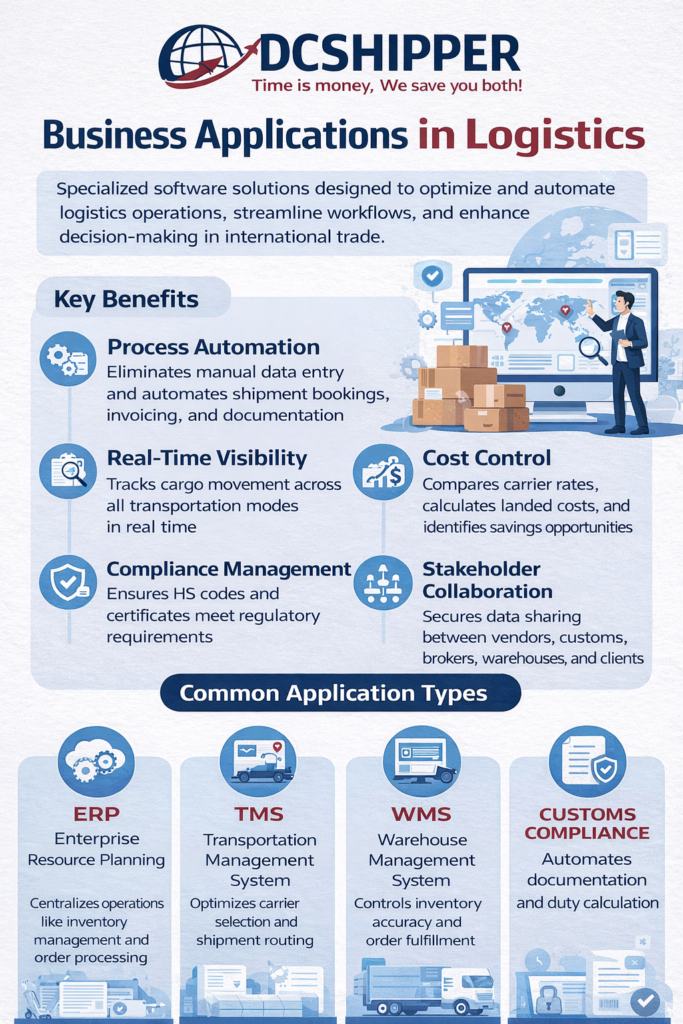
- Process Automation: Eliminates manual data entry for shipment bookings, documentation, and invoicing
- Real-Time Visibility: Tracks cargo movement across ocean, air, and ground transportation modes
- Compliance Management: Validates HS codes, certificates of origin, and regulatory requirements automatically
- Cost Control: Compares carrier rates, calculates landed costs, and identifies optimization opportunities
- Stakeholder Collaboration: Provides secure portals for vendors, customs brokers, and warehouses to exchange information
At DocShipper, we integrate specialized business applications throughout the supply chain to ensure seamless coordination from factory pickup to final delivery.
Technical Framework & Strategic Implementation
Modern business applications operate through cloud-based architectures that enable access from any location. This proves essential for international logistics where stakeholders span multiple time zones and regulatory jurisdictions.
The API integration layer represents the critical technical component. Applications must connect with customs clearance systems like the EU’s Export Control System (ECS), carrier booking platforms, and financial systems. Without proper integration, data silos persist.
Enterprise Resource Planning (ERP) systems form the foundation for larger organizations. These comprehensive platforms manage procurement, inventory, warehousing, and distribution. SAP, Oracle, and Microsoft Dynamics dominate this segment, though implementation complexity requires specialized expertise.
For logistics-specific operations, Transportation Management Systems (TMS) optimize carrier selection, route planning, and freight cost allocation. These applications calculate dimensional weight, compare shipping modes, and generate commercial invoices with the correct Incoterms.
Warehouse Management Systems (WMS) control inventory accuracy through barcode scanning, location tracking, and picking optimization. When integrated with TMS platforms, they enable seamless order fulfillment from storage to shipment.
DocShipper utilizes specialized business applications to verify documentation accuracy before customs submission, preventing costly delays and ensuring regulatory compliance across all destination countries.
Real-World Applications & Performance Data
Implementation results demonstrate measurable operational improvements. A European electronics importer reduced customs clearance time by 43% after deploying an integrated business application that automated HS code classification and pre-validated certificates of origin.
| Application Type | Primary Function | Typical ROI Timeline | Key Benefit |
|---|---|---|---|
| TMS | Carrier management & rate optimization | 6-12 months | 12-18% freight cost reduction |
| WMS | Inventory accuracy & order fulfillment | 9-15 months | 99.5%+ inventory accuracy |
| Customs Compliance | Automated documentation & duty calculation | 3-6 months | 85% reduction in clearance delays |
| CRM | Customer communication & quote management | 4-8 months | 30% faster quote turnaround |
| Track & Trace | Real-time shipment visibility | Immediate | 70% reduction in status inquiries |
Use Case: Pharmaceutical Cold Chain Management
A pharmaceutical distributor implemented a specialized business application for temperature-controlled logistics. The system integrated with IoT sensors inside refrigerated containers, triggering alerts when temperatures deviated from the 2-8°C range required for vaccine shipments.
Results after 6 months:
- Zero product losses due to temperature excursions (previously 2.3% spoilage rate)
- Automated compliance documentation for FDA and EMA regulatory submissions
- Real-time visibility for 847 concurrent shipments across 23 countries
- $340,000 reduction in insurance premiums due to improved risk profile
- 4.2-hour average response time to temperature deviations (previously 19 hours)
The application’s predictive analytics identified that 68% of temperature issues occurred during airport ground handling, prompting carrier contract renegotiations that included mandatory pre-cooling protocols.
DocShipper Platform
Optimize Your Global Logistics with Cutting-Edge Solutions
Enhance efficiency, cut costs, and gain 24/7 visibility 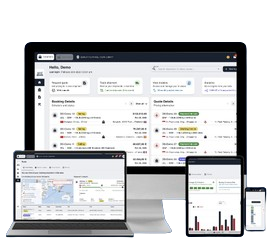 over your entire supply chain.
- Cut your shipping costs and maximize your margins
- Manage sourcing, freight, & customs on one platform
- Get real-time tracking and analytics
Conclusion
Business applications transform logistics operations from reactive problem-solving to proactive optimization. The right technology stack eliminates manual errors, accelerates customs clearance, and provides the visibility needed for strategic decision-making in international trade.
Need guidance selecting and implementing logistics applications for your supply chain? Contact DocShipper for expert consultation on technology solutions tailored to your import/export requirements.
📚 Quiz
Test Your Knowledge: Business Application
1. What is the primary definition of a Business Application in a logistics context?
2. A logistics manager argues that an ERP system alone is sufficient to fully replace a Transportation Management System (TMS). Is this correct?
3. A pharmaceutical company needs to monitor temperature inside refrigerated containers in real time and automatically trigger compliance documentation for FDA submissions. Which type of business application best fits this scenario?
🎯 Your Result
📞 Free Quote in 24hFAQ | Business Application: Definition, Types & Implementation Examples
ERP systems manage entire business operations including finance, HR, and procurement, while TMS platforms specialize exclusively in transportation planning, carrier selection, and freight cost management. Many companies use both, with TMS feeding data into the broader ERP framework.
Even small-volume importers benefit from cloud-based applications that automate customs documentation and track shipments. Entry-level platforms start under $100/month and prevent costly errors that outweigh subscription costs after just one avoided customs penalty.
Cloud-based logistics applications deploy in 2-6 weeks for standard configurations. Complex ERP implementations with custom workflows require 6-18 months. Phased rollouts starting with core functions minimize disruption while delivering immediate value.
Modern applications use REST APIs and EDI standards to connect with accounting software, e-commerce platforms, and customs systems. Integration complexity depends on legacy system architecture, but most platforms offer pre-built connectors for common solutions like QuickBooks, Shopify, and SAP.
Enterprise-grade applications employ AES-256 encryption, multi-factor authentication, and role-based access controls. Compliance certifications like ISO 27001 and SOC 2 verify security practices. Data residency options ensure information stays within required jurisdictions for GDPR and other regulations.
Logistics applications automatically convert currencies using real-time exchange rates from financial data providers. They calculate landed costs in the buyer's currency while maintaining accounting records in the seller's base currency, simplifying reconciliation and financial reporting.
Reputable providers include data portability clauses in contracts, ensuring you can export information in standard formats. Cloud-based systems reduce risk compared to on-premise software since data remains accessible during transitions. Always verify backup and export capabilities before committing.
Advanced compliance applications integrate tariff databases that calculate duties based on HS codes, country of origin, and applicable trade agreements. They update automatically when tariff schedules change, though complex classifications still require expert validation for high-value shipments.
Many forwarders offer proprietary client portals for booking shipments, tracking cargo, and accessing documents. These systems vary significantly in capability. Some provide basic visibility while others rival standalone TMS platforms with advanced analytics and multi-carrier integration.
Mobile apps enable warehouse staff to scan barcodes, drivers to capture proof of delivery, and customs brokers to photograph inspection results. Offline functionality ensures operations continue without internet connectivity, syncing data automatically when connections restore.
User-friendly interfaces minimize training needs, typically requiring 4-8 hours for basic operations. Role-specific training for customs compliance or advanced analytics extends to 2-3 days. Ongoing support through knowledge bases, video tutorials, and help desks accelerates proficiency.
AI-powered applications analyze historical patterns, weather data, port congestion, and geopolitical events to forecast potential delays. Predictive alerts enable proactive carrier changes or inventory adjustments before disruptions impact delivery schedules, though accuracy varies by data quality and model sophistication.
Need Help with
Logistics or Sourcing ?
First, we secure the right products from the right suppliers at the right price by managing the sourcing process from start to finish. Then, we simplify your shipping experience - from pickup to final delivery - ensuring any product, anywhere, is delivered at highly competitive prices.


Fill the Form
Prefer email? Send us your inquiry, and we’ll get back to you as soon as possible.
Contact us