


In short ⚡
A Business Continuity Plan (BCP) is a strategic framework that ensures critical business operations continue during and after a disruption—whether from natural disasters, cyberattacks, supply chain breakdowns, or geopolitical crises. It identifies essential functions, establishes recovery protocols, and minimizes financial and operational impacts in international logistics.
Introduction
Many international businesses discover their vulnerability only when disaster strikes—a port closure, customs blockage, or warehouse fire that halts operations overnight. Without a structured response plan, companies face revenue loss, damaged reputation, and regulatory penalties.
In global logistics, where supply chains span continents and involve multiple stakeholders, a Business Continuity Plan becomes mission-critical. It transforms reactive chaos into proactive resilience, ensuring shipments move, clients receive goods, and operations recover swiftly.
Key characteristics of an effective BCP include:
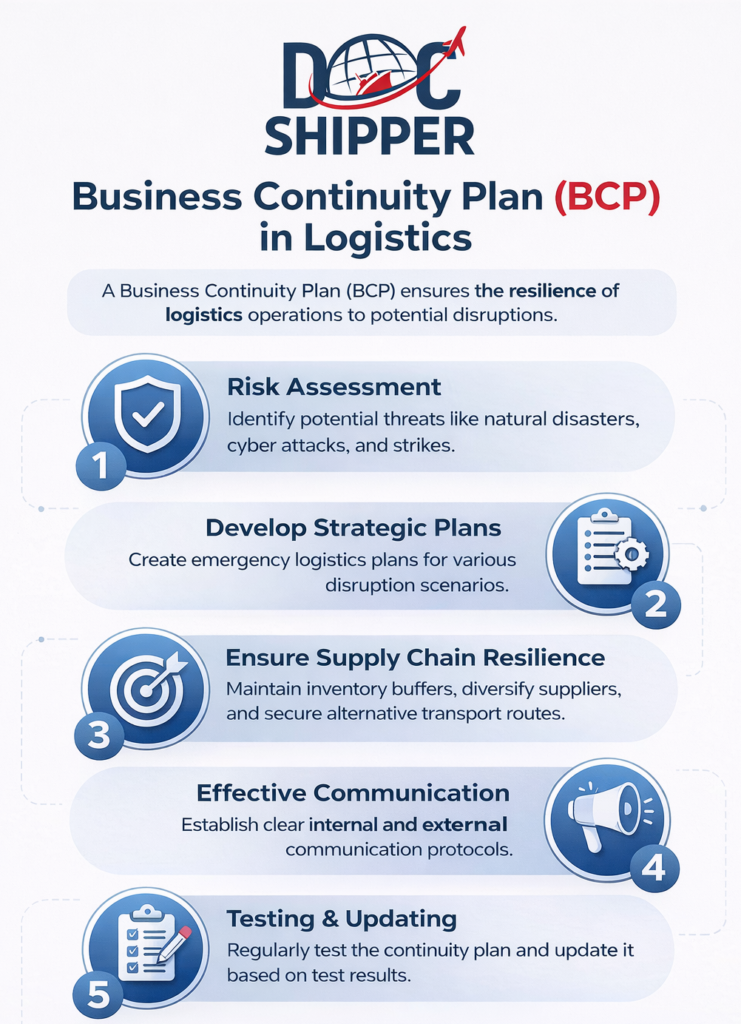
- Risk Assessment: Identifying potential threats to logistics operations (geopolitical, environmental, technological).
- Critical Function Mapping: Determining which processes must continue regardless of circumstances (customs clearance, warehousing, last-mile delivery).
- Recovery Time Objectives (RTO): Defining maximum acceptable downtime for each function.
- Alternative Resource Planning: Establishing backup suppliers, routes, and facilities.
- Communication Protocols: Ensuring stakeholders receive timely updates during crises.
BCP Framework & Strategic Implementation
A robust Business Continuity Plan in international logistics operates on four foundational pillars: prevention, preparedness, response, and recovery. Each phase requires specific actions tailored to cross-border trade complexities.
Prevention involves identifying vulnerabilities before they materialize. Logistics providers conduct Business Impact Analyses (BIA) to quantify potential losses from disruptions. This includes evaluating single points of failure—such as reliance on one port or a single customs broker—and implementing redundancy measures.
Preparedness translates risk assessments into actionable protocols. Companies establish alternative shipping routes, maintain safety stock in multiple locations, and pre-negotiate agreements with backup carriers. Documentation becomes critical: having digitized customs paperwork, insurance certificates, and regulatory compliance records ensures operations continue even if physical offices become inaccessible.
The response phase activates when disruption occurs. Clear command structures determine who makes decisions, how resources get reallocated, and which clients receive priority. According to ISO 22301 standards, organizations should test response mechanisms quarterly through simulations and tabletop exercises.
Recovery focuses on returning to normal operations while documenting lessons learned. This phase includes financial reconciliation, client communication regarding delays, and updating the BCP based on real-world performance. At DocShipper, we integrate BCP reviews into our quarterly client meetings, ensuring our logistics strategies evolve with emerging risks.
Legal compliance adds another layer of complexity. The EU’s General Data Protection Regulation (GDPR) mandates data recovery capabilities, while customs authorities require continuous access to trade documentation. A comprehensive BCP addresses both operational and regulatory continuity, preventing legal penalties during crises.
Real-World Applications & Data-Driven Insights
The COVID-19 pandemic provided a global stress test for Business Continuity Plans. Companies with robust BCPs adapted within weeks, while unprepared competitors faced months of disruption. Data reveals the tangible impact of preparedness:
| Scenario | Without BCP | With BCP |
|---|---|---|
| Port Closure (7 days) | 21-day shipment delay, 15% revenue loss | 3-day rerouting, 2% revenue impact |
| Customs System Outage | Shipment holds, penalty fees | Pre-cleared documentation, immediate processing |
| Warehouse Fire | Complete inventory loss, 90-day recovery | Backup facility activation, 5-day transition |
| Cyberattack on Systems | 14-day operational shutdown | Cloud backup restoration within 4 hours |
Case Study: Electronics Importer During Suez Canal Blockage (2021)
When the Ever Given blocked the Suez Canal, a European electronics distributor with a comprehensive BCP immediately activated alternative routes. While competitors waited 12 days for canal clearance, this company rerouted shipments via air freight for high-priority clients and rail through Turkey for less urgent cargo. Total additional cost: €45,000. Estimated savings from avoiding stock-outs and contract penalties: €320,000.
Industry benchmarks show companies with tested BCPs recover 3.5 times faster than unprepared competitors. The Business Continuity Institute reports that organizations investing 2-4% of logistics budgets in BCP development experience 60% fewer operational disruptions annually.
Key implementation metrics include:
- Recovery Time Objective (RTO): 4-24 hours for critical customs processes
- Recovery Point Objective (RPO): Maximum 1-hour data loss for shipment tracking systems
- Alternative Supplier Activation: Within 48 hours of primary supplier failure
- Communication Response: Client notification within 2 hours of disruption identification
- Financial Reserves: 15-20% contingency budget for crisis logistics costs
Conclusion
A Business Continuity Plan transforms logistics resilience from reactive scrambling to strategic advantage. In an industry where delays cascade into financial losses and damaged relationships, preparedness determines competitive survival.
Need expert guidance developing your logistics BCP? Contact DocShipper for customized continuity planning that protects your supply chain.
📚 Quiz
Test Your Knowledge: Business Continuity Plan (BCP)
Q1 — What is the primary purpose of a Business Continuity Plan (BCP) in international logistics?
Q2 — A logistics manager argues that having comprehensive cargo insurance makes a BCP unnecessary. Is this correct?
Q3 — During the 2021 Suez Canal blockage, a European electronics distributor with a tested BCP rerouted shipments via air freight and rail. What was the key outcome compared to unprepared competitors?
🎯 Your Result
📞 Free Quote in 24hFAQ | Business Continuity Plan (BCP): Definition, Implementation & Real-World Examples
A BCP addresses overall business operations continuity, while disaster recovery focuses specifically on IT systems and data restoration. BCPs encompass logistics, staffing, and client communication beyond technical infrastructure.
Quarterly reviews are recommended, with immediate updates after major disruptions, regulatory changes, or significant business expansion. Annual full-scale testing ensures plan effectiveness.
Port closures, customs system failures, carrier bankruptcies, natural disasters, geopolitical conflicts, cyberattacks, and pandemic-related restrictions represent the primary activation scenarios.
No. Insurance provides financial compensation after losses occur, but cannot prevent operational disruptions. A BCP minimizes downtime and maintains client service during crises, which insurance cannot achieve.
Initial development ranges from $15,000-$50,000, with annual maintenance costs of 2-4% of total logistics budget. Return on investment typically manifests within the first avoided disruption.
Many customs agencies, particularly in the EU and US, favor Authorized Economic Operator (AEO) applicants with documented BCPs, as they demonstrate supply chain security and reliability.
Absolutely. Scaled-down plans focusing on critical functions—backup documentation, alternative suppliers, and communication protocols—provide significant protection without enterprise-level complexity or cost.
Cloud-based systems enable real-time data backup, remote operations, and automated stakeholder notifications. Digital twins of logistics networks allow simulation testing without disrupting actual operations.
Comprehensive BCPs include region-specific protocols accounting for local regulations, alternative transport modes, and country-specific risk factors while maintaining centralized coordination and communication frameworks.
While not universally mandated, ISO 22301 certification, AEO programs, and certain industry regulations (pharmaceuticals, aerospace) require documented continuity capabilities. Contractual obligations often specify BCP maintenance.
Through tabletop exercises, simulation drills, third-party audits, and key performance indicators like response time metrics, alternative supplier activation speed, and communication protocol adherence during tests.
Creating comprehensive documents that never get tested or updated. A BCP becomes obsolete within months without regular drills, stakeholder training, and incorporation of lessons learned from industry disruptions.
Need Help with Logistics or Sourcing ?
First, we secure the right products from the right suppliers at the right price by managing the sourcing process from start to finish. Then, we simplify your shipping experience - from pickup to final delivery - ensuring any product, anywhere, is delivered at highly competitive prices.


Fill the Form
Prefer email? Send us your inquiry, and we’ll get back to you as soon as possible.
Contact us


:%20Definition%20&%20Guide%20for%202026)