
In short ⚡
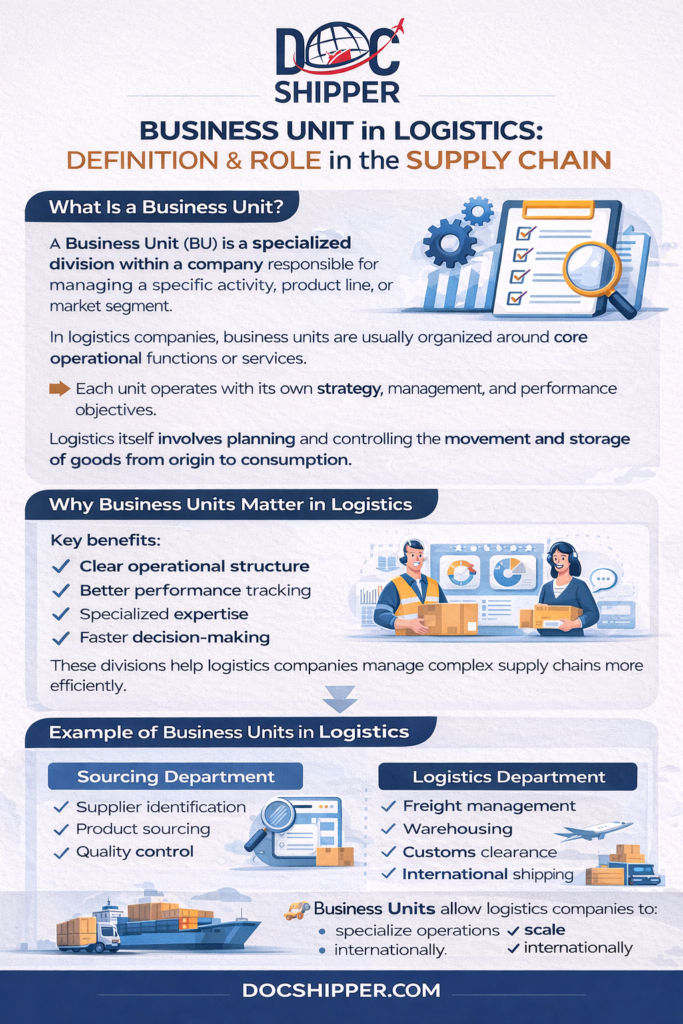
A Business Unit (BU) is a semi-autonomous division within a larger organization that operates as a distinct profit center with its own revenue, costs, and strategic objectives. Each BU typically manages specific product lines, markets, or geographic regions, enabling focused decision-making and accountability while benefiting from corporate resources and infrastructure.
Introduction
Many companies struggle with balancing centralized control and operational flexibility. The Business Unit model solves this by creating focused divisions that act like independent businesses within a corporate umbrella.
In international logistics and trade, understanding BU structures is critical. Freight forwarders, manufacturers, and distributors often organize by geographic regions or service types (air freight BU, ocean freight BU, customs brokerage BU). This segmentation improves accountability and customer responsiveness.
- Profit & Loss Responsibility: Each BU manages its own financial performance
- Strategic Autonomy: Independent decision-making within corporate guidelines
- Market Focus: Specialization by product, geography, or customer segment
- Resource Allocation: Dedicated teams, budgets, and operational assets
- Performance Measurement: Clear KPIs and accountability metrics
Organizational Structure & Strategic Expertise
A Business Unit operates with significant autonomy while remaining integrated into the parent organization. This hybrid model combines entrepreneurial agility with corporate stability.
Governance Framework: Each BU reports to corporate leadership but maintains independent operations. The BU General Manager acts as a mini-CEO, responsible for strategy execution, budget management, and team performance. Corporate headquarters provides shared services (HR, IT, legal) and strategic direction, while the BU handles day-to-day operations.
Financial Independence: BUs function as distinct profit centers. They generate revenue through sales, manage operational costs, and are evaluated on profitability metrics like EBITDA, ROI, and market share. This financial transparency enables data-driven resource allocation across the enterprise.
Operational Specialization: BUs develop deep expertise in their focus areas. A logistics company might establish separate BUs for air freight, ocean shipping, and warehousing. Each unit builds specialized knowledge, vendor relationships, and operational processes tailored to its market segment.
Strategic Alignment: While BUs operate independently, they must align with corporate objectives. Regular reviews ensure consistency with brand standards, compliance requirements, and long-term strategic goals. This balance prevents siloed operations while preserving agility.
Legal Considerations: According to SEC reporting requirements, publicly traded companies must disclose segment information for significant BUs. This transparency helps investors understand revenue sources and risk exposure across different business lines.
At DocShipper, we structure our operations by service type and geographic region. Our customs brokerage BU operates independently from our freight forwarding division, ensuring specialized expertise while maintaining integrated client service across our global network.
Practical Examples & Performance Data
Understanding BU structures through real-world applications clarifies their strategic value in international logistics and commerce.
Comparative Analysis: BU vs. Functional Structure
| Criterion | Business Unit Model | Functional Structure |
|---|---|---|
| Decision Speed | Fast – BU managers decide independently | Slow – requires cross-functional approval |
| Market Responsiveness | High – focused on specific segments | Moderate – generalized approach |
| Resource Efficiency | Moderate – some duplication across BUs | High – centralized resource pooling |
| Accountability | Clear – P&L responsibility per BU | Diffuse – shared responsibility |
| Innovation Potential | High – entrepreneurial culture | Low – bureaucratic processes |
Use Case: Global Logistics Provider
Scenario: A multinational freight forwarder operates with five distinct BUs:
- Air Freight BU: $450M annual revenue, 18% profit margin, serving time-sensitive shipments
- Ocean Freight BU: $820M revenue, 12% margin, handling containerized cargo
- Customs Brokerage BU: $180M revenue, 25% margin, providing compliance services
- Warehousing BU: $320M revenue, 15% margin, managing distribution centers
- E-commerce Logistics BU: $210M revenue, 8% margin, targeting online retailers
Performance Impact: By structuring as BUs, the company increased overall profitability by 22% over three years. The Customs Brokerage BU achieved the highest margins due to specialized regulatory expertise. The E-commerce BU, despite lower margins, captured a fast-growing market segment worth $2.1B annually.
DocShipper Platform
Cut logistics costs. Not corners.
See exactly where your logistics costs are bleeding — and how to fix it. Book your expert demo.

Key Success Factors for BU Implementation
- Clear Boundaries: Define product/market scope to prevent internal competition
- Shared Services: Centralize non-differentiating functions (IT, HR, finance) to reduce costs
- Performance Metrics: Establish transparent KPIs aligned with corporate strategy
- Talent Development: Create leadership pipelines within each BU
- Cross-BU Collaboration: Facilitate knowledge sharing without compromising autonomy
Conclusion
The Business Unit model empowers organizations to combine strategic focus with operational agility. For logistics companies and international traders, this structure enables specialized service delivery while maintaining corporate coherence.
Need expert guidance on structuring your logistics operations or understanding BU-specific service offerings? Contact DocShipper for tailored solutions across our specialized business units.
📚 Quizz
Test Your Knowledge: Business Unit
Q1 — What best defines a Business Unit (BU) within a large organization?
Q2 — A colleague claims that a Business Unit and a subsidiary are the same thing because both operate with financial independence. Is this correct?
Q3 — A multinational freight forwarder wants to improve accountability and market responsiveness across its air freight, ocean shipping, and customs brokerage services. Which organizational approach is most appropriate?
🎯 Your Result
📞 Free Quote in 24hFAQ | Business Unit: Definition, Structure & Practical Examples
A Business Unit operates within the parent company's legal entity, while a subsidiary is a separate legal corporation. BUs share corporate legal identity; subsidiaries have independent legal status and liability.
Organizations analyze market diversity, product complexity, geographic spread, and customer segmentation. High diversity across these dimensions favors BU structures; homogeneous markets suit functional organizations better.
Yes. Some BUs operate under distinct brands to target specific market segments, while maintaining corporate ownership. This strategy balances brand differentiation with resource consolidation.
Common KPIs include revenue growth, EBITDA margin, market share, customer acquisition cost, customer lifetime value, and return on invested capital. Metrics vary by industry and strategic priorities.
Companies implement account management frameworks where a primary BU owns the client relationship, with other units providing specialized services. Clear protocols prevent conflicts and ensure seamless customer experience.
Common issues include resource duplication, internal competition, inconsistent customer experience, and coordination overhead. Effective governance and shared service models mitigate these risks.
Compensation typically combines base salary, performance bonuses tied to BU metrics, and long-term incentives linked to corporate performance. This aligns individual success with both unit and enterprise objectives.
Yes. Well-defined BUs with separate financials and operations can be divested as standalone businesses. This flexibility enables portfolio optimization and strategic realignment.
Growing companies typically adopt BU models when they expand into multiple product lines or geographic markets. The transition requires establishing clear P&L accountability and operational independence for each unit.
ERP systems, business intelligence platforms, and collaboration tools enable BUs to maintain operational independence while sharing data and resources. Integrated technology infrastructure is critical for effective BU coordination.
While BUs operate autonomously, corporate legal and compliance teams establish enterprise-wide standards. BUs implement these requirements within their operations, with regular audits ensuring consistency.
No universal threshold exists. BUs should be large enough to justify dedicated management and resources, yet small enough to maintain agility. Typical ranges span $50M to $500M in annual revenue.
Need Help with
Logistics or Sourcing ?
First, we secure the right products from the right suppliers at the right price by managing the sourcing process from start to finish. Then, we simplify your shipping experience - from pickup to final delivery - ensuring any product, anywhere, is delivered at highly competitive prices.


Fill the Form
Prefer email? Send us your inquiry, and we’ll get back to you as soon as possible.
Contact us