In short ⚡
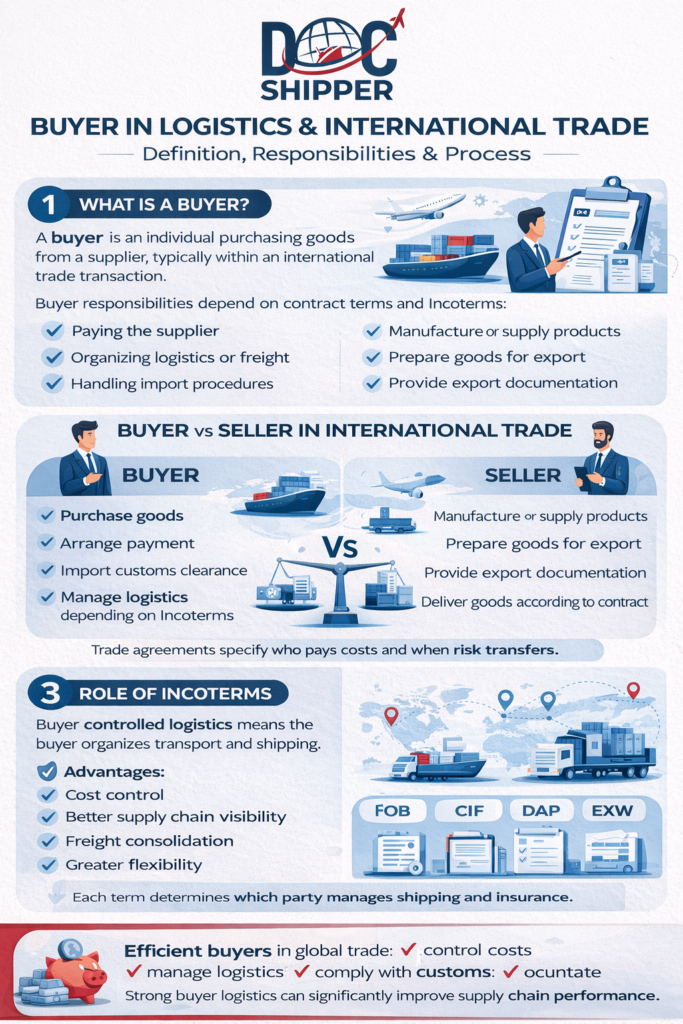
The buyer is the party in an international transaction who purchases goods or services from a seller (exporter). In import/export operations, the buyer assumes responsibility for payment, customs clearance at destination, and compliance with local regulations. This role determines contractual obligations, risk allocation, and logistics coordination throughout the supply chain.
Introduction
Many importers underestimate the complexity of the buyer’s role in international trade. Beyond simply placing orders, buyers navigate customs regulations, payment terms, and logistics coordination. A single misstep can lead to shipment delays, unexpected costs, or compliance violations.
The buyer’s position in the supply chain directly impacts profitability and operational efficiency. Understanding this role is essential for successful import operations, whether you’re sourcing raw materials from Asia or finished goods from Europe.
Key characteristics of the buyer’s role include:
- Payment obligation: Ensuring funds transfer according to agreed terms (LC, TT, OA)
- Import compliance: Managing customs documentation, duties, and local regulations
- Risk management: Understanding Incoterms and insurance requirements
- Quality control: Verifying goods meet specifications before or upon arrival
- Logistics coordination: Arranging inland transport and warehousing at destination
Buyer Responsibilities & Legal Framework
The buyer’s obligations vary significantly based on the chosen Incoterms rule. Under EXW (Ex Works), the buyer assumes all risks and costs from the seller’s premises. Conversely, under DDP (Delivered Duty Paid), the seller handles most logistics, leaving the buyer with minimal responsibility until goods arrive.
Payment mechanisms represent a critical buyer responsibility. Letters of Credit (LC) protect both parties through bank guarantees, while Telegraphic Transfer (TT) offers speed but higher risk for buyers. Open Account (OA) terms favor established relationships where the buyer pays post-delivery.
The import license requirement depends on product category and destination country. Controlled goods (pharmaceuticals, electronics, chemicals) often require pre-approval from regulatory authorities. The buyer must verify these requirements before finalizing purchase agreements. According to WTO import licensing procedures, non-compliance can result in shipment rejection or penalties.
Customs clearance at destination falls under buyer responsibility in most scenarios. This includes submitting commercial invoices, packing lists, certificates of origin, and paying applicable duties. Incorrect classification or valuation can trigger audits or fines.
The insurance obligation depends on Incoterms. Under CIF (Cost, Insurance, Freight), the seller provides minimum coverage. However, buyers often purchase additional insurance to cover full replacement value. At DocShipper, we systematically verify insurance adequacy to prevent coverage gaps that could expose buyers to significant losses.
Practical Scenarios & Data-Driven Examples
Understanding buyer responsibilities becomes clearer through real-world applications. Consider a European retailer importing electronics from China under FOB Shanghai terms.
Case Study: Electronics Import Under FOB Terms
| Responsibility | Party | Cost Impact |
|---|---|---|
| Export customs clearance | Seller | $350 |
| Ocean freight Shanghai-Hamburg | Buyer | $2,800 |
| Marine insurance (110% CIF value) | Buyer | $420 |
| Import customs duties (EU: 2.5%) | Buyer | $1,250 |
| VAT (Germany: 19%) | Buyer | $10,450 |
| Customs brokerage | Buyer | $280 |
In this scenario, the buyer’s total landed cost exceeds the FOB price by approximately 30%. This calculation demonstrates why buyers must factor all post-purchase expenses into pricing decisions.
Payment timing considerations:
- 30% deposit upon order confirmation (reduces seller risk)
- 70% balance against copy of Bill of Lading (standard FOB practice)
- Alternative: 100% LC at sight (higher bank fees but maximum security)
Documentation checklist for buyers:
- Commercial invoice with accurate HS codes
- Packing list detailing quantities and weights
- Certificate of Origin (preferential tariff eligibility)
- Bill of Lading or Air Waybill (proof of shipment)
- Product certifications (CE, FCC, safety standards)
Data from the International Chamber of Commerce shows that 68% of payment disputes in international trade stem from documentation discrepancies. Buyers who implement systematic document verification reduce clearance delays by an average of 40%.
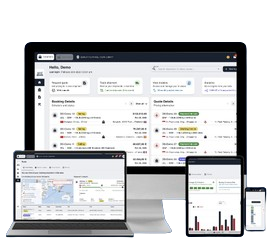
DocShipper Platform
One platform. Your entire supply chain
Sourcing, freight, customs & documents — all centralised, all visible, 24/7.
Conclusion
The buyer’s role extends far beyond purchase authorization, encompassing payment security, regulatory compliance, and logistics management. Mastering these responsibilities directly impacts cost control and supply chain reliability.
Need expert guidance on import procedures or customs clearance? Contact DocShipper for comprehensive support tailored to your specific trade requirements.
📚 Quiz
Test Your Knowledge: Buyer
Q1 — In international trade, which of the following best defines the role of the buyer?
Q2 — Under EXW (Ex Works) Incoterms, which statement correctly describes the buyer's obligations?
Q3 — A European retailer imports electronics from China under FOB Shanghai terms. The FOB price is $50,000. Which of the following correctly reflects the buyer's total landed cost?
🎯 Your Result
📞 Free Quote in 24hFAQ | Buyer: Definition, Role & Practical Examples in International Trade
The buyer is the purchasing party in a transaction, while the importer is the entity legally responsible for customs clearance at destination. In many cases, they are the same entity, but buyers may use customs brokers or third-party logistics providers as the importer of record.
Payment responsibility depends on the Incoterms rule. Under DDP, the seller pays all duties. Under most other terms (FOB, CIF, CFR), the buyer pays import duties and taxes at the destination country.
Refusal after clearance is complex and costly. The buyer remains liable for duties paid and storage fees. Rejection typically requires proving non-conformity with purchase agreement specifications, which must be documented through inspection reports.
Under a Letter of Credit, the issuing bank pays the seller if documents comply with LC terms. The bank then recovers funds from the buyer. Non-payment to the bank damages the buyer's creditworthiness and may result in legal action.
Buyers implement pre-shipment inspections (PSI) through third-party agencies. Inspectors verify product specifications, quantities, and packaging against purchase orders. This occurs before the seller releases goods for export.
Under Ex Works, the buyer assumes all responsibilities from the seller's premises, including loading, export clearance, international transport, insurance, import clearance, and delivery to final destination. This represents maximum buyer obligation.
Incoterms modification requires written agreement from both parties. Changes affect pricing, risk allocation, and logistics arrangements. Amendments should be formalized through contract addendums to prevent disputes.
Buyers should maintain commercial invoices, packing lists, Bills of Lading, customs declarations, payment records, and certificates of origin for a minimum of 5-7 years, depending on jurisdiction. This supports audit defense and duty drawback claims.
Landed cost includes product price, international freight, insurance, customs duties, taxes (VAT/GST), brokerage fees, inland transport, and handling charges. Accurate calculation prevents pricing errors and ensures profitability.
Recourse depends on Incoterms and insurance coverage. Buyers must document damage through survey reports immediately upon receipt. Claims are filed against the carrier (freight damage) or insurance provider (insured risks) within specified timeframes.
Generally, export compliance is the seller's responsibility. However, buyers can face consequences if knowingly participating in illegal exports (dual-use goods, sanctioned countries). Due diligence on seller legitimacy and product legality is essential.
Buyers use forward contracts to lock in exchange rates, reducing exposure to currency fluctuations between order placement and payment. Alternatively, contracts may specify payment in the buyer's currency, transferring risk to the seller.
Need Help with
Logistics or Sourcing ?
First, we secure the right products from the right suppliers at the right price by managing the sourcing process from start to finish. Then, we simplify your shipping experience - from pickup to final delivery - ensuring any product, anywhere, is delivered at highly competitive prices.


Fill the Form
Prefer email? Send us your inquiry, and we’ll get back to you as soon as possible.
Contact us