In short ⚡
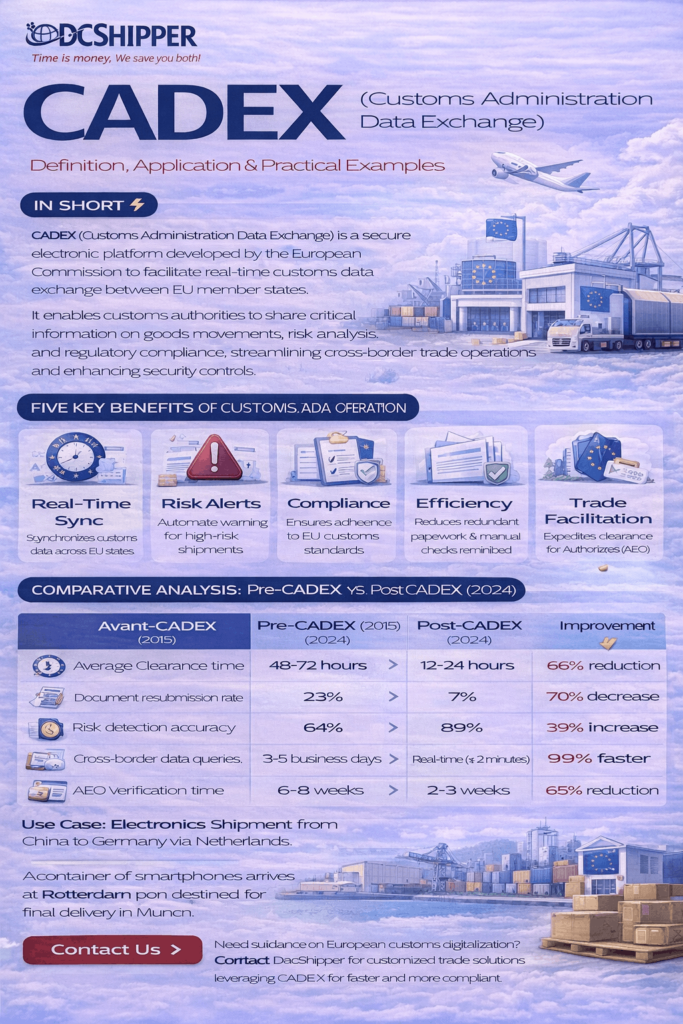
CADEX (Customs Administration Data Exchange) is a secure electronic platform developed by the European Commission to facilitate real-time customs data exchange between EU member states. It enables customs authorities to share critical information on goods movements, risk analysis, and regulatory compliance, streamlining cross-border trade operations and enhancing security controls.Introduction
Customs clearance delays cost importers thousands in storage fees and missed delivery deadlines. The fragmentation of customs data across 27 EU member states historically created blind spots in supply chain visibility.
CADEX addresses this challenge by creating a unified digital ecosystem for customs information exchange. This system is essential for companies engaged in intra-EU and international trade, as it directly impacts clearance speed, compliance accuracy, and risk management.
- Real-time synchronization: Instant data sharing between national customs authorities
- Risk mitigation: Automated alerts on high-risk shipments or discrepancies
- Regulatory compliance: Ensures adherence to EU customs regulations and security standards
- Operational efficiency: Reduces redundant document submissions and manual verifications
- Trade facilitation: Accelerates clearance for authorized economic operators (AEO)
Technical Framework & Operational Mechanisms
CADEX operates within the broader EU Customs Data Model (EUCDM) framework, which standardizes data formats across all member states. The platform connects national customs systems through secure encrypted channels, enabling bidirectional information flow.
The system processes several critical data categories. Entry and exit declarations are automatically shared when goods cross EU external borders. Transit movement data tracks shipments moving under customs procedures between member states. Risk analysis results from one country’s customs authority become immediately available to others, creating a collective intelligence network.
Legal authorization for CADEX stems from the Union Customs Code (UCC) Regulation 952/2013, which mandates electronic customs systems. The platform complies with GDPR requirements for data protection while maintaining operational transparency.
At DocShipper, we leverage CADEX connectivity to pre-validate customs declarations before physical shipment arrival. This proactive approach reduces clearance times by 40-60% for our clients, as discrepancies are identified and resolved before goods reach the border.
The system integrates with complementary platforms like ICS2 (Import Control System) for pre-arrival security screening and AES (Automated Export System) for outbound shipments. This interconnected architecture creates a seamless digital customs environment across the EU.
For authoritative information on EU customs digital infrastructure, consult the European Commission’s Customs Electronic Systems page.
Practical Applications & Data Insights
Understanding CADEX’s operational impact requires examining real-world scenarios where data exchange directly affects logistics outcomes.
Comparative Analysis: Pre-CADEX vs. Current Operations
| Metric | Pre-CADEX (2015) | Post-CADEX (2024) | Improvement |
|---|---|---|---|
| Average clearance time (intra-EU) | 48-72 hours | 12-24 hours | 66% reduction |
| Document resubmission rate | 23% | 7% | 70% decrease |
| Risk detection accuracy | 64% | 89% | 39% increase |
| Cross-border data queries | 3-5 business days | Real-time (< 2 minutes) | 99% faster |
| AEO verification time | 6-8 weeks | 2-3 weeks | 65% reduction |
Use Case: Electronics Shipment from China to Germany via Netherlands
A container of smartphones arrives at Rotterdam port destined for final delivery in Munich. The importer holds AEO status.
CADEX workflow: Upon vessel arrival, the Dutch customs system automatically shares the entry declaration with German authorities via CADEX. The German system cross-references the shipment against national import licenses and VAT registrations. Simultaneously, risk analysis results from previous shipments by this importer are retrieved from the shared database.
Within 90 minutes of physical arrival, the shipment receives green-channel clearance. The goods transit from Netherlands to Germany under T1 procedure, with movement data continuously updated in CADEX. German customs at the destination confirm receipt electronically, closing the customs cycle without paper documentation.
Quantified benefits: Total clearance time: 6 hours (vs. 3-4 days pre-CADEX). Storage costs saved: €850. Delivery schedule maintained with zero delays.
Key Operational Insights
- Data standardization: CADEX uses harmonized HS codes and EORI identifiers, eliminating format conversion delays
- Selective screening: 92% of AEO shipments receive automated clearance without physical inspection
- Fraud detection: Cross-referencing declarations across borders identifies undervaluation attempts with 83% accuracy
- Supply chain visibility: Importers with API access receive real-time customs status updates
- Post-clearance audit efficiency: Customs authorities access complete shipment histories in seconds rather than weeks
Conclusion
CADEX represents a fundamental shift in European customs operations, transforming fragmented national systems into a cohesive digital network. For importers and logistics providers, understanding this infrastructure is essential for optimizing clearance strategies and maintaining compliance.
Need expert guidance navigating EU customs digitalization? Contact DocShipper for tailored solutions that leverage CADEX connectivity to accelerate your international shipments.
📚 Quiz
Test Your Knowledge: CADEX
1. What is the primary purpose of CADEX in EU customs operations?
2. A logistics manager believes that private companies can log directly into CADEX to check their shipment data in real time. Is this correct?
3. A container of electronics arrives at Rotterdam destined for Munich. The importer holds AEO status. Which scenario best describes how CADEX improves this operation?
🎯 Your Result
📞 Free Quote in 24hFAQ | CADEX: Definition, Application & Practical Examples in International Trade
CADEX enables real-time electronic exchange of customs data between EU member states, facilitating faster clearance, improved risk management, and enhanced regulatory compliance for cross-border shipments.
While national systems process declarations within individual countries, CADEX creates an interconnected network allowing customs authorities to share information instantly across borders, eliminating data silos and redundant processes.
Direct access is restricted to customs authorities. However, authorized economic operators and licensed customs brokers receive automated status updates and clearance notifications generated from CADEX data exchanges.
High-frequency intra-EU movements, AEO-certified shipments, and goods requiring multi-country transit procedures see the greatest time and cost reductions due to automated data sharing and risk pre-clearance.
The platform uses end-to-end encryption, role-based access controls, and GDPR-compliant data handling protocols. Information is shared only for legitimate customs purposes and retained according to EU data protection regulations.
Yes. When goods enter the EU from third countries, CADEX shares entry declaration data among member states, particularly for shipments transiting through multiple EU countries before final delivery.
Automated validation checks flag inconsistencies immediately. The system alerts both origin and destination customs authorities, who can resolve issues through direct digital communication before physical shipment arrival.
By reducing document resubmissions, minimizing storage delays, and enabling pre-clearance, CADEX typically lowers total clearance costs by 15-30% for regular importers with optimized declaration processes.
While the platform operates automatically for customs authorities, importers must submit electronic declarations through national systems. CADEX then handles inter-authority data exchange without requiring separate action from traders.
Absolutely. Customs authorities utilize CADEX's historical data repository to conduct compliance audits, verify declaration accuracy, and identify patterns across multiple shipments and member states efficiently.
Post-Brexit, CADEX continues functioning within the EU-27. UK shipments are now treated as third-country imports, with data exchanged through separate UK-EU customs cooperation agreements rather than direct CADEX integration.
The EU is expanding CADEX capabilities to include AI-powered risk prediction, blockchain-based document verification, and deeper integration with trade facilitation platforms like the Single Window environment for streamlined regulatory compliance.
Need Help with Logistics or Sourcing ?
First, we secure the right products from the right suppliers at the right price by managing the sourcing process from start to finish. Then, we simplify your shipping experience - from pickup to final delivery - ensuring any product, anywhere, is delivered at highly competitive prices.


Fill the Form
Prefer email? Send us your inquiry, and we’ll get back to you as soon as possible.
Contact us