


In short ⚡
Cargo refers to goods or merchandise transported by ship, aircraft, truck, or rail for commercial purposes. In international trade, cargo encompasses all physical commodities moved from origin to destination, excluding passenger baggage. Proper cargo classification determines shipping methods, insurance requirements, and customs procedures essential for cross-border commerce.
Introduction
Many importers confuse “cargo” with “freight” or fail to understand how cargo classification impacts shipping costs and transit times. This distinction matters significantly when selecting transport modes or negotiating carrier contracts.
Cargo forms the backbone of global supply chains. Every physical product crossing international borders—from smartphones to industrial machinery—qualifies as cargo requiring specific handling protocols.
Understanding cargo fundamentals helps businesses:
- Select optimal transport modes based on cargo characteristics
- Calculate accurate shipping costs using volume or weight metrics
- Comply with international regulations for hazardous or perishable goods
- Negotiate better rates with carriers through proper cargo classification
- Reduce damage risks by matching packaging to cargo type
Cargo Classification & Technical Expertise
International logistics distinguishes cargo types based on physical properties, handling requirements, and regulatory frameworks. The International Maritime Organization (IMO) and International Air Transport Association (IATA) establish global standards for cargo categorization.
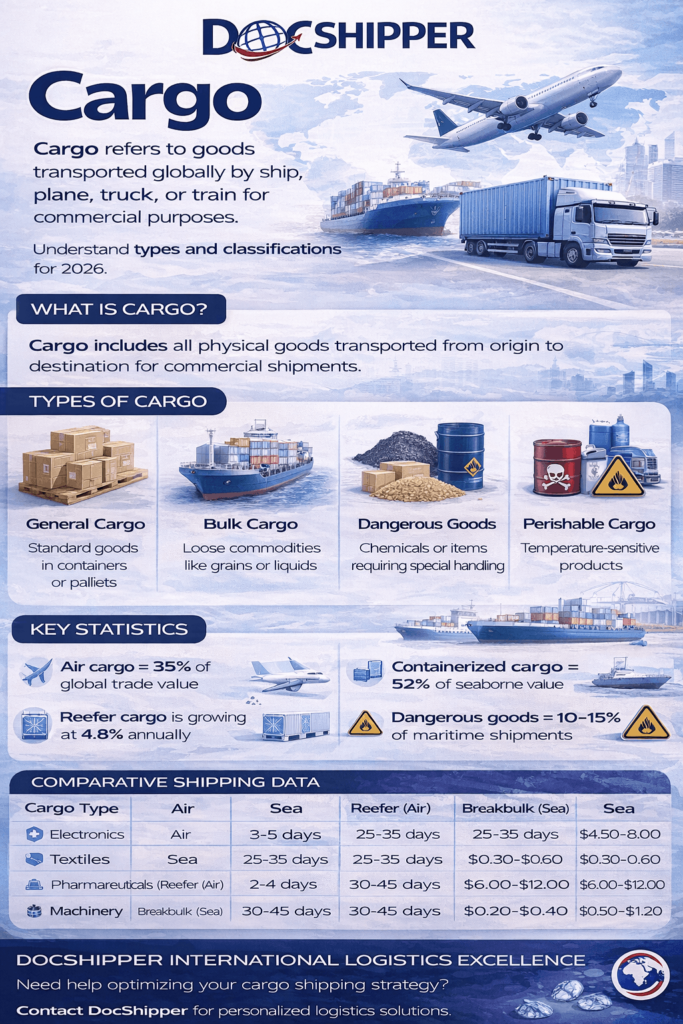
General cargo includes manufactured goods, consumer products, and non-hazardous materials shipped in standard containers or pallets. This category represents approximately 70% of global trade volume. General cargo requires minimal special handling beyond basic protection from weather and theft.
Bulk cargo consists of unpackaged commodities loaded directly into vessel holds or specialized containers. Dry bulk includes grains, coal, and minerals, while liquid bulk covers petroleum products and chemicals. The IMO SOLAS Convention mandates specific loading procedures to prevent vessel instability.
Dangerous goods (DG cargo) require specialized handling under the UN Model Regulations on the Transport of Dangerous Goods. Nine hazard classes exist, from explosives (Class 1) to miscellaneous dangerous substances (Class 9). Carriers demand detailed Material Safety Data Sheets (MSDS) and proper packaging certification.
Perishable cargo demands temperature-controlled environments throughout transit. Reefer containers maintain specific temperature ranges (-25°C to +25°C) for pharmaceuticals, fresh produce, and frozen foods. Time-sensitivity transforms perishable cargo into high-value logistics operations.
At DocShipper, we systematically verify cargo classification before booking shipments to ensure compliance with carrier requirements and avoid costly delays at customs checkpoints.
Concrete Examples & Comparative Data
Cargo characteristics directly influence shipping decisions. Consider these real-world scenarios demonstrating how cargo type determines logistics strategy:
| Cargo Type | Weight/Volume Ratio | Preferred Transport | Average Transit Time | Cost per kg |
|---|---|---|---|---|
| Electronics (General) | High density | Air freight | 3-5 days | $4.50-$8.00 |
| Textiles (General) | Low density | Sea freight (FCL) | 25-35 days | $0.30-$0.60 |
| Pharmaceuticals (Perishable) | Variable | Air freight (reefer) | 2-4 days | $6.00-$12.00 |
| Machinery (Heavy) | Very high density | Sea freight (breakbulk) | 30-45 days | $0.20-$0.40 |
| Chemicals (Dangerous) | Medium density | Sea freight (tank container) | 28-40 days | $0.50-$1.20 |
Use Case: A European electronics manufacturer ships 5,000 kg of smartphones (high-value, compact cargo) from Shenzhen to Rotterdam. Dimensional weight calculation: 8 CBM × 167 kg/CBM = 1,336 kg chargeable weight. Despite actual weight being higher, air freight remains cost-effective due to inventory holding costs and market demand urgency.
Key Data Points:
- Containerized cargo accounts for 52% of global seaborne trade value
- Air cargo represents only 1% of shipment volume but 35% of trade value
- Reefer cargo grows at 4.8% annually, driven by pharmaceutical and food sectors
- Dangerous goods comprise 10-15% of maritime cargo, requiring specialized handling
- Break-bulk cargo costs average 40-60% more than containerized equivalents
Conclusion
Cargo classification directly impacts shipping costs, transit times, and regulatory compliance. Matching cargo characteristics to appropriate transport modes reduces expenses while ensuring goods arrive safely and on schedule.
Need expert guidance on optimizing your cargo shipping strategy? Contact DocShipper for personalized logistics solutions tailored to your specific cargo requirements.
📚 Quiz
Test Your Knowledge: Cargo
1. Which of the following best defines "cargo" in international logistics?
2. Air cargo represents only 1% of global shipment volume. What share of total trade value does it account for?
3. A shipper needs to transport 8,000 kg of industrial turbines that are too large for standard containers. Which cargo type and transport mode best applies?
🎯 Your Result
📞 Free Quote in 24hFAQ | Cargo: Definition, Types & Concrete Examples in International Logistics
Cargo refers to the goods themselves, while freight describes the commercial transportation service. Freight includes the process and cost of moving cargo from origin to destination.
Airlines use the greater of actual weight or volumetric weight (length × width × height in cm ÷ 6000). This dimensional weight calculation prevents undercharging for bulky, lightweight cargo.
Essential documents include commercial invoice, packing list, bill of lading or airway bill, certificate of origin, and any product-specific certificates (MSDS for dangerous goods, health certificates for food products).
Yes, cargo insurance covers loss or damage during transport. Policies typically cover all-risk or named-perils, with premiums based on cargo value, route risk, and packaging quality.
Class 1: Explosives; Class 2: Gases; Class 3: Flammable liquids; Class 4: Flammable solids; Class 5: Oxidizing substances; Class 6: Toxic substances; Class 7: Radioactive materials; Class 8: Corrosives; Class 9: Miscellaneous dangerous goods.
Transit duration depends on product type and temperature requirements. Fresh produce typically requires delivery within 7-14 days, while frozen goods can sustain 30-45 day ocean transits in reefer containers.
Break-bulk cargo consists of goods too large or heavy for standard containers, shipped individually on pallets, in crates, or as bare units. Examples include construction equipment, turbines, and steel beams.
No. Import restrictions vary by country. Some nations prohibit certain goods (weapons, narcotics), restrict agricultural products, or require special permits for dual-use technologies. Always verify destination country regulations before shipping.
Consolidation combines multiple small shipments into one container or pallet to reduce per-unit shipping costs. Freight forwarders group cargo from different shippers heading to similar destinations.
Modern cargo tracking uses GPS devices, RFID tags, and IoT sensors providing real-time location and condition data. Carriers and forwarders offer online portals where shippers monitor shipment progress through bill of lading or container numbers.
FCL (Full Container Load) means one shipper fills an entire container. LCL (Less than Container Load) combines cargo from multiple shippers in one container, offering cost savings for smaller shipments but longer transit times due to consolidation processes.
Yes. Standard cargo aircraft accept pallets up to 96" × 125" and individual pieces up to 3,000 kg. Oversized cargo requires charter flights or specialized freighter aircraft with reinforced loading systems.
Need Help with Logistics or Sourcing ?
First, we secure the right products from the right suppliers at the right price by managing the sourcing process from start to finish. Then, we simplify your shipping experience - from pickup to final delivery - ensuring any product, anywhere, is delivered at highly competitive prices.


Fill the Form
Prefer email? Send us your inquiry, and we’ll get back to you as soon as possible.
Contact us


