


In short ⚡
The Carrier Certificate and Release Order is a critical shipping document issued by ocean carriers or their agents, authorizing freight forwarders to release cargo to consignees. This document confirms freight payment, validates shipment details, and enables the physical transfer of goods from carrier custody to the designated party.
Introduction
In international freight operations, cargo release confusion causes 23% of port delays according to maritime logistics studies. The Carrier Certificate and Release Order eliminates ambiguity by providing clear authorization chains.
This document serves as the bridge between ocean transport completion and inland delivery initiation. Without proper release documentation, containers remain trapped in terminal facilities, generating demurrage charges and supply chain disruptions.
Key characteristics include:
- Authorization function: Grants legal permission for cargo release from carrier control
- Payment verification: Confirms all freight charges have been settled
- Chain of custody: Establishes clear handover responsibility between parties
- Terminal access: Enables freight forwarders to retrieve containers from port facilities
- Liability transfer: Marks the point where carrier responsibility ends and consignee responsibility begins
Document Mechanics & Legal Framework
The Carrier Certificate and Release Order operates within the Hague-Visby Rules framework, which governs carrier liability until proper cargo delivery. This document represents the carrier’s fulfillment of contractual obligations under the bill of lading.
Issuance triggers occur when three conditions are met: freight payment confirmation, cargo arrival at destination port, and original bill of lading surrender (or telex release authorization). The carrier or their appointed agent then generates the release order.
Legal authorization scope extends to designated freight forwarders and customs brokers. According to Federal Maritime Commission regulations, only parties named in the release order can legally retrieve cargo from terminal operators.
The document contains critical data elements: bill of lading reference number, container identification codes, seal numbers, cargo description, consignee details, and authorized release party information. Missing or incorrect data invalidates the release authority.
Validity periods typically span 5-7 business days from issuance. Extended validity requires carrier approval and may incur additional documentation fees. At DocShipper, we coordinate release order timing with customs clearance schedules to prevent validity expiration and associated delays.
The liability transition mechanism activates upon physical cargo handover. Carriers maintain responsibility for cargo condition until the release order execution moment. Post-release damage claims fall under consignee or freight forwarder insurance coverage rather than carrier liability.
Practical Applications & Industry Data
Understanding release order workflows through concrete scenarios clarifies operational requirements and prevents common processing errors.
Comparative Processing Scenarios
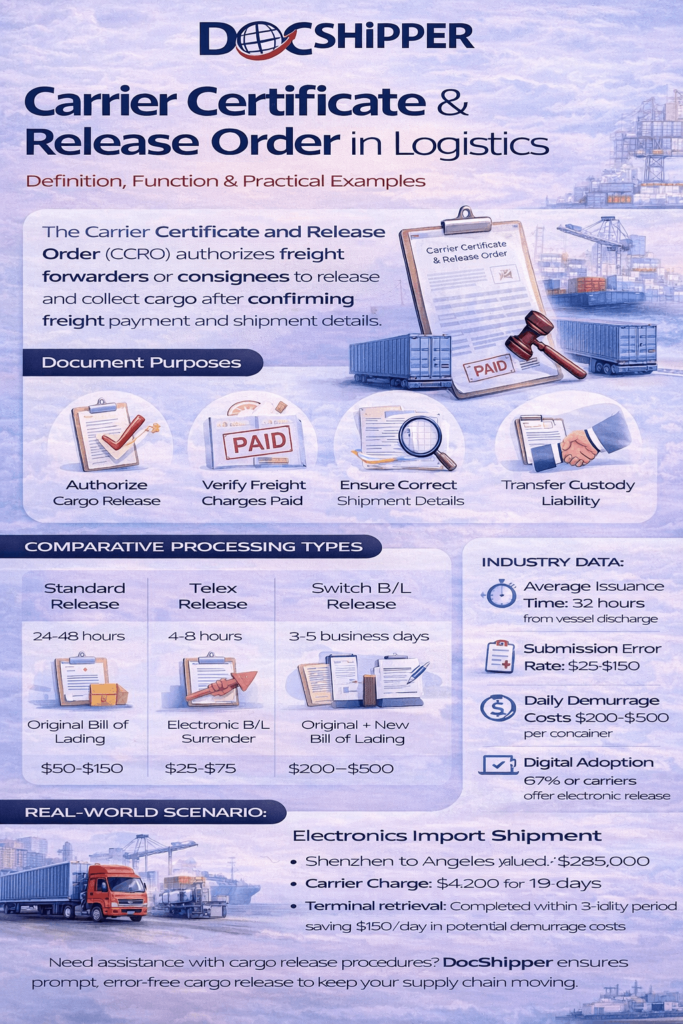
| Scenario Type | Processing Time | Documentation Required | Cost Implications |
|---|---|---|---|
| Standard Release | 24-48 hours | Original B/L, freight payment proof | $50-$150 processing fee |
| Telex Release | 4-8 hours | Electronic B/L surrender confirmation | $25-$75 expedite charge |
| Switch B/L Release | 3-5 business days | Original + new B/L, carrier approval | $200-$500 switching fee |
| Letter of Indemnity | 48-72 hours | Bank guarantee, LOI, insurance certificate | $500-$2,000 + guarantee fees |
Real-World Case Study
Electronics Import Scenario: A technology distributor imports 40-foot containers of consumer electronics from Shenzhen to Los Angeles. The shipment value totals $285,000 with freight charges of $4,200.
The freight forwarder receives the Carrier Certificate and Release Order 36 hours after vessel arrival. The document authorizes cargo pickup from the terminal within 5 days. Customs clearance completes in 18 hours, allowing container retrieval on day 3.
Without the release order, the container would remain at the terminal, accruing $150 daily demurrage charges. The 3-day processing window saves $450 in potential fees while maintaining supply chain velocity.
Industry Performance Metrics
- Average processing time: 32 hours from vessel discharge to release order issuance
- Documentation error rate: 12% of initial submissions require correction
- Cost impact: Delayed releases generate $800-$2,500 in additional charges per container
- Digital adoption: 67% of major carriers now offer electronic release order systems
- Dispute frequency: 8% of releases involve payment or documentation disputes requiring resolution
At DocShipper, we pre-validate all release documentation before carrier submission, reducing error rates to below 3% and accelerating cargo availability by an average of 14 hours compared to industry standards.
Conclusion
The Carrier Certificate and Release Order functions as the critical authorization mechanism enabling cargo transfer from maritime carriers to consignees. Proper document management prevents costly delays and maintains supply chain continuity.
Need expert assistance with release order coordination and cargo clearance? Contact DocShipper for comprehensive freight forwarding support.
📚 Quizz
Test Your Knowledge: Carrier Certificate & Release Order
Q1 — What is the primary function of a Carrier Certificate and Release Order?
Q2 — A consignee believes that once the vessel arrives at the destination port, the carrier's liability for cargo automatically transfers to them. Is this correct?
Q3 — A technology distributor's freight forwarder receives a Release Order 36 hours after vessel arrival. Customs clearance takes 18 hours. The release order is valid for 5 days. On which day can the container be retrieved — and what happens if it is not picked up within the validity window?
🎯 Your Result
📞 Free Quote in 24hFAQ | Carrier Certificate and Release Order: Definition, Function & Practical Examples
Carriers require a Letter of Indemnity backed by a bank guarantee, typically 150% of cargo value, plus insurance coverage. Processing adds 2-5 business days to release timelines.
No. Carriers issue release orders to a single designated party to maintain clear chain of custody. Transfer requires formal amendment with carrier approval.
Telex release eliminates physical document requirements through electronic bill of lading surrender, reducing processing time from 24-48 hours to 4-8 hours.
Standard processing costs $50-$150. Expedited services range $75-$200. Documentation corrections add $35-$100 per amendment.
Typically the consignee or their freight forwarder covers release documentation fees as part of destination charges, separate from ocean freight costs.
Pre-arrival releases are possible with advance payment confirmation, but physical cargo release remains contingent on actual vessel discharge completion.
Essential elements include bill of lading number, container IDs, seal numbers, cargo description, consignee name, authorized release party, and carrier authentication.
Standard validity spans 5-7 business days from issuance. Extensions require carrier approval and may incur $50-$100 renewal fees.
Common issues include mismatched container numbers, expired validity dates, unauthorized party names, missing carrier signatures, or outstanding freight charges.
Transfers require formal carrier amendment requests with supporting documentation. Processing takes 24-48 hours and incurs $75-$150 administrative fees.
No standardized format exists. Each carrier maintains proprietary templates, though core data elements remain consistent across shipping lines.
Post-release damage claims fall under freight forwarder or consignee insurance policies. Carrier liability ends upon proper cargo handover per release documentation.
Need Help with Logistics or Sourcing ?
First, we secure the right products from the right suppliers at the right price by managing the sourcing process from start to finish. Then, we simplify your shipping experience - from pickup to final delivery - ensuring any product, anywhere, is delivered at highly competitive prices.


Fill the Form
Prefer email? Send us your inquiry, and we’ll get back to you as soon as possible.
Contact us


