


In short ⚡
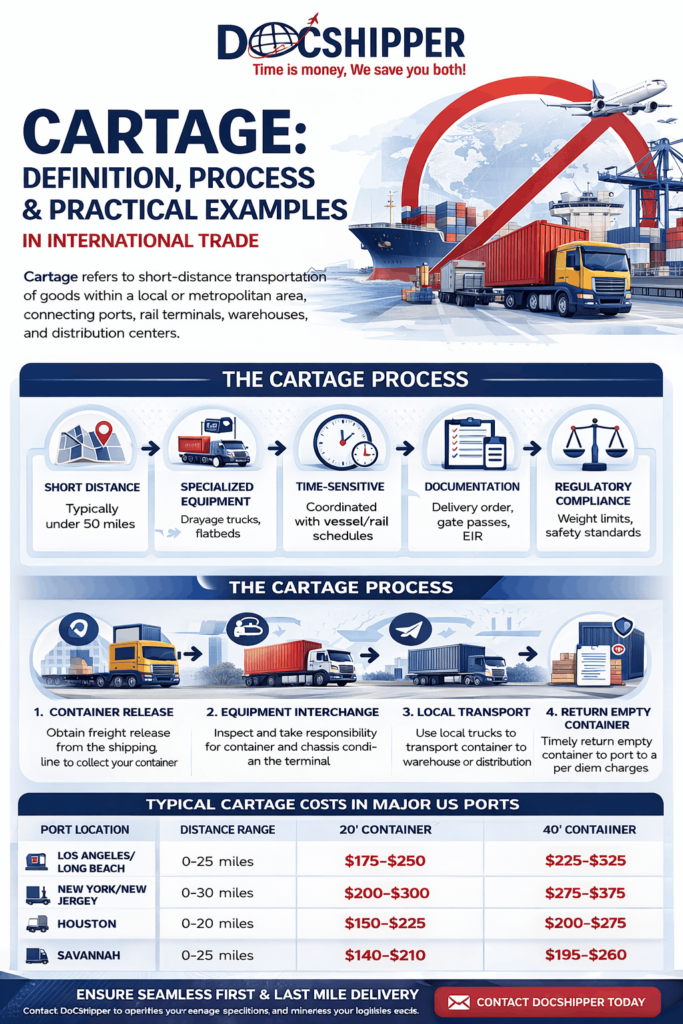
Cartage refers to the short-distance transportation of goods, typically within a metropolitan area or between nearby facilities. This essential logistics service connects ports, warehouses, rail terminals, and distribution centers, serving as the critical first or last mile in the international supply chain. Cartage ensures cargo moves efficiently from arrival points to storage or final destinations.
Introduction
Many importers and exporters underestimate the complexity of moving containers from port to warehouse—a process that seems simple but involves strict timing, documentation, and coordination. Without proper cartage planning, cargo sits idle at terminals, accumulating demurrage charges that can reach hundreds of dollars per day.
Cartage represents the bridge between long-haul transportation and final delivery. In international trade, this short-distance movement directly impacts customs clearance speed, inventory availability, and overall supply chain costs. Understanding cartage operations helps businesses avoid delays and optimize their logistics budgets.
Key characteristics of cartage services include:
- Short-distance focus: Typically under 50 miles from ports or rail terminals
- Specialized equipment: Container chassis, flatbeds, and drayage trucks
- Time-sensitive operations: Coordinated with vessel arrivals and warehouse schedules
- Documentation requirements: Delivery orders, equipment interchange receipts, and gate passes
- Regulatory compliance: Weight restrictions, environmental standards, and safety protocols
Understanding Cartage Mechanisms & Operations
Cartage operations follow a structured process beginning with container release authorization. Once a vessel discharges cargo at port, the consignee must obtain release documentation from the shipping line and customs authorities. This step involves verifying payment of ocean freight, presenting the Bill of Lading, and confirming customs clearance status.
The equipment interchange represents a critical checkpoint where cartage carriers assume responsibility for containers. Drivers present proper credentials at terminal gates, where inspectors document container condition through detailed reports. Any pre-existing damage must be noted to avoid liability disputes. At DocShipper, we coordinate this process systematically to prevent documentation errors that delay cargo release.
Route optimization significantly impacts cartage efficiency. Carriers must navigate port congestion, weight limit restrictions on local roads, and specific delivery time windows. Advanced planning accounts for bridge height clearances, hazardous material routing requirements, and seasonal traffic patterns. Professional cartage providers maintain real-time communication with terminals and receivers to adjust schedules dynamically.
The delivery appointment system requires precise coordination between multiple parties. Warehouses and distribution centers impose strict receiving windows to manage dock capacity. Missing an appointment can result in detention charges for the container and truck, as well as rescheduling fees. Successful cartage operations balance terminal pickup times with receiver availability.
Equipment return procedures complete the cartage cycle. Empty containers must be returned to designated depots within specified free time periods—typically 3 to 5 days. Late returns trigger per diem charges that accumulate rapidly. According to the Federal Maritime Commission, understanding these timelines is essential for cost control in containerized shipping.
Practical Examples & Cost Data
Cartage costs vary significantly based on distance, container type, and local market conditions. The following table illustrates typical pricing structures in major US ports:
| Port Location | Distance Range | 20′ Container | 40′ Container |
|---|---|---|---|
| Los Angeles/Long Beach | 0-25 miles | $175-$250 | $225-$325 |
| New York/New Jersey | 0-30 miles | $200-$300 | $275-$375 |
| Houston | 0-20 miles | $150-$225 | $200-$275 |
| Savannah | 0-25 miles | $140-$210 | $185-$260 |
Use Case: Electronics Importer in Southern California
A consumer electronics company imports 50 containers monthly from Asia through the Port of Long Beach to their warehouse in Ontario, California (35 miles). Their cartage analysis reveals:
- Base cartage cost: $275 per 40′ container × 50 = $13,750/month
- Fuel surcharge (15%): $2,062
- Chassis rental (5 days average): $35/day × 5 × 50 = $8,750
- Congestion fees (peak season): $50 per container = $2,500
- Total monthly cartage expense: $27,062
By implementing appointment scheduling optimization and negotiating volume discounts, the company reduced costs by 18% while improving delivery reliability. This demonstrates how strategic cartage management directly impacts bottom-line profitability.
Additional cost factors include:
- Overweight penalties: $75-$150 per occurrence when exceeding road weight limits
- Detention charges: $100-$200 per hour after 2-hour free time at delivery location
- Weekend/holiday premiums: 50-100% surcharge for non-business hours
- Hazmat handling: $50-$150 additional for dangerous goods cartage
- Expedited service: 25-50% premium for same-day or priority delivery
Conclusion
Cartage serves as the essential link connecting international cargo to domestic distribution networks. Mastering its operational requirements, cost structures, and timing constraints enables businesses to maintain supply chain velocity while controlling logistics expenses.
Need expert guidance on optimizing your cartage operations? Contact DocShipper for comprehensive logistics support tailored to your import/export requirements.
📚 Quiz
Test Your Knowledge: Cartage
Q1 — What best defines "cartage" in logistics?
Q2 — A common misconception is that cartage and drayage are completely different services. What is the correct interpretation?
Q3 — Under FOB (Free On Board) terms, an importer receives 40' containers at the Port of Los Angeles. Who is responsible for the cartage cost from the port to the importer's warehouse?
🎯 Your Result
📞 Free Quote in 24hFAQ | Cartage: Definition, Process & Practical Examples
The terms are often used interchangeably, but drayage specifically refers to container movement from ports or rail terminals, while cartage can include any short-distance freight transportation within metropolitan areas, including non-containerized cargo.
Standard cartage from port to warehouse typically requires 24-48 hours, accounting for container release processing, terminal pickup scheduling, and delivery appointments. Expedited service can reduce this to same-day delivery with premium fees.
Under FOB (Free On Board) terms, the buyer assumes responsibility for all transportation costs from the port of loading, including cartage from the destination port to the final delivery location. The seller covers cartage to the origin port.
Essential documents include the delivery order from the shipping line, equipment interchange receipt, customs release notification, commercial invoice, and packing list. Hazardous materials require additional safety data sheets and placarding documentation.
Yes, specialized cartage providers offer flatbed and lowboy trailers for oversized freight. However, this requires route surveys, special permits, and sometimes pilot car escorts, significantly increasing costs and transit time compared to standard container cartage.
During peak seasons or labor disruptions, ports implement congestion surcharges ranging from $50-$200 per container. These temporary fees compensate carriers for extended wait times at terminal gates and are typically passed directly to shippers.
Chassis split billing separates container transportation charges from chassis rental fees. The cartage carrier charges for trucking services while chassis providers bill separately for equipment usage, typically $25-$50 per day with the first few days included in the cartage rate.
If delivery cannot be completed due to receiver unavailability or incorrect addresses, carriers charge redelivery fees ($75-$150) plus storage costs. The container may be returned to a carrier yard where daily storage charges accumulate until delivery instructions are clarified.
Yes, shippers moving 20+ containers monthly can negotiate volume discounts of 10-25% off standard rates. Annual contracts with minimum volume commitments typically secure the most favorable pricing and priority service during capacity constraints.
Cartage carriers maintain motor truck cargo insurance covering damage during transportation, typically with $100,000-$250,000 limits per occurrence. Shippers with high-value cargo should verify coverage limits and consider supplemental cargo insurance for full replacement value protection.
FCL (Full Container Load) cartage moves entire containers directly from port to destination. LCL (Less than Container Load) requires additional handling at consolidation warehouses where containers are unstuffed and individual shipments are sorted for separate delivery, adding 1-3 days to transit time.
Modern cartage operations utilize GPS tracking, electronic proof of delivery, automated appointment scheduling, and real-time visibility platforms. These technologies reduce detention time, improve delivery accuracy, and provide shippers with precise ETA information for inventory planning purposes.
Need Help with Logistics or Sourcing ?
First, we secure the right products from the right suppliers at the right price by managing the sourcing process from start to finish. Then, we simplify your shipping experience - from pickup to final delivery - ensuring any product, anywhere, is delivered at highly competitive prices.


Fill the Form
Prefer email? Send us your inquiry, and we’ll get back to you as soon as possible.
Contact us


