


In short ⚡
Centralized Inventory Control is a supply chain management strategy where inventory oversight, purchasing decisions, and stock allocation are managed from a single central location rather than distributed across multiple sites. This approach enables unified visibility, standardized processes, and optimized resource allocation across an entire distribution network.
Introduction
Many international businesses struggle with inconsistent stock levels, redundant purchasing, and poor inventory visibility across warehouses. These challenges multiply exponentially when operations span multiple countries or continents.
Centralized Inventory Control addresses these issues by consolidating inventory management under one command structure. This approach has become essential for companies engaged in international trade, where coordination between manufacturing origins, transit hubs, and final destinations determines profitability.
Key characteristics include:
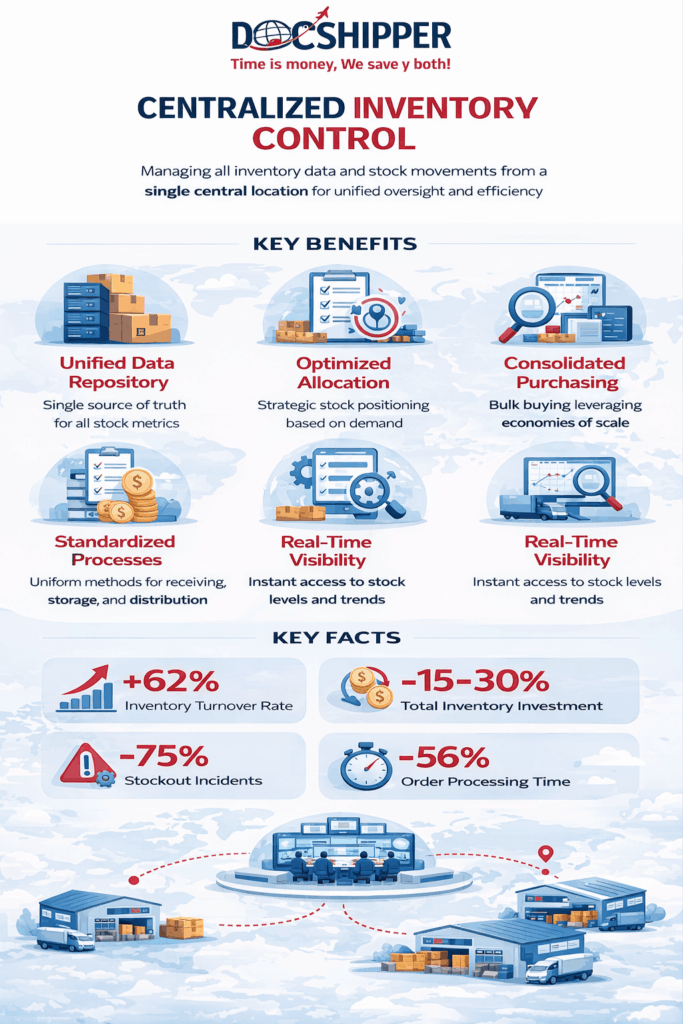
- Unified data repository: Single source of truth for all inventory metrics across locations
- Consolidated purchasing authority: Centralized procurement decisions leveraging economies of scale
- Standardized processes: Uniform procedures for receiving, storage, and distribution
- Real-time visibility: Instant access to stock levels, movements, and forecasts network-wide
- Optimized allocation: Strategic stock positioning based on demand patterns and logistics costs
Technical Framework & Strategic Implementation
Implementing centralized inventory control requires both technological infrastructure and organizational alignment. The system operates through integrated software platforms that connect all storage locations to a central management hub.
Technology architecture typically includes a Warehouse Management System (WMS) synchronized with Enterprise Resource Planning (ERP) software. These systems communicate via APIs to provide real-time data exchange. Cloud-based solutions have become standard, enabling access from any location while maintaining data security.
Demand forecasting becomes significantly more accurate under centralized control. The system aggregates historical sales data, seasonal trends, and market intelligence from all locations. Advanced algorithms identify patterns that individual warehouses might miss, reducing both stockouts and excess inventory.
Safety stock optimization represents a major advantage. Instead of each location maintaining individual buffers, the centralized system calculates network-wide safety stock requirements. This approach typically reduces total inventory investment by 15-30% while maintaining service levels.
Compliance management becomes streamlined when inventory control is centralized. For international operations, this means unified handling of customs documentation, product certifications, and regulatory requirements. At DocShipper, we integrate centralized inventory protocols with customs clearance procedures to ensure seamless cross-border movements.
According to the World Trade Organization’s Trade Facilitation Agreement, standardized inventory procedures significantly reduce border delays and administrative costs for international shipments.
Exception handling follows predefined escalation protocols. When inventory discrepancies occur, the central system automatically flags anomalies and routes them to specialized teams. This prevents local variations in problem-solving approaches that often lead to inconsistent outcomes.
Practical Examples & Performance Data
Real-world implementation demonstrates measurable benefits across various industries and company sizes. The following examples illustrate typical scenarios and outcomes.
Comparative Performance Analysis
| Metric | Decentralized System | Centralized System | Improvement |
|---|---|---|---|
| Inventory Turnover Ratio | 4.2 times/year | 6.8 times/year | +62% |
| Stockout Incidents | 8.5% of SKUs | 2.1% of SKUs | -75% |
| Carrying Costs | 28% of inventory value | 19% of inventory value | -32% |
| Order Processing Time | 3.2 days | 1.4 days | -56% |
| Inventory Accuracy | 91% | 98.5% | +8.2% |
Use Case: Electronics Importer
A European electronics distributor operating five warehouses across France, Germany, and Poland implemented centralized inventory control in 2023. Previous decentralized management resulted in frequent stock imbalances—some locations overstocked while others faced shortages.
Initial situation: Total inventory value €12.4 million spread across locations with 23% redundancy. Average delivery time to customers: 4.8 days. Quarterly inventory adjustments averaged €340,000 due to discrepancies.
Implementation: Six-month transition to cloud-based centralized system. All purchasing consolidated under central procurement team. Real-time stock synchronization established between all facilities. DocShipper coordinated the customs documentation standardization to ensure consistent import procedures across entry points.
Results after 12 months: Inventory value reduced to €9.1 million (27% reduction) while maintaining 99.2% product availability. Average delivery time decreased to 2.9 days. Inventory discrepancies fell to €48,000 quarterly. Annual carrying cost savings exceeded €890,000.
Critical Success Factors
- Data quality: Accurate SKU information, consistent naming conventions, and real-time synchronization
- Change management: Comprehensive training for warehouse staff adapting to centralized protocols
- System integration: Seamless connection between WMS, ERP, and transportation management systems
- Performance metrics: Clear KPIs measuring fill rates, inventory turns, and accuracy levels
- Scalability planning: Infrastructure capable of handling growth without performance degradation
Conclusion
Centralized Inventory Control transforms fragmented warehouse operations into a coordinated network, delivering measurable improvements in cost efficiency, service levels, and operational visibility. For international traders, this approach eliminates the complexity of managing inventory across borders while maintaining compliance with varying regulatory requirements.
Need assistance implementing centralized inventory strategies for your international operations? Contact DocShipper for expert guidance on optimizing your global supply chain.
📚 Quiz
Centralized Inventory Control
Q1 — What best defines Centralized Inventory Control?
Q2 — A common misconception is that centralized inventory control increases total inventory investment because it must stock all locations from one point. What does the data actually show?
Q3 — A European electronics distributor with five warehouses across three countries is experiencing stock imbalances: some sites are overstocked while others face shortages. Which approach best resolves this?
🎯 Your Result
📞 Free Quote in 24hFAQ | Centralized Inventory Control: Definition, Implementation & Practical Examples
Centralized control consolidates all inventory decisions and oversight at a single command center, while decentralized systems allow individual locations to manage their own stock independently. Centralized approaches provide better visibility and coordination but require robust technology infrastructure.
By aggregating demand forecasts across all locations, centralized systems calculate optimal network-wide stock levels rather than maintaining separate safety buffers at each site. This typically reduces total inventory investment by 15-30% while maintaining service levels.
Essential components include a Warehouse Management System (WMS), Enterprise Resource Planning (ERP) software, real-time data synchronization capabilities, and cloud-based access. Integration with transportation management and customs systems enhances effectiveness for international operations.
Absolutely. Cloud-based solutions have made centralized inventory control accessible to companies of all sizes. Even businesses with two or three warehouses achieve significant benefits through unified visibility and standardized processes without massive capital investment.
Implementation timelines vary based on company size and complexity. Small operations may transition in 2-3 months, while large multinational networks might require 9-12 months. Phased rollouts minimize disruption and allow for adjustments based on early-stage learnings.
Resistance to change from warehouse staff accustomed to local autonomy, data quality issues requiring cleanup before migration, integration complexities with legacy systems, and initial performance dips during transition periods represent typical obstacles that proper planning can mitigate.
Centralized systems standardize documentation procedures, harmonize product classifications, and maintain consistent compliance protocols across entry points. This reduces customs delays, minimizes documentation errors, and simplifies audit processes for multi-country operations.
Key performance indicators include inventory turnover ratio, stockout frequency, order fulfillment accuracy, carrying costs as percentage of inventory value, inventory record accuracy, and order cycle time. Baseline measurements before implementation enable clear before-after comparisons.
Yes, but requires enhanced real-time tracking and automated expiration date management. Centralized systems excel at rotating stock based on first-in-first-out principles and can automatically prioritize distribution from locations with products approaching expiration dates.
Centralized visibility enables faster response to disruptions by immediately identifying alternative supply sources or redistribution opportunities across the network. Central command structures can implement contingency protocols uniformly rather than relying on inconsistent local responses.
AI enhances demand forecasting accuracy, automates replenishment decisions, predicts potential stockouts before they occur, and optimizes allocation across locations based on complex variables including transportation costs, lead times, and regional demand patterns.
Yes, hybrid approaches are increasingly common. The centralized system manages owned inventory while integrating drop-ship supplier data for unified visibility. This provides customers with complete product availability information regardless of fulfillment source while maintaining central oversight of all transactions.
Need Help with
Logistics or Sourcing ?
First, we secure the right products from the right suppliers at the right price by managing the sourcing process from start to finish. Then, we simplify your shipping experience - from pickup to final delivery - ensuring any product, anywhere, is delivered at highly competitive prices.


Fill the Form
Prefer email? Send us your inquiry, and we’ll get back to you as soon as possible.
Contact us


