


In short ⚡
A Certificated Carrier is a transportation company authorized by governmental regulatory bodies to operate commercial freight or passenger services. This certification ensures compliance with safety standards, insurance requirements, and operational regulations within specific jurisdictions or international trade routes.
Introduction
Many businesses struggle to distinguish between legitimate carriers and unregulated operators. This confusion can lead to shipment delays, legal complications, or insurance claim denials. Understanding what constitutes a certificated carrier is essential for any company engaged in international trade.
In global logistics, working with certificated carriers ensures legal compliance and protects your cargo throughout the supply chain. These authorized operators meet strict governmental standards that non-certificated entities cannot guarantee.
- Legal authorization to transport goods across specific jurisdictions
- Mandatory insurance coverage protecting shippers and cargo owners
- Regular safety inspections and compliance audits by regulatory authorities
- Financial stability requirements ensuring operational continuity
- Liability frameworks defining responsibility in case of loss or damage
Regulatory Framework & Certification Process
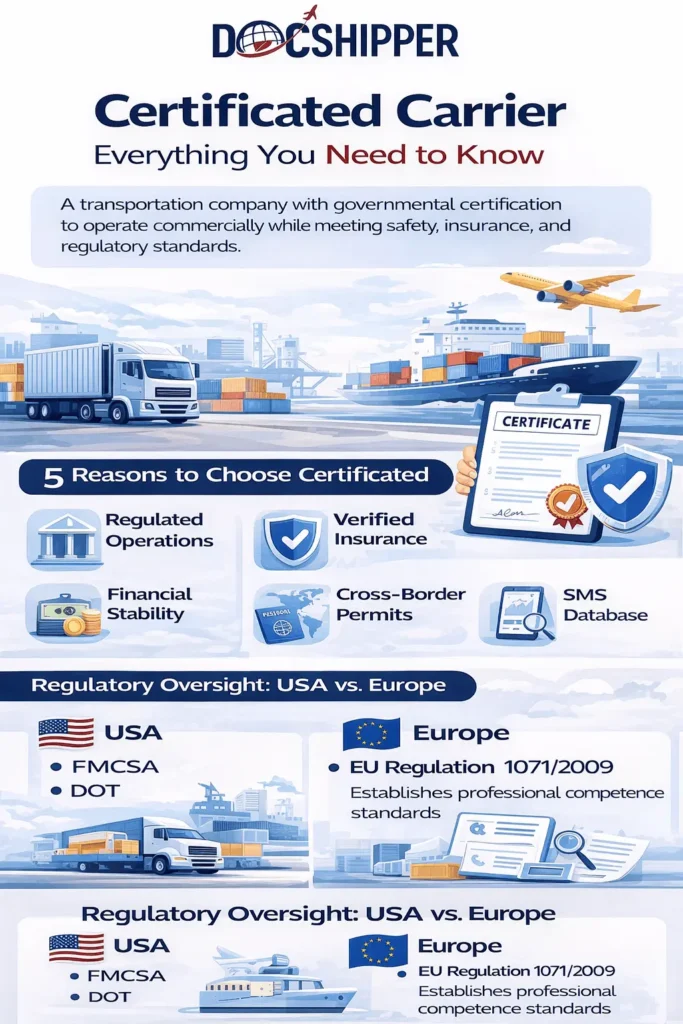
Certification requirements vary by transportation mode and jurisdiction. In the United States, the Federal Motor Carrier Safety Administration (FMCSA) oversees road transport carriers, while maritime operations fall under Coast Guard and Federal Maritime Commission regulations. European carriers must comply with EU Regulation 1071/2009 establishing professional competence standards.
The certification process involves several critical steps. Carriers must demonstrate financial responsibility through bonding or insurance minimums—typically $75,000 for general freight and up to $5 million for hazardous materials in the US. They must also prove professional competence through management qualifications and operational experience.
Operating authority defines the scope of permitted activities. Common carrier certificates allow transportation for any customer, while contract carrier permits restrict services to specific clients under negotiated agreements. International carriers need additional certifications like ATA Carnet authorization or customs bonding.
Regulatory bodies conduct safety compliance reviews examining driver qualifications, vehicle maintenance records, and hours-of-service adherence. Violations can result in certificate suspension or revocation. The FMCSA Safety Measurement System publicly tracks carrier performance metrics.
At DocShipper, we verify carrier certifications before engaging any transportation partner. This due diligence prevents shipment disruptions and ensures your cargo moves through compliant channels from origin to destination.
Practical Applications & Industry Data
Understanding how certification impacts real-world logistics helps businesses make informed carrier selections. The following comparative analysis illustrates key differences between certificated and non-certificated operators.
| Criteria | Certificated Carrier | Non-Certificated Operator |
|---|---|---|
| Insurance Coverage | Minimum $75K–$5M verified | Optional or unverified |
| Regulatory Oversight | Continuous FMCSA/DOT monitoring | None or minimal |
| Liability Limits | Legally defined per regulations | Contractual only (often limited) |
| Safety Record Access | Public SMS database available | No standardized reporting |
| Cross-Border Authority | International permits verified | Typically domestic only |
Use Case: A European electronics manufacturer shipping components to Mexico faced a critical decision. Option A involved a certificated carrier with FMCSA and CTPAT certification charging $4,200 for door-to-door service. Option B offered a non-certificated broker at $3,100 using undisclosed subcontractors.
The manufacturer chose Option A. During transit, customs flagged the shipment for inspection. The certificated carrier’s C-TPAT status reduced inspection time from 48 hours to 6 hours, preventing production line delays. The $1,100 premium paid for certification saved an estimated $28,000 in downtime costs.
Industry data reveals certificated carriers maintain a 97.3% on-time delivery rate compared to 84.1% for unregulated operators (2023 Logistics Management Survey). Cargo insurance claims are processed 40% faster when certificated carriers are involved, as documentation standards meet insurer requirements.
For hazardous materials, certification is non-negotiable. The DOT Hazmat Registration requires carriers to demonstrate specialized training, equipment standards, and emergency response capabilities. Non-compliance results in fines up to $75,000 per violation and potential criminal liability.
DocShipper maintains partnerships exclusively with certificated carriers across our global network. This ensures every shipment benefits from regulatory protections and insurance coverage, regardless of origin or destination complexity.
Conclusion
Certificated carriers provide the legal framework and operational reliability essential for modern international logistics. Their regulatory compliance protects your business from liability while ensuring shipment security throughout the supply chain.
Need assistance verifying carrier credentials or managing complex international shipments? Contact DocShipper for expert guidance on selecting certified logistics partners tailored to your specific requirements.
📚 Quiz
Test Your Knowledge: Certificated Carrier
Q1 — What is the defining characteristic of a Certificated Carrier?
Q2 — A common misconception is that a Certificated Carrier and a freight forwarder are the same thing. What is the key difference?
Q3 — A European manufacturer needs to ship hazardous materials from the US to Mexico. Which option best demonstrates the value of using a certificated carrier in this scenario?
🎯 Your Result
📞 Free Quote in 24hFAQ | Certificated Carrier: Definition, Requirements & Practical Examples
A certificated carrier physically transports goods using owned or leased vehicles under regulatory authority. A freight forwarder arranges transportation through third-party carriers without operating transport assets themselves.
Use the FMCSA's SAFER database (safer.fmcsa.dot.gov) for US carriers. Enter the DOT number or company name to access operating authority, insurance status, and safety ratings instantly.
No. Maritime carriers operate under different frameworks like Federal Maritime Commission (FMC) licensing in the US or IMO conventions internationally. Requirements focus on vessel safety and environmental standards rather than driver qualifications.
Regulatory agencies typically provide grace periods for existing shipments. However, the carrier cannot accept new loads. Your contract should include clauses addressing certification lapses and alternative carrier arrangements.
Yes. Cross-border operations require authorization in each jurisdiction. For example, US-Mexico transport needs both FMCSA operating authority and Mexican SCT permits, plus customs bonding in both countries.
Initial FMCSA registration costs approximately $300 for the Unified Carrier Registration plus $1,500-$8,000 annually for required insurance bonds. Total startup costs including safety compliance often exceed $15,000.
Private carriers transporting their own goods may operate without common carrier certification in some jurisdictions. However, any for-hire transportation of third-party cargo requires proper operating authority.
US requirements range from $750,000 for general freight to $5 million for hazardous materials. International shipments may require higher limits based on cargo value and destination country regulations.
Roadside inspections occur randomly, while comprehensive compliance reviews happen every 12-18 months for high-risk carriers. Low-risk operators may go 3-5 years between full audits depending on safety scores.
Yes. Air carriers must obtain FAA Part 135 or 121 certification focusing on aircraft airworthiness, pilot qualifications, and maintenance standards. TSA security certifications are also mandatory for cargo operations.
Certificated carriers are liable under the Carmack Amendment (US) or CMR Convention (Europe) with defined claim procedures. Their mandatory insurance provides recovery mechanisms that unregulated operators cannot guarantee.
No. Operating authority is non-transferable. The acquiring company must apply for new certification, though existing safety records may influence approval timelines and conditions imposed by regulators.
Need Help with
Logistics or Sourcing ?
First, we secure the right products from the right suppliers at the right price by managing the sourcing process from start to finish. Then, we simplify your shipping experience - from pickup to final delivery - ensuring any product, anywhere, is delivered at highly competitive prices.


Fill the Form
Prefer email? Send us your inquiry, and we’ll get back to you as soon as possible.
Contact us


