


In short ⚡
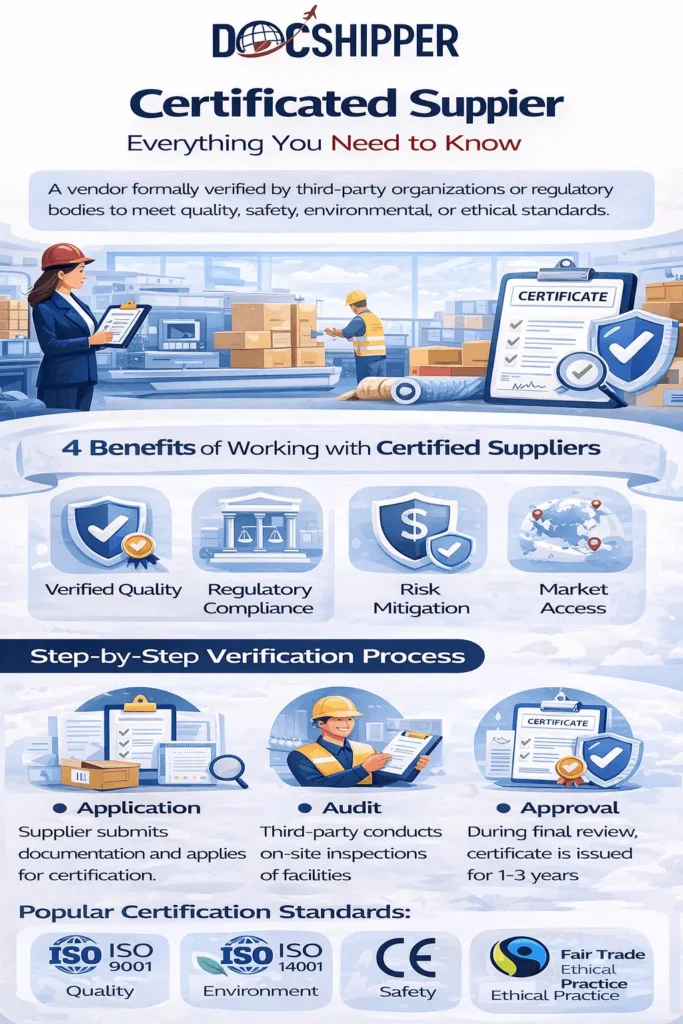
A Certified Supplier is a vendor that has undergone formal verification by third-party organizations or regulatory bodies to demonstrate compliance with specific quality, safety, environmental, or ethical standards. This certification provides buyers with documented assurance that the supplier meets predetermined criteria for production, management systems, or business practices.
Introduction
In international trade, one critical question haunts importers: How do I know my supplier truly meets quality and compliance standards? Unverified suppliers represent significant risks including product defects, regulatory violations, and reputational damage. This uncertainty costs businesses millions annually in rejected shipments and legal complications.
Certified suppliers address this challenge by providing independently verified credentials. In global supply chains where physical audits are expensive and time-consuming, certification acts as a trust mechanism. It transforms subjective supplier claims into objective, verifiable credentials.
Key characteristics of certified suppliers include:
- Third-party validation by accredited certification bodies
- Documented compliance with international or industry-specific standards
- Regular audits and renewal requirements to maintain certification status
- Traceability through certificate numbers and public registries
- Risk mitigation for importers regarding quality, safety, and legal compliance
Certification Standards & Verification Process
Supplier certification operates through standardized frameworks established by international organizations. The most recognized certifications fall into several categories, each addressing different supply chain concerns.
ISO certifications represent the gold standard for management systems. ISO 9001 verifies quality management processes, while ISO 14001 confirms environmental management practices. These certifications require comprehensive documentation, internal audits, and continuous improvement mechanisms. Suppliers must demonstrate consistent adherence to documented procedures across all operations.
Product-specific certifications validate that goods meet safety and performance standards. CE marking for European markets, UL certification for electrical safety, and FDA registration for food and medical products fall into this category. These certifications often require laboratory testing and ongoing compliance monitoring.
Ethical and social certifications address labor practices and sustainability. SA8000 certification verifies compliance with labor rights, while Fair Trade certification ensures ethical sourcing practices. These standards have gained prominence as consumers demand transparency about production conditions.
The verification process typically involves three stages. First, the supplier submits an application with documentation demonstrating preliminary compliance. Second, an accredited auditor conducts on-site inspections, reviewing facilities, processes, and records. Third, the certification body reviews audit findings and issues certificates valid for specific periods, usually one to three years.
At DocShipper, we systematically verify supplier certifications before initiating procurement relationships, cross-referencing certificate numbers with official registries to prevent fraudulent credentials. This due diligence protects our clients from compliance failures that could halt customs clearance or trigger product recalls.
For authoritative information on international standards, consult the International Organization for Standardization (ISO), which maintains comprehensive databases of accredited certification bodies and standard requirements.
Practical Examples & Industry Data
Understanding certification impact requires examining real-world scenarios. Consider the electronics manufacturing sector, where certification directly affects market access and buyer confidence.
Comparative Analysis: Certified vs. Non-Certified Suppliers
| Criteria | Certified Supplier | Non-Certified Supplier |
|---|---|---|
| Quality Defect Rate | 0.5-2% (industry average) | 5-15% (estimated range) |
| Customs Clearance Issues | Minimal (documentation verified) | Frequent delays for verification |
| Audit Transparency | Full documentation available | Limited or self-reported data |
| Market Access | Global (certification recognized) | Restricted (additional testing required) |
| Price Premium | 5-15% higher unit cost | Lower initial cost |
Use Case: Medical Device Importation
A European importer required surgical instruments from an Asian manufacturer. The certified supplier held ISO 13485 (medical device quality management) and CE marking. This certification enabled:
- Direct market entry: Products cleared customs in 48 hours with certificate verification
- Reduced testing costs: €15,000 saved by avoiding redundant quality testing
- Insurance compliance: Product liability insurance secured at standard rates
- Regulatory confidence: No additional documentation required by health authorities
- Supply chain efficiency: Quarterly audits replaced continuous monitoring needs
Industry data from the Global Trade Compliance Association indicates that certified suppliers reduce compliance-related delays by 73% compared to non-certified alternatives. The initial price premium typically generates ROI within 18-24 months through reduced defect rates, faster customs processing, and lower quality control expenses.
For textile imports, OEKO-TEX certification provides another concrete example. This standard tests for harmful substances in fabrics. Retailers increasingly require this certification, with 68% of European fashion brands mandating it for suppliers as of 2023. Non-certified suppliers face market exclusion regardless of price competitiveness.
Conclusion
Certified suppliers transform supply chain risk management from reactive problem-solving to proactive quality assurance. The documented compliance they provide serves as both operational insurance and competitive advantage in regulated markets.
Need guidance on verifying supplier certifications or navigating compliance requirements? Contact DocShipper for expert assistance in supplier validation and international procurement.
📚 Quiz
Test Your Knowledge: Certified Supplier
Q1 — What does it mean for a supplier to be "certified"?
Q2 — A common misconception about certified suppliers is that their certification permanently guarantees every shipment is compliant. What is the correct interpretation?
Q3 — A European importer needs to source surgical instruments from Asia. Which scenario best illustrates the practical advantage of choosing a certified supplier?
🎯 Your Result
📞 Free Quote in 24hFAQ | Certified Supplier: Definition, Verification & Practical Examples
Certification applies to suppliers demonstrating standard compliance. Accreditation applies to the certification bodies themselves, verifying their competence to issue certificates. Only accredited bodies can issue internationally recognized certifications.
Check the certificate number against the issuing body's official registry. Verify the certification body is accredited by recognized organizations like IAF or ILAC. Request recent audit reports and confirm expiration dates.
Initial unit prices typically run 5-15% higher, but total cost of ownership often decreases due to lower defect rates, reduced inspection needs, and faster customs clearance. Long-term savings frequently offset premium pricing.
Priority depends on product category and destination market. ISO 9001 provides broad quality assurance. Product-specific certifications like CE, UL, or FDA registration address regulatory requirements. Industry standards like BSCI or SA8000 satisfy ethical sourcing demands.
Yes. Certifications require renewal through periodic audits, typically every 1-3 years. Non-compliance discovered during surveillance audits, customer complaints, or regulatory violations can trigger suspension or revocation.
Both serve different purposes. ISO certifications demonstrate management system competence. Industry-specific certifications prove technical compliance with sector requirements. Many buyers require both for comprehensive supplier qualification.
Initial certification typically requires 3-6 months including documentation preparation, gap analysis, corrective actions, and formal audit. Timeline varies based on organization size, standard complexity, and existing compliance level.
International standards like ISO enjoy global recognition, but product certifications vary by market. CE marking applies to European Economic Area, while FCC certification covers US electronics. Research destination market requirements before supplier selection.
Certification doesn't guarantee every shipment meets standards, only that management systems exist to ensure compliance. Buyers should still conduct incoming inspections. Repeated non-compliance can trigger certification body investigations and potential revocation.
Certification costs scale with organization size. Small suppliers may start with basic certifications before pursuing comprehensive standards. Group certification programs and government subsidies in some regions reduce financial barriers.
Recognized certifications expedite clearance by providing pre-verified compliance documentation. Customs authorities accept certified test reports and quality documentation, reducing physical inspection frequency and processing delays.
Certification requirements depend on product risk, regulatory environment, and buyer policies. High-risk products (medical, food, children's items) typically mandate certification. Low-risk commodities may not require formal certification if other quality assurance mechanisms exist.
Need Help with
Logistics or Sourcing ?
First, we secure the right products from the right suppliers at the right price by managing the sourcing process from start to finish. Then, we simplify your shipping experience - from pickup to final delivery - ensuring any product, anywhere, is delivered at highly competitive prices.


Fill the Form
Prefer email? Send us your inquiry, and we’ll get back to you as soon as possible.
Contact us


