


In short ⚡
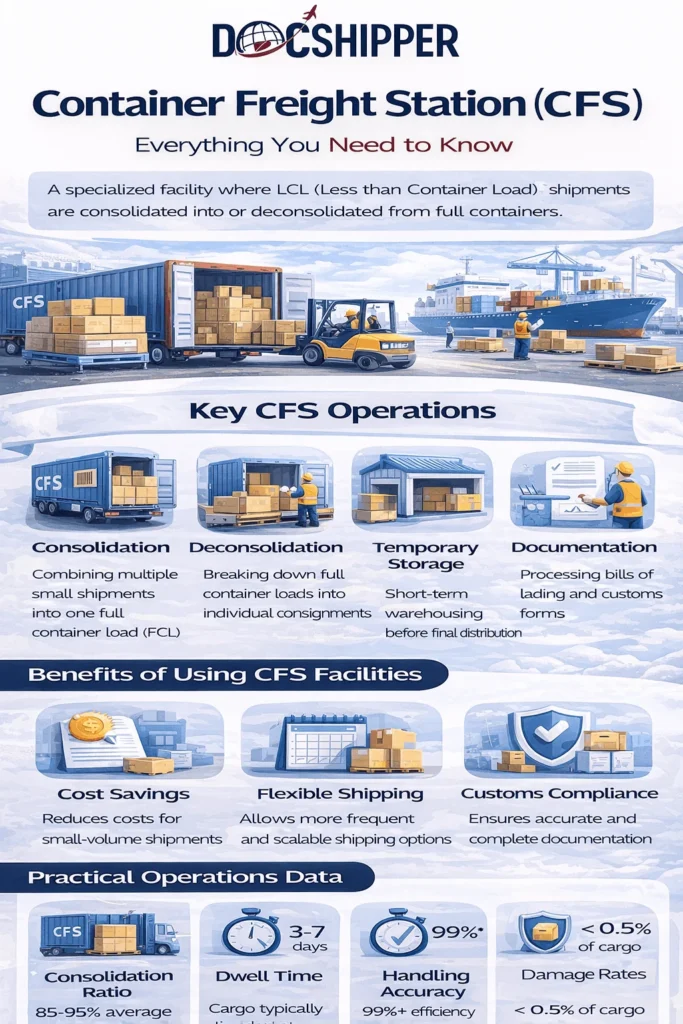
A Container Freight Station (CFS) is a specialized warehouse facility where Less than Container Load (LCL) shipments are consolidated into full containers for export or deconsolidated from containers for import distribution. This critical node in international logistics enables cost-effective shipping for cargo volumes that don't justify full container utilization.
Introduction
Many importers and exporters struggle with a common dilemma: their cargo volume is too small to fill an entire container, yet they need reliable international shipping. This is where the Container Freight Station becomes indispensable.
In global supply chains, CFS facilities serve as consolidation hubs that bridge the gap between small-volume shippers and ocean carriers. These warehouses handle the complex logistics of combining multiple shipments, managing customs documentation, and ensuring proper container loading.
Key characteristics of CFS operations include:
- Consolidation services – Combining multiple LCL shipments into Full Container Load (FCL)
- Deconsolidation – Breaking down FCL shipments into individual consignments
- Cargo handling – Palletizing, wrapping, labeling, and securing goods
- Documentation management – Processing bills of lading, packing lists, and customs forms
- Temporary storage – Short-term warehousing before container stuffing or after destuffing
CFS Operations & Technical Expertise
The operational framework of a CFS facility involves sophisticated logistics coordination. Upon receiving LCL cargo, the station performs intake inspection, documentation verification, and assigns storage locations based on destination routing and consolidation schedules.
Container stuffing follows strict protocols. Freight forwarders calculate weight distribution to prevent container imbalance during ocean transit. Heavy items are positioned at the bottom, while fragile goods receive protective dunnage. The process adheres to International Maritime Organization (IMO) regulations and Container Safety Convention (CSC) standards.
At destination ports, the deconsolidation process reverses this operation. Containers arrive at the CFS, where personnel unload cargo under customs supervision. Each shipment is segregated, inspected for damage, and prepared for final delivery or customs clearance.
Customs compliance represents a critical CFS function. According to World Customs Organization guidelines, CFS operators must maintain detailed cargo manifests, facilitate inspections, and coordinate with customs brokers. Any discrepancies in documentation can result in shipment detention.
The billing structure for CFS services typically includes handling charges, storage fees (often calculated per cubic meter or weight), and documentation fees. At DocShipper, we systematically verify CFS charges to ensure our clients avoid unexpected costs and maintain transparent pricing throughout the consolidation process.
Practical Examples & Operational Data
Understanding CFS operations becomes clearer through real-world scenarios and comparative analysis. Consider the cost implications for different shipping volumes:
| Cargo Volume | Shipping Method | Typical Cost (Shanghai-Los Angeles) | Transit Time |
|---|---|---|---|
| 2 CBM | LCL via CFS | $180-240 | 25-30 days |
| 15 CBM | LCL via CFS | $1,350-1,800 | 25-30 days |
| 33 CBM (Full 20′ Container) | FCL (Direct) | $2,200-2,800 | 18-22 days |
| 67 CBM (Full 40′ Container) | FCL (Direct) | $3,000-3,800 | 18-22 days |
Use Case: E-commerce Importer
An online retailer in Germany imports electronics from Shenzhen. Their monthly volume averages 8 cubic meters—too small for FCL. By utilizing CFS consolidation services, they ship weekly batches of 2 CBM each. The CFS in Shenzhen combines their cargo with other shipments destined for Hamburg, reducing per-unit shipping costs by approximately 35% compared to air freight alternatives.
Key operational metrics for CFS efficiency include:
- Consolidation ratio – Average container utilization of 85-95% maximizes cost efficiency
- Dwell time – Cargo typically remains at CFS for 3-7 days before container departure
- Handling accuracy – Professional CFS facilities maintain 99%+ accuracy in cargo segregation
- Documentation turnaround – Bills of lading issued within 24-48 hours of container stuffing
- Damage rates – Properly managed CFS operations report cargo damage below 0.5%
Conclusion
The Container Freight Station remains an essential infrastructure component for businesses requiring flexible, cost-effective international shipping solutions. Understanding CFS operations enables importers and exporters to optimize logistics costs while maintaining supply chain reliability.
Need expert guidance on CFS consolidation for your shipments? Contact DocShipper for tailored logistics solutions that streamline your international freight operations.
📚 Quiz
Test Your Knowledge: Container Freight Station (CFS)
Q1. What is the primary function of a Container Freight Station (CFS)?
Q2. A shipper assumes that using a CFS will always result in faster transit times than shipping a full container (FCL). Is this correct?
Q3. A German e-commerce retailer imports 8 CBM of electronics per month from Shenzhen. Which shipping solution best fits their needs?
🎯 Your Result
📞 Free Quote in 24hFAQ | CFS (Container Freight Station): Definition, Operations & Practical Examples
CFS (Container Freight Station) handles LCL cargo consolidation/deconsolidation, while CY (Container Yard) stores full containers. CFS involves cargo handling inside warehouses; CY manages sealed containers in outdoor yards.
Typical dwell time ranges from 3-7 days for export consolidation. Import deconsolidation may take 5-10 days depending on customs clearance speed and consignee pickup schedules.
CFS fees typically include handling charges (per shipment), storage fees (per CBM/day after free time), documentation fees, and sometimes palletization or special packaging costs.
Most modern CFS facilities provide tracking through freight forwarders. You receive notifications when cargo arrives at CFS, during container stuffing, and upon departure to port.
While primarily associated with ocean shipping, some air cargo terminals operate similar consolidation facilities for air freight, though the term "CFS" is less commonly used in aviation.
Essential documents include commercial invoice, packing list, bill of lading instructions, and any certificates (origin, phytosanitary, etc.). Customs-bonded CFS may require additional customs declarations.
Professional CFS operators use dunnage materials, load bars, airbags, and shrink-wrapping. Heavy items are positioned strategically, and weight distribution follows container loading guidelines to prevent shifting.
Document damage immediately with photos and notify your freight forwarder. CFS facilities typically carry cargo liability insurance. Claims must be filed within specified timeframes per your shipping contract.
Only licensed CFS facilities can handle dangerous goods. These require IMDG Code compliance, special segregation, and documentation. Not all CFS locations accept hazardous cargo.
Evaluate facility certifications (ISO, C-TPAT), cargo handling equipment, security measures, customs bonding status, and track record. Established freight forwarders like DocShipper partner with vetted CFS networks globally.
CFS/CFS indicates cargo moves from origin CFS to destination CFS. The freight forwarder consolidates at origin, ships via ocean, then deconsolidates at destination for individual delivery—common for LCL shipments.
Most CFS facilities offer 3-5 free days for export cargo and 5-7 days for imports. Beyond free time, demurrage charges apply, typically $5-15 per CBM per day depending on location.
Need Help with
Logistics or Sourcing ?
First, we secure the right products from the right suppliers at the right price by managing the sourcing process from start to finish. Then, we simplify your shipping experience - from pickup to final delivery - ensuring any product, anywhere, is delivered at highly competitive prices.


Fill the Form
Prefer email? Send us your inquiry, and we’ll get back to you as soon as possible.
Contact us


