Ship’s Bow: Definition & Maritime Guide for 2026

  • admin 8 Min
  • Published on March 17, 2026
img

In short ⚡

The bow is the forward-most part of a ship's hull, designed to cut through water efficiently and reduce resistance. Its shape determines vessel speed, fuel consumption, and seaworthiness. Understanding bow design is essential for maritime logistics professionals optimizing cargo transport.

Introduction

Many logistics professionals overlook how ship design directly impacts delivery schedules and freight costs. The bow isn’t just the “front” of a vessel—it’s a critical engineering element that affects everything from fuel efficiency to cargo safety during rough seas.

In international shipping, bow configuration influences transit times, operational costs, and even regulatory compliance. Container ships, bulk carriers, and tankers each require specific bow designs adapted to their cargo profiles and routes.

  • Hydrodynamic efficiency: Reduces drag and fuel consumption by up to 15%
  • Wave resistance: Prevents cargo damage during adverse weather conditions
  • Speed optimization: Enables faster transit times on competitive trade routes
  • Structural integrity: Withstands collision forces and ice navigation
  • Regulatory compliance: Must meet IMO standards for specific vessel classes

Technical Design & Maritime Engineering

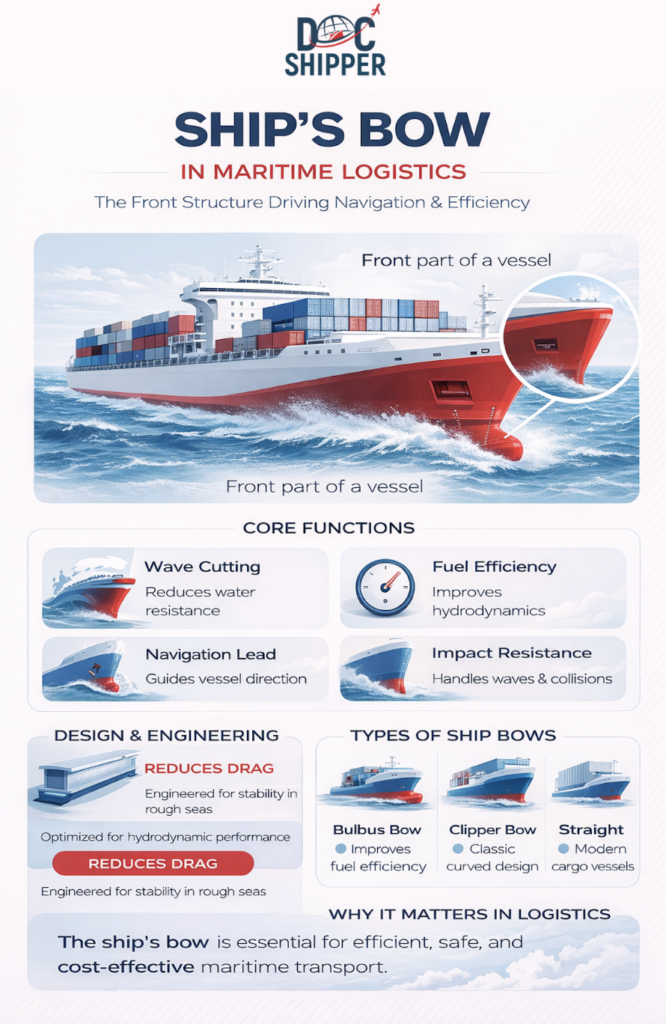
The bow’s geometry directly determines a vessel’s wave-making resistance—the energy lost creating waves as the ship moves. Modern designs employ computational fluid dynamics (CFD) to minimize this effect. The bulbous bow, now standard on 90% of large commercial vessels, creates a secondary wave system that cancels out the primary bow wave.

Naval architects distinguish between several bow types. The clipper bow extends forward with elegant curvature, common on passenger ships prioritizing aesthetics. The raked bow slopes backward, reducing pitching motion in heavy seas. Container ships typically feature vertical bows maximizing cargo capacity while maintaining structural strength.

Ice-class vessels require reinforced bow plating ranging from 25mm to 50mm thickness, compared to 12-18mm on standard hulls. The International Association of Classification Societies (IACS) establishes these specifications through unified requirements governing polar navigation.

The angle of entry—where bow sides meet the waterline—critically affects performance. Sharper angles (15-20°) suit high-speed vessels, while blunter angles (30-40°) provide better stability for heavy cargo operations. At DocShipper, we analyze vessel specifications to match cargo requirements with optimal ship configurations, ensuring your freight travels on the most efficient routes.

Bow thrusters represent another technical consideration. These transverse propulsion units enable precise maneuvering in ports without tug assistance. Modern container terminals increasingly require this capability to maintain tight scheduling windows. The bow flare—the outward curve above the waterline—prevents green water (solid wave masses) from flooding the deck during rough passages.

Ship's bow

Practical Examples & Performance Data

Real-world performance metrics demonstrate the bow’s operational impact. A 2022 study comparing conventional and optimized bow designs on the Asia-Europe route revealed significant differences:

Bow Type Fuel Consumption (tons/day) Average Speed (knots) Transit Time (days)
Conventional Vertical 185 19.5 32
Optimized Bulbous 162 20.8 29
Axe Bow (Ice-Class) 178 18.2 35

The optimized bulbous bow achieved 12.4% fuel savings and reduced transit time by three days—equivalent to $47,000 per voyage in operational costs for a 14,000 TEU vessel at 2023 bunker prices.

Case Study: A European automotive manufacturer shipping components from Shanghai to Rotterdam faced consistent delays during winter months. Analysis revealed their contracted vessel’s conventional bow design struggled with North Atlantic swells. By switching to a carrier with an advanced X-Bow design (inverted bow reducing pitching by 30%), they achieved 94% on-time delivery versus the previous 78% rate.

Ice-breaking operations demonstrate extreme bow performance requirements. The Russian nuclear icebreaker Arktika features a spoon-shaped bow capable of crushing 3-meter ice at continuous speeds of 2 knots. Commercial vessels transiting the Northern Sea Route require less extreme but still specialized bow reinforcement—typically adding 8-12% to hull construction costs but enabling access to routes 40% shorter than Suez Canal alternatives.

  • Bulbous bow retrofit: $800,000-$1.2M investment, payback period 18-24 months through fuel savings
  • Bow thruster installation: Reduces port time by 25-35 minutes per call
  • Ice-class bow upgrade: Opens Arctic routes saving 10-14 days on Asia-Europe transits
  • Flare optimization: Decreases deck cargo damage by up to 40% in heavy weather
  • Hydrodynamic testing: Modern CFD analysis costs $50,000-$80,000 but identifies 5-8% efficiency gains

Conclusion

The ship’s bow represents far more than aesthetic design—it’s a critical factor determining freight costs, delivery reliability, and cargo safety. Optimized bow configurations deliver measurable operational advantages in competitive global logistics.

Need expert guidance on vessel selection or route optimization for your international shipments? Contact DocShipper for tailored maritime logistics solutions.

📚 Quiz
Test Your Knowledge: Ship's Bow

FAQ | Bow (Ship's Bow): Definition, Technical Features & Practical Examples

The bow cuts through water to minimize resistance, enabling efficient forward motion. Its shape determines fuel consumption, speed capability, and vessel stability in various sea conditions.

Ask us anything!

Need Help with Logistics or Sourcing ?

First, we secure the right products from the right suppliers at the right price by managing the sourcing process from start to finish. Then, we simplify your shipping experience - from pickup to final delivery - ensuring any product, anywhere, is delivered at highly competitive prices.

Live Chat

Get instant assistance from our team—just click and start chatting!

Live Chat Now
image

Fill the Form

Prefer email? Send us your inquiry, and we’ll get back to you as soon as possible.

Contact us
image

Call us

Reach out to us on WhatsApp for quick, convenient, and personal support.

Call us
image