In short ⚡
Sea transport offers low-cost, scalable international shipping, especially for heavy, bulky, and non-urgent cargo, while providing broad access to global ports and trade lanes.
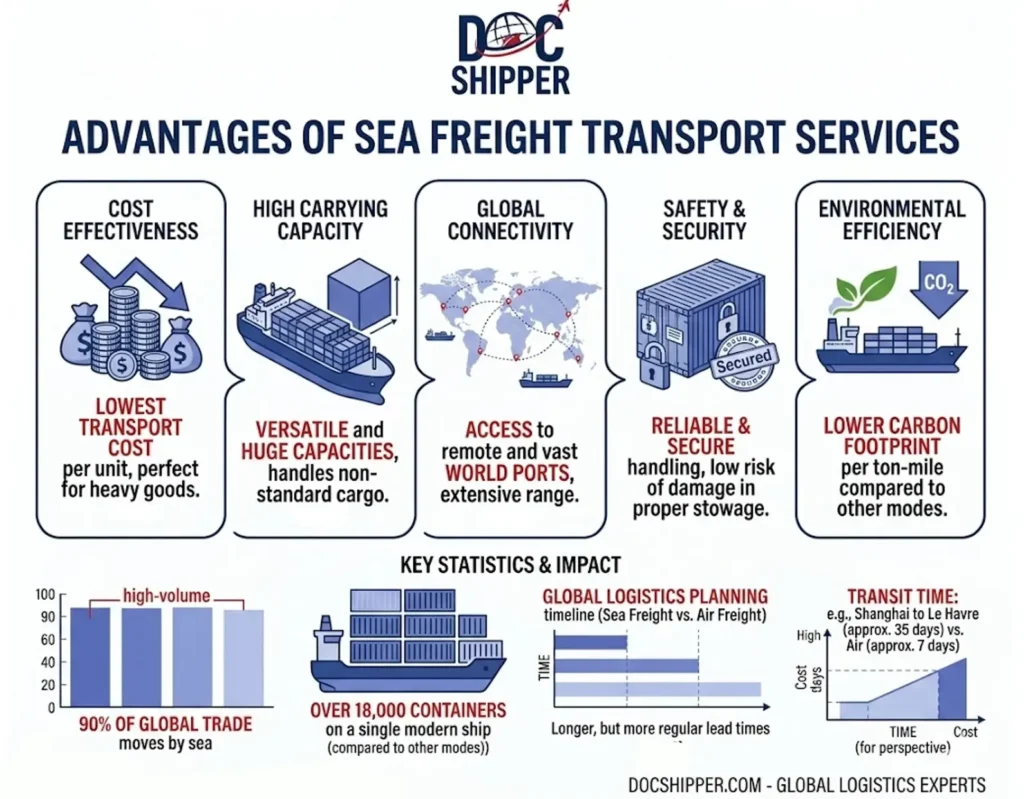
It combines lower cost per ton, the ability to handle large volumes and oversized cargo, flexible options like FCL/LCL, and a lower carbon footprint than air and long-haul road freight.
We hope you’ll find this article genuinely useful, but remember, if you ever feel lost at any step, whether it’s finding a supplier, validating quality, managing international shipping or customs, DocShipper can handle it all for you!
What sea transport is and how it supports global trade
Sea transport is the backbone of cross-border trade, it’s how your cargo moves between continents through a network of ports, carriers, and freight forwarding partners.
When you’re weighing the advantages of sea transport, you’re really looking at a system built for scale, predictable processes, and standardized documentation that keeps imports and exports flowing.
Here’s the thing, most supply chains quietly depend on ocean lanes more than people realize, and the UNCTAD regularly highlights just how much global trade volume is carried by sea.
DocShipper Info
Need clarity on Incoterms, booking, and bills of lading?
Our experts structure your sea freight flow end to end.
How sea freight works in the supply chain
Last year, we saw a buyer panic because the factory said “goods shipped”, but nothing showed in tracking, the truth was simple: the container was gated in, but the bill of lading hadn’t been issued yet.
That’s a classic moment where understanding sea freight removes stress and helps you control your shipment timeline.
To make the advantages of sea transport real in your day-to-day logistics, you need to know the chain of custody from pickup to port handling to discharge.
Use this quick workflow to visualize what “ocean shipping” actually looks like in your supply chain:
- Procurement confirms specs, packaging, and delivery terms (Incoterms like FOB, CIF, DDP)
- Supplier prepares the consignment, labeling, palletization, and packing list
- Pickup to warehousing or directly to port, with load optimization if you consolidate
- Export customs clearance, including harmonized system code classification, compliance checks, and export declarations
- Carrier booking, freight rate confirmation, and carrier contract validation
- Container containerization and port handling (gate-in, VGM, cut-off deadlines)
- Ocean leg with tracking and tracing milestones
- Import customs clearance, calculating customs duties, tariff impacts, and value-added tax
- Delivery to your DC, 3PL, or fulfillment center, then last-mile delivery if needed
And yes, you’ll hear “AWB” in transport meetings, but that’s for an airway bill, in ocean freight your key title document is the bill of lading.
From experience, the fastest wins come from aligning Incoterms with who controls export filing, booking, and insurance, not from chasing a slightly cheaper freight quote.
Before you approve the booking, run this short checklist to reduce surprises in sea freight forwarding:
- Confirm Incoterms and who pays origin charges, THC, and destination fees
- Verify HS code and whether permits or inspections apply for customs clearance
- Match commercial invoice values to payment terms to avoid compliance flags
- Decide on cargo insurance coverage level (don’t assume “carrier liability” protects you)
- Lock packaging standards to prevent damage and reduce claims disputes
Main types of sea cargo and vessels
Direct tip: if you can name your cargo type precisely, you’ll negotiate a cleaner freight rate and avoid “mystery surcharges” later.
One reason the advantages of sea transport are so strong is that ocean shipping offers specialized vessels for almost every product category in your import export flow.
This table helps you match common cargo with the right ocean solution:
| Cargo type | Typical vessel / service | Operational notes |
| Containerized goods (cartons, pallets, retail stock) | Container ship (FCL/LCL) | Best for standardized containerization, easier tracking and tracing, predictable port handling |
| Raw materials (grain, ore, coal) | Bulk carrier | Optimized for high volume, watch moisture specs and sampling, quality disputes can happen at discharge |
| Liquids (chemicals, edible oils, fuels) | Tanker or ISO tank container | Strong compliance requirements, documentation accuracy matters for customs and safety |
| Vehicles and rolling equipment | Ro-Ro (roll-on/roll-off) | Great for drivable cargo, but you must control accessory security and condition reporting |
| Oversized machinery, project cargo | Breakbulk / heavy-lift vessel | Requires lifting plans, lashing surveys, and careful scheduling with terminals |
| Temperature-controlled goods | Reefer container | Power monitoring is critical, plus pre-trip inspection and contingency planning at transshipment ports |
You’ll notice fast that cargo classification impacts more than the ship choice, it affects customs clearance, trade regulations, insurance requirements, and even your warehousing plan on arrival.
DocShipper Advice
Unsure between FCL, bulk, RoRo, or reefer?
We help you match cargo type with the optimal ocean solution.
Why sea transport cuts your logistics costs
If you’re chasing the advantages of sea transport, cost is usually the first reason, ocean freight often delivers the lowest unit economics when your shipment isn’t urgent.
You’ve probably dealt with quotes that look cheap until destination charges appear, the real savings come from controlling the whole cost stack, not only the ocean line item.
In cost benchmarking conversations, the World Bank logistics indicators often come up because port performance and border processes directly shape your landed cost.
Lower cost per ton for long-distance shipping
Bold truth: if you’re moving weight or cubic meters across oceans, air won’t “compete”, it will just punish your margin.
The advantages of sea transport show up in your cost per ton and cost per cubic meter, especially when you move full loads and plan inventory properly.
We’ve seen importers cut total landed cost simply by switching from frequent small air shipments to a monthly ocean plan tied to inventory management and a local 3PL.
To see where the savings actually come from, focus on these cost drivers:
- Freight rate spread over more volume with FCL or well-built consolidation
- Better load optimization and carton engineering, fewer “shipped air” voids in the container
- Lower handling cost per unit at origin when you standardize pallet sizes
- More predictable freight brokerage and carrier contracting when you commit volume
- Reduced expediting costs because you plan around vessel schedules
Just don’t ignore financing, longer transit means cash is tied up, so align purchase terms and reorder points with the sailing calendar.
DocShipper Info
Want a full landed cost breakdown?
We benchmark your ocean freight to eliminate hidden fees.
When sea freight beats air and road on price
When does ocean win on price, and when does it disappoint you, that’s the question most importers get stuck on.
As a rule, the advantages of sea transport dominate when your cargo is dense, non-urgent, and you can tolerate port-to-door variability.
We once watched a brand insist on air for “speed”, then lose a week anyway due to a missing battery compliance document, that was an expensive lesson in choosing the right mode and getting paperwork right.
Use this comparison table to pick the cheapest realistic option for your shipment profile:
| Mode | Where it usually wins | Typical hidden cost traps |
| Sea freight | Long distance, heavy or bulky cargo, steady replenishment | Destination charges, demurrage and detention, port congestion, weak Incoterms setup |
| Air freight | Urgent, high-value, low-volume, tight launch dates | Dimensional weight, security screening, capacity peaks, strict documentation |
| Road freight | Regional moves, cross-border trucking within a continent | Border delays, driver constraints, fuel volatility, limited oversized options |
If you want to lock in savings, coordinate your customs clearance plan early and treat destination handling as part of the sourcing decision, not an afterthought.
DocShipper Alert
Not sure if sea beats air for your shipment?
We compare total cost and risk before you book.
How sea freight handles large volumes and oversized cargo
The advantages of sea transport get really obvious the moment you need to move serious volume, ocean shipping was built for scale.
If your supplier says “we can only ship partials”, you’re not stuck, you can redesign the shipment plan with consolidation, container loading strategy, and the right service level.
Industry standards from ISO influence container dimensions and handling norms, which is why consistent packaging and labeling makes such a difference at terminals.
High-capacity container and bulk shipping
We’ve seen a simple mistake ruin a “cheap” sea plan: cartons were too weak, the bottom layers collapsed, and the container arrived looking like a landslide.
That’s why the advantages of sea transport depend on how you prepare the cargo, not only on the vessel capacity.
Here’s a practical workflow you can follow to ship high volumes without chaos:
- Choose service: FCL for maximum control, or LCL if you’re consolidating
- Define loading plan with your freight forwarding agent, include pallet pattern and dunnage
- Confirm container type, dry, reefer, open top, flat rack
- Book early around peak season to protect space and rates
- Set inbound plan for warehousing and receiving slots to avoid detention
You’ll reduce damage, speed up unloading, and keep your fulfillment calendar predictable.
Before loading, use this quick checklist to protect your large-volume ocean shipment:
- Validate carton strength and moisture protection for long transit
- Standardize palletization and label each pallet with SKU and carton count
- Photograph stuffing and seal number, keep it with your documentation set
- Confirm who issues the bill of lading instructions and deadlines
- Align inventory management reorder points with sailing and discharge dates
DocShipper Advice
Planning FCL or consolidation?
We optimize container plans to reduce damage, detention, and delays.
Moving oversized, heavy, and special cargo by sea
Direct tip: if your cargo is oversized, start with the lifting points and center of gravity, not with the freight quote.
The advantages of sea transport extend to project cargo, heavy machinery, and non-containerized moves that would be impractical by air.
We’ve helped shippers avoid a costly rework when a supplier built a wooden cradle that didn’t match the port’s lifting equipment, a one-hour design review would’ve prevented it.
To keep heavy lifts under control, watch these operational risk areas:
- Port handling feasibility, crane capacity, booking windows, terminal restrictions
- Lashing and securing plan, survey requirements, weather tolerance during loading
- Route survey for inland pre-carriage and last-mile delivery (bridges, permits, escorts)
- Insurance scope, make sure cargo insurance covers lift-on/lift-off operations
Safety and reliability advantages of sea transport
One underrated part of the advantages of sea transport is how structured the system is, it’s built around repeatable procedures, standardized documents, and mature safety rules.
You’ve probably dealt with suppliers who “ship first, explain later”, the ocean process forces clearer milestones and responsibilities if you set it up well.
Global frameworks from the IMO shape maritime safety, and those standards cascade down to carriers, terminals, and packing requirements.
International regulations and secure containerization
We once saw a container held because the seal number on the documents didn’t match the physical seal, not fraud, just sloppy coordination between the factory and trucker.
That incident wiped out the reliability benefits the shipper expected from the advantages of sea transport.
To keep your shipments compliant and secure, focus on these documentation and control points:
- Accurate bill of lading instructions, shipper/consignee, HS codes, weights, marks
- Verified gross mass submission and cut-off compliance
- Consistent containerization standards, bracing, dunnage, moisture control
- Clear incoterms so responsibilities for export filing and port charges don’t blur
Before the container gates in, run this checklist to avoid preventable holds:
- Match seal number across stuffing photos, trucking note, and draft B/L
- Validate product description vs invoice to reduce customs queries
- Confirm compliance documents, MSDS if applicable, test reports if regulated
- Align customs clearance broker data fields with your commercial documents
- Decide on insurance and keep the policy accessible to your 3PL team
Transporting hazardous and sensitive goods safely
Are you shipping batteries, chemicals, cosmetics, or anything temperature-sensitive, and wondering if ocean is “safe enough”?
It can be, and the advantages of sea transport include specialized equipment and mature handling protocols, but only if your classification and packing are correct.
We’ve seen a lithium shipment delayed because the UN number was right but the packaging label was outdated, small detail, big consequences at the terminal gate.
Use this step-by-step workflow to move sensitive or dangerous cargo with fewer surprises:
- Classify goods correctly, include UN number, packing group, and required labels
- Confirm carrier acceptance rules early, some lines restrict certain DG classes
- Prepare documentation set, MSDS, DG declaration, invoices, packing list, permits
- Choose equipment, reefer, ventilated container, or ISO tank when needed
- Plan multimodal transport to destination with a controlled handoff to trucking and warehousing
If you’re unsure, we can sanity-check the classification and documentation with your forwarder setup so your shipment doesn’t get stopped at the worst possible moment.
Environmental benefits of choosing sea freight
When you look at the advantages of sea transport, the environmental angle quickly becomes hard to ignore. If you’re under pressure to reduce your supply chain emissions, sea freight is often your most realistic lever for large-volume international trade.
You’ve probably been asked by clients or partners about your carbon footprint. Choosing ocean shipping over air is often the first concrete answer you can give.
Lower carbon footprint than other transport modes
A few years ago, we supported a client importing furniture from Asia who switched from air to sea freight after calculating emissions per shipment. The result was clear, their CO2 output dropped dramatically while costs fell at the same time. That’s one of the strongest advantages of sea transport when sustainability matters.
According to data highlighted by the International Maritime Organization, maritime transport emits significantly less CO2 per ton-kilometer than air freight and generally less than long-haul road transport. For you, that means moving higher volumes with a lower carbon intensity.
To make it concrete, here’s a simplified comparison:
| Mode of Transport | CO2 Emissions per Ton-Km | Best Use Case |
| Air Freight | Very High | Urgent, high-value goods |
| Road Freight | Medium | Regional and last-mile |
| Sea Freight | Low | Long-distance, high-volume cargo |
If you ship full containers over intercontinental routes, ocean freight becomes one of the most environmentally efficient solutions available at scale.
DocShipper Info
Looking to quantify CO2 savings on sea freight?
We provide emission estimates and greener routing options.
Ongoing innovations toward greener shipping
Here’s what many importers overlook, the maritime industry is actively transforming itself. You’re not just choosing a lower-emission mode today, you’re also benefiting from continuous improvements.
Carriers are investing in LNG-powered vessels, biofuels, methanol propulsion, and wind-assisted technologies. Slow steaming strategies, better hull designs, and digital route optimization are also cutting fuel consumption.
If you want to assess how green your shipments really are, start with this quick checklist:
- Ask your carrier for CO2 emission reports per shipment.
- Check whether vessels use alternative fuels or energy-efficient technologies.
- Prioritize direct routes to reduce transshipment emissions.
- Consider carbon offset programs for unavoidable emissions.
From experience, you’ll see that simply switching to optimized sea freight lanes can already improve your sustainability reporting without disrupting your supply chain.
Global reach and flexible service options
Another major reason behind the advantages of sea transport is its unmatched global reach. If you source from Asia, manufacture in Europe, and distribute in North America, sea freight connects it all.
You’re not limited to a few hubs. You’re tapping into a dense network of ports and trade lanes that handle the bulk of global merchandise trade.
Looking for a Reliable Shipping & Sourcing Partner?
DocShipper Platform
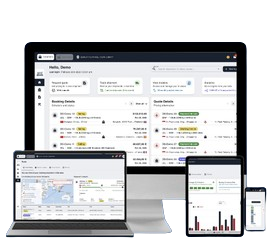
One platform. Your entire supply chain
Sourcing, freight, customs & documents — all centralised, all visible, 24/7.
Access to worldwide ports and trade lanes
We once handled a shipment for a client expanding into West Africa, a region they thought was “hard to reach.” In reality, established maritime corridors and major container ports made the operation smoother than expected. That’s the quiet power behind the advantages of sea transport.
According to UNCTAD, over 80 percent of global merchandise trade by volume moves by sea. That means you can access:
- Major container hubs in Asia, Europe, and North America.
- Emerging markets via regional feeder services.
- Specialized terminals for bulk, RoRo, and project cargo.
If you plan your Incoterms correctly and align port selection with your final destination, you’ll optimize both transit time and inland costs.
DocShipper Advice
Expanding to new markets?
We design port-to-door strategies aligned with your sourcing model.
FCL, LCL, and consolidation for different shipment sizes
Do you really need a full container every time you ship? Not necessarily.
With FCL you book an entire container, which gives you better control, faster handling, and lower risk of damage. With LCL, you share container space and only pay for the volume you use. Consolidation services allow you to group multiple suppliers into one shipment.
Here’s a quick comparison to guide your decision:
| Option | Best For | Main Advantage |
| FCL | Large volumes | Security and cost efficiency per unit |
| LCL | Smaller shipments | Lower upfront freight cost |
| Consolidation | Multiple suppliers | Optimized container utilization |
When we manage supplier consolidation in China, you immediately reduce fragmented shipments and gain better visibility across your purchase orders.
When sea freight is not the best choice
Let’s be honest, despite the many advantages of sea transport, it’s not always the right answer. If you ignore its limits, you’ll expose your supply chain to delays and opportunity costs.
You need to recognize when another mode fits better.
Time-sensitive, perishable, and high-value cargo limits
We’ve seen importers attempt to ship urgent electronics by sea to save money, only to miss a product launch window. The savings on freight were minor compared to lost sales.
Sea freight involves longer transit times, often several weeks on intercontinental routes. If your cargo is:
- Highly perishable with short shelf life.
- Time-critical for seasonal or promotional sales.
- Extremely high in value and sensitive to delays.
Air freight might protect your margins better, even at a higher cost per kilogram.
Weather, port congestion, and last-mile constraints
Sea freight is powerful, but it’s not immune to disruption.
Storms, geopolitical tensions, port congestion, and customs bottlenecks can extend transit times. You’ve probably followed headlines about major ports facing weeks of backlog, and those delays ripple through your inventory planning.
Before confirming ocean shipping, ask yourself:
- Can your inventory buffer absorb a 1 to 2 week delay?
- Is your destination port known for congestion?
- Do you have reliable inland transport arranged?
If your answer is no to most of these, you may need a multimodal strategy instead of pure sea freight.
DocShipper Alert
Facing tight launch or perishable constraints?
We assess multimodal alternatives before delays impact revenue.
How to decide if sea transport fits your logistics strategy
Understanding the advantages of sea transport is one thing. Deciding whether it aligns with your specific logistics model is another.
This is where you move from theory to operational strategy.
Key factors to compare with air, road, and rail
What should you really compare before choosing sea freight?
You’ll want to evaluate these dimensions side by side:
- Total landed cost, including freight, insurance, duties, and inland transport.
- Transit time and its impact on inventory turnover.
- Risk exposure, including damage and delay probability.
- Carbon footprint and ESG commitments.
If you structure your decision around these criteria, you’ll see clearly when sea freight dominates and when it doesn’t.
Practical tips to optimize your ocean shipments
Here’s a bold truth, most inefficiencies in sea freight come from poor preparation, not from the ocean itself.
To maximize the advantages of sea transport, follow this simple workflow:
- Step 1: Forecast volumes accurately and book early during peak seasons.
- Step 2: Choose the right Incoterm to control costs and responsibilities.
- Step 3: Verify supplier packaging and container loading plans.
- Step 4: Arrange cargo insurance adapted to your product risk profile.
- Step 5: Monitor shipment milestones and anticipate customs clearance.
When we guide clients through this structured approach, their ocean freight operations become predictable and cost-efficient rather than reactive.
Conclusion
The advantages of sea transport go far beyond simple cost savings. You gain scalability, global access, environmental benefits, and flexible service options that support long-term growth.
To wrap it up, here are the key takeaways you should remember:
- Sea freight offers lower cost per ton and lower emissions for long distances.
- You can move massive volumes and oversized cargo efficiently.
- Flexible solutions like FCL and LCL adapt to your shipment size.
- It’s not ideal for urgent or highly time-sensitive goods.
- A structured comparison with other modes ensures the right strategic fit.
If you align these elements with your business model, ocean shipping becomes a strategic asset rather than just a transport option.
FAQ | Advantages of sea transport: how ocean shipping benefits your business
The surprise usually comes from “local charges” that weren’t spelled out in the quote. To keep control:
Document all this in a simple cost sheet, so any “extra” invoice can be challenged with facts.
- Ask for a **door-to-door cost breakdown** before booking: origin fees, ocean freight, destination charges, THC, documentation, delivery.
- Clarify **who pays what** in your Incoterms (FOB vs CIF vs DAP/DDP, etc.). Write it into the contract, not just emails.
- Request a list of **possible surcharges** (GRI, PSS, congestion, war risk, BAF) and when they can be applied.
- Check if the quote is from a **freight forwarder or destination agent**, and who will actually invoice you at arrival.
- For LCL, ask specifically about **minimum charges** and how they calculate volume (m³ vs w/m).
Most delays come from small inconsistencies, not huge compliance issues. Watch for:
- **Mismatched data**: product description, quantity, value or HS code differing between invoice, packing list, and bill of lading.
- **Wrong consignee details**: company name, tax ID, or address errors that block customs clearance.
- **Incorrect or missing HS codes**: leads to inspections, fines, or reclassification.
- **Late approvals** of draft B/L: you miss vessel cut-off or need costly amendments.
- **Missing special documents**: certificates of origin, fumigation certificates, MSDS, licenses.
To prevent this:
- Create a **pre-shipment document checklist** shared with your supplier and forwarder.
- Ask your customs broker to **validate HS codes and product descriptions** before first shipment.
- Always review and approve **draft B/L and draft customs entry** before filing.
- Lock a **single “data owner”** (you or your broker) who controls all final values and codes.
FOB can work in your favor, but only if you actively manage the origin side:
- Appoint your own **freight forwarder** and introduce them to the supplier early.
- Share a **clear shipping SOP** with the factory: packaging standards, labeling, palletization, INCOTERM, and cut-off times.
- Make sure the supplier knows **who books the container**, who arranges **trucking to port**, and who handles **export customs**.
- Ask your forwarder for **booking confirmations and VGM/gate-in status**, don’t rely on the factory’s word.
- Tie **payment terms** to traceable milestones (e.g., against on-board B/L or at least after container gate-in).
This way you keep rate visibility, routing decisions, and documentation quality under your control instead of the supplier’s.
Damage is usually linked to poor stuffing, not the vessel. Focus on what happens at the factory:
- Define **carton strength** and stacking limits based on product weight and transit time.
- Standardize **pallet sizes and heights** so the load pattern is stable and compatible with your destination warehouse.
- Use a **stuffing plan**: indicate where heavy vs light pallets go, and how to distribute weight.
- Add proper **dunnage and bracing** (airbags, wood, straps) so cargo can’t shift in heavy seas.
- Apply **moisture protection** (desiccants, liners, waterproof wrapping) for long transits or humid routes.
- Ask for **photo evidence** during stuffing: empty container, mid-load, full load, and sealed doors with visible seal number.
These steps drastically cut down on breakage and give you proof if you need to file a claim.
You can’t stop storms or congestion, but you can manage the impact if you act early:
- Get **accurate status updates** from your forwarder: is the delay on the ocean leg, at transshipment, or at destination?
- Check for **customs or documentation holds** and fix data discrepancies immediately (invoice, HS code, permits).
- Ask your forwarder to estimate **new ETA and earliest delivery date**, then update your sales/inventory plans.
- If the container is at port, calculate potential **demurrage and detention**, and:
- Pre-book **customs clearance** and inland trucking.
- Advance-pay duties/taxes if needed so nothing waits on payment.
- For critical SKUs, consider **partial reallocation** (e.g., prioritize some customers, delay promotions).
After the incident, review the root cause with your forwarder and adjust buffer times and routing for future sailings.
You don’t need massive volume to benefit from ocean shipping, but you must design it around your scale:
- Start with **LCL or consolidation** instead of forcing full containers too early.
- Use a **3PL or shared warehouse** near the destination port to break bulk and ship smaller local orders.
- Shorten your risk by running **smaller, more frequent sea shipments** combined with occasional air for peaks.
- Negotiate with suppliers for **smaller MOQs** and align production batches with a monthly or bi-weekly sailing.
- Work with a forwarder that offers **PO management** and can merge multiple suppliers into one outbound container.
This gives you the cost advantage of sea freight while keeping enough agility to respond to demand changes.
Even with correct UN numbers, you can still run into serious issues if you miss operational details:
- Using **generic packaging** that doesn’t meet DG or temperature standards.
- Forgetting to **update labels and marks** to the latest regulations.
- Booking with carriers or services that **don’t accept your DG class** or limit quantities.
- Not planning **reefer setpoints, data logging, and backup power** for temperature-sensitive goods.
- Ignoring **inland DG rules**, so the problem appears on the truck leg, not the ocean leg.
To avoid this:
- Have your **DG declaration and packing plan** reviewed by a DG-trained person (your forwarder or a specialist).
- Confirm with the carrier in writing that your **class, packing group, and quantity** are accepted on the chosen service.
- For cold chain, agree on **temperature ranges, alarm thresholds, and monitoring access** before booking.
- Ensure your customs broker and warehouse know they’re handling **DG or sensitive cargo**, so they plan storage and handling accordingly.
Need Help with
Logistics or Sourcing ?
First, we secure the right products from the right suppliers at the right price by managing the sourcing process from start to finish. Then, we simplify your shipping experience - from pickup to final delivery - ensuring any product, anywhere, is delivered at highly competitive prices.
Fill the Form
Prefer email? Send us your inquiry, and we’ll get back to you as soon as possible.
Contact us