Ecommerce shipping solutions: how to cut costs, ship faster, and keep customers happy

  • admin 16 Min
  • Published on June 7, 2022 Updated on April 10, 2026
img

In short ⚡

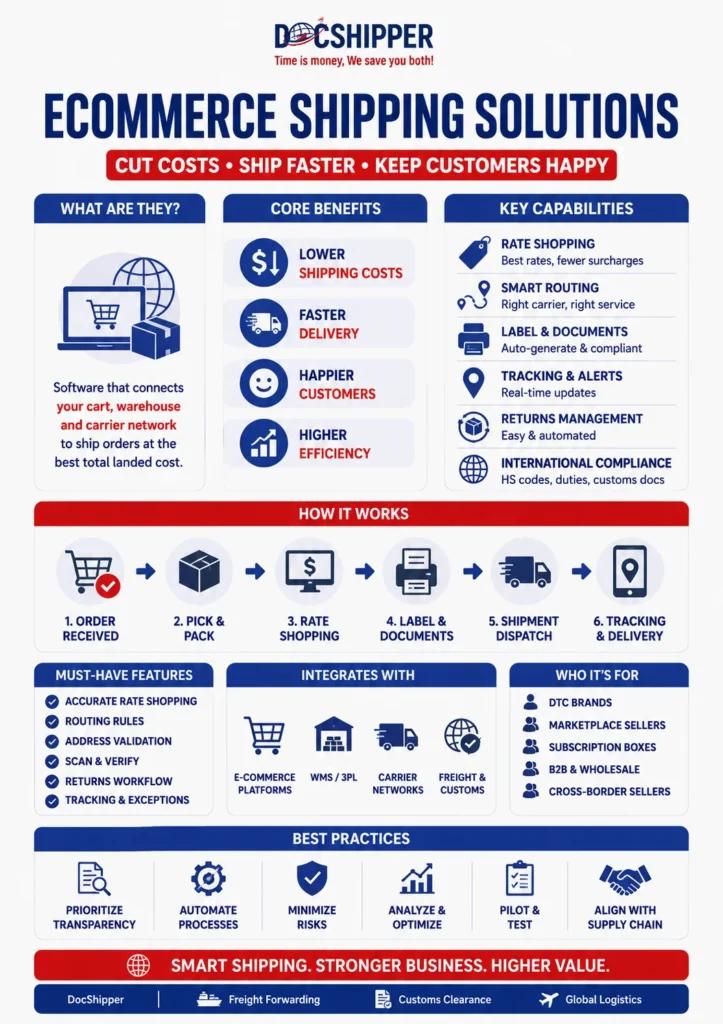
Ecommerce shipping solutions are software tools that sit between your cart, warehouse, and carrier network to decide how each order ships at the best total landed cost.

They automate rate shopping, routing rules, label and document generation, tracking, returns, and international compliance so you cut freight costs, ship faster, and reduce support issues.

We hope you’ll find this article genuinely useful, but remember, if you ever feel lost at any step, whether it’s finding a supplier, validating quality, managing international shipping or customs,  DocShipper can handle it all for you!

Free shipping quote 24h      I want to talk to a sourcing expert

Understanding ecommerce shipping solutions and how they fit into your tech stack

If you’re looking at ecommerce shipping solutions, you’re probably not hunting for “a label printer in the cloud”.

You’re trying to stop late deliveries, tame freight rates and surcharges, keep tracking clean, and avoid that painful support loop where your customer asks, “Where’s my order?” and you’ve got three different answers.

Here’s the thing, shipping software only works when it sits correctly in your supply chain tech stack, between inventory management, warehousing, carrier networks, and sometimes your freight forwarding and customs clearance partners.

Quick workflow: how a shipment actually moves through your stack

Order createdinventory reservedpick/packrate shoppinglabel + documentshandoff to carrier or 3PLtracking eventsreturns (if needed)

Checklist, before you commit to any ecommerce shipping solutions

  • Can you connect your store and marketplace channels without fragile hacks?
  • Will it support your mix of last-mile delivery, trucking, and international export shipments?
  • Do you need WMS features like wave picking, cross-docking, or just basic batch labels?
  • Can it produce customs paperwork reliably, including harmonized system code data?
  • Does it keep consignee and consignor data consistent across labels, invoices, and tracking?

DocShipper Info

Shipping tools only deliver value when aligned with freight, customs, and warehousing flows.
We help you map and optimize your full logistics stack before you commit to any platform.

What ecommerce shipping solutions actually do beyond label printing

Good ecommerce shipping solutions act like the routing brain of your fulfillment, they decide how each shipment leaves your warehouse, and at what total landed cost.

You’ll notice fast that the “label” is the easy part, the real value shows up when the platform controls decisions around carrier selection, service levels, and exception handling.

From experience, one of the most expensive mistakes is letting your team “eyeball” shipping methods at pack-out.

We’ve seen a brand ship 400 parcels in two days on an express service because the default rule was wrong, then scramble when the surcharge bill hit and margins disappeared.

Beyond labels, you’re typically getting:

  • Rate shopping across carriers, with rules for freight rates, zones, dim weight, and surcharges.
  • Order orchestration, split shipments, consolidation, and deconsolidation when inventory sits in multiple locations.
  • Tracking normalization, so customers don’t bounce between carrier sites for status updates.
  • Returns flows, RMA logic, and disposition rules tied to inventory management.
  • International shipping controls, commercial invoices, customs duties estimates, and brokerage instructions.

If you export, this is where compliance sneaks in.

Even in parcel mode, the data you push affects customs clearance, tariffs, and whether your shipment gets held for missing HS codes.

Mini workflow: cost control rules inside ecommerce shipping solutions

Read ordercalculate cartonizationshop ratesapply routing ruleschoose serviceprint labelpush tracking to store

And yes, when you move into cargo, you’ll want to connect these decisions to freight forwarding documents like the airway bill or bill of lading, even if your first mile starts as palletization to a consolidation hub.


DocShipper Advice

Before scaling features, stress-test your routing rules and carrier logic.
A quick audit can uncover hidden margin leaks in rate selection and service defaults.

How shipping tools integrate with carts, WMS, 3PLs, and carrier networks

The best ecommerce shipping solutions don’t “replace” your stack, they connect it.

Let us explain the practical version: your cart captures the promise, your WMS runs the warehouse reality, and the shipping tool translates both into carrier-compliant shipments.

We’ve watched integrations break in very predictable ways.

A merchant connects a shipping app to Shopify, forgets the WMS mapping, then orders route twice, inventory goes negative, and the consignee gets two tracking numbers for one purchase.

Most integrations fall into four lanes:

  • Carts and marketplaces, order import, address validation, routing, tracking sync.
  • WMS and warehousing, pick/pack confirmation, cartonization, batching, cross-docking signals.
  • 3PLs and contract logistics, tendering shipments, SLA checks, scheduling dock appointments.
  • Carrier networks, label creation, pickup requests, tracking events, claims, freight insurance options.

Carrier connectivity is where things get real, especially when you mix parcel with multimodal transport.

If you do LTL or containerization, your “shipping tool” may also need to talk to trucking, drayage, and booking systems, not just last-mile APIs.

Integration workflow: how data should flow end-to-end

StoreOMSWMSshipping platformcarriertracking back to store + notifications

One more insider tip, watch the data fields.

The World Customs Organization guidelines on classification are a reminder that sloppy product data, missing HS codes, vague descriptions, wrong country of origin, turns into customs clearance delays that no tracking page can “fix”.

Looking for a Reliable Shipping & Sourcing Partner?

We handle the entire sourcing process, supplier research, negotiation, production, and inspections, so you can focus on what matters most: growing your business.

Key features you need in an ecommerce shipping platform

Choosing ecommerce shipping solutions based on “it connects to my store” is how you end up switching tools in six months.

You want features that protect margin, reduce lead time variability, and keep operations calm when volumes spike.

Checklist: what to confirm before you scale

  • Accurate rate shopping with surcharge visibility and dimensional weight logic.
  • Rules-based routing tied to SKU, destination, service level, and promised delivery date.
  • Batch processing, pick list support, and scan-to-verify to cut packing errors.
  • Clean tracking, branded notifications, and exception alerts.
  • Returns workflows that feed inventory management and warehousing decisions.
Feature Why it matters operationally What to look for
Rate shopping Controls freight rates and margin Real carrier contracts, zone maps, dim rules, surcharge breakdown
Routing rules Prevents “human default” mistakes Rules by SKU, weight, destination, cutoff time, just-in-time constraints
Warehouse fit Speeds up pick/pack and reduces mis-shipments Batch labels, scanning, cartonization, palletization support
Tracking + exceptions Reduces support tickets and churn Milestone normalization, proactive alerts, claims support
Returns Protects cash and resale value RMA logic, disposition, restock automation, reverse logistics labels

DocShipper Advice

Feature lists mean nothing without operational fit.
Let us benchmark your shipping setup against volume, margin, and warehouse complexity before you scale.

Must-have capabilities for cost control, speed, and accuracy

At a minimum, your ecommerce shipping solutions should behave like an operations manager that never gets tired.

That means enforcing policy, not just offering options.

We’ve seen what happens when accuracy isn’t designed in.

A team ships the right product to the wrong consignee because address validation was off, then pays double shipping, eats a refund, and loses a week of inventory availability.

Prioritize these must-haves:

  • Address validation and parsing, fewer returns to sender and carrier corrections.
  • Cartonization logic, so you don’t overpay on dim weight.
  • Multi-carrier rating that respects your negotiated contracts.
  • Rules-based service selection, including cutoff times and scheduling constraints.
  • Scan-based verification at pack-out to prevent mis-picks.

Step-by-step workflow: setting up routing rules that actually save money

Import carrier contractsdefine packaging typesset service-level targetsbuild rules by margin and lead timetest on past ordersroll out with monitoring

If you do import or export, add a lane for incoterms decisions.

It’s not just “ship it DDP”, it’s aligning who pays duties, who acts as importer of record, and how brokerage gets instructed.

DocShipper Alert

Manual overrides and weak validation destroy accuracy fast.
Build enforced rules and compliance checks before errors turn into refunds and lost inventory.

Advanced options for automation, analytics, and international compliance

Once basics are stable, advanced ecommerce shipping solutions unlock automation across procurement, warehousing, and logistics.

This is where you stop reacting to problems and start preventing them.

We’ve handled cases where a seller scaled into cross-border without compliant data.

Orders moved, then customs clearance stalled because product descriptions were too generic, duties got reassessed, and the buyer refused delivery after surprise charges.

Advanced capabilities worth paying for:

  • Analytics on cost per shipment, carrier performance, routing outcomes, and exception rates.
  • Automation for label batching, pickup scheduling, and tendering to 3PLs.
  • International compliance tooling, HS codes, commercial invoices, export data, landed cost estimates.
  • Returns intelligence, reason codes, disposition automation, refurbish vs restock decisions.
  • Multi-node fulfillment, smart sourcing from the right warehouse, consolidation rules, split-ship controls.

Practical workflow: cross-border order to customs-cleared delivery

Verify product master dataassign HS code + origingenerate invoicechoose incotermsbook carriercustoms clearance + brokeragelast-mile deliveryproof of delivery

If you’re shipping internationally at volume, you’ll also want document discipline, even when you’re not issuing a bill of lading every day.

Standards referenced by the International Air Transport Association matter here because airway bill data quality affects acceptance, handling, and downstream tracking, and you’ll feel it when cargo moves through multiple nodes.

At DocShipper, we plug into this reality end-to-end, from freight forwarding and consolidation to customs clearance and final-mile coordination, so your shipping software doesn’t sit alone.

When you’re ready, we help you align the tech with the physical flow of goods, the paperwork, and the cost model, because that’s where shipping stops being a headache and becomes a lever.

DocShipper Alert

Integration gaps create duplicate orders, stock errors, and costly delays.
We secure your data flow end-to-end so shipping, WMS, and carriers stay synchronized.

DocShipper Info

Cross-border growth demands more than basic automation.
We align HS codes, airway bill data, and brokerage flows with your shipping platform.

Comparing ecommerce shipping solutions for different business sizes and models

You cannot choose the right ecommerce shipping solutions if you ignore your volume, margins, and operational complexity. What works for a Shopify startup will break under a multi-warehouse omnichannel brand.

Your shipping stack must match your growth stage. Otherwise you overpay, under-automate, or both.

Solution Best for Key Strengths Limitations Typical Pricing Model
ShipStation SMBs, DTC brands Strong marketplace integrations, automation rules, branded tracking Limited deep freight and B2B features Tiered monthly subscription
Easyship Cross-border ecommerce International rate comparison, duties calculation, courier variety Less advanced warehouse logic Free tier plus pay-per-shipment or subscription
Shippo Startups, growing stores Simple API, discounted carrier rates, easy setup Advanced reporting requires higher tiers Per-label or subscription
Sendcloud European sellers Strong EU carrier network, returns portal, automation Limited outside Europe Subscription based on volume
ShippingEasy SMBs with email marketing focus Shipping plus CRM and email tools Less robust for complex operations Subscription
Ordoro Inventory-heavy ecommerce Inventory management, dropshipping workflows Higher cost at scale Tiered subscription
MetaPack Enterprise, omnichannel Global carrier network, advanced delivery options, SLA management Enterprise pricing and onboarding Custom enterprise contracts

If you ship fewer than 500 orders per month, focus on simplicity and carrier discounts. If you ship over 10,000 orders monthly, you need automation rules, multi-warehouse logic, and SLA tracking.

Different business models also require different tools:

  • DTC brand, prioritize branded tracking, fast label generation, returns portal.
  • Marketplace seller, prioritize multichannel sync and bulk processing.
  • Subscription box, prioritize batch fulfillment and predictable rate optimization.
  • B2B or wholesale, prioritize pallet shipping, freight integration, and Incoterm control.
  • Cross-border seller, prioritize landed cost calculation and customs documentation.

If you operate internationally, your shipping software must handle HS codes, commercial invoices, and duty calculations correctly. Mistakes here destroy margins and customer trust.

At DocShipper, we often connect ecommerce brands with hybrid models. You combine shipping software for label automation and our freight, customs, and supplier coordination services for upstream control.

DocShipper Advice

Your growth stage should dictate your shipping architecture.
We design hybrid models combining software, freight, and customs control for scalable operations.

How to evaluate and choose the right ecommerce shipping solution

You do not choose based on features alone. You choose based on operational friction, cost leakage, and scalability.

Start with this evaluation checklist.

  • Does it integrate natively with your ecommerce platform, ERP, and WMS?
  • Can it connect to your 3PL or in-house warehouse via API?
  • Does it support your target carriers and negotiated rates?
  • Can it automate shipping rules based on weight, SKU, or destination?
  • Does it generate compliant customs documents for international orders?
  • Is the returns workflow automated and customer-facing?
  • Does pricing scale predictably as your volume grows?

Next, map your internal workflow before signing any contract. You must see where automation replaces manual steps.

Evaluation Criteria Questions You Should Ask
Integration Depth Is it plug-and-play or will you need developer resources?
Carrier Flexibility Can you add regional and last-mile carriers easily?
International Capability Does it calculate duties and taxes at checkout?
Scalability Can it handle peak season 3x volume spikes?
Data & Analytics Can you track cost per order and delivery performance?

Always run a live pilot before full deployment. Process at least 200 to 500 real orders through the system.

You should also calculate total landed operational cost, not just subscription fees. Include:

  • Carrier rate impact
  • Time saved per order
  • Error reduction rate
  • Return processing efficiency
  • Customer service ticket reduction

The cheapest software is often the most expensive in operational waste. Choose based on long-term margin protection.

When you work with us at DocShipper, we analyze your sourcing origin, freight mode, customs flow, and final-mile strategy. Then we help you align shipping software with your global supply chain reality.

DocShipper Info

Selection should follow a structured operational audit.
We run pilots, cost simulations, and integration checks before you commit long term.

Conclusion

You now understand that ecommerce shipping solutions are not just label generators. They are margin protection tools and growth enablers.

  • Match your shipping software to your order volume and business model.
  • Prioritize integrations with your ecommerce, WMS, and carrier ecosystem.
  • Automate rules to reduce manual errors and speed fulfillment.
  • Evaluate international compliance features if you ship cross-border.
  • Run real-world pilots before committing long term.
  • Think total operational cost, not just monthly subscription fees.
  • Align your shipping software with your broader sourcing and logistics strategy.

If you want to scale globally without losing control over freight, customs, and supplier coordination, we can help you design a fully integrated ecommerce shipping architecture. At DocShipper, we connect sourcing, freight, compliance, and final-mile delivery into one coherent system.

FAQ | Ecommerce shipping solutions: how to cut costs, ship faster, and keep customers happy

An ecommerce shipping solution is the operational “brain” that decides how each order leaves your warehouse. It typically:

  • Pulls orders from your store/OMS and reserves inventory.
  • Validates addresses and calculates packaging (cartonization).
  • Shops rates across multiple carriers using your real contracts.
  • Applies routing rules (service level, margin, cutoff times, destination).
  • Generates labels and documents (commercial invoices, CN22/23, etc.).
  • Sends tracking back to your store and to the customer.
  • Manages returns labels, RMAs, and restocking instructions.

Ask us anything!

Need Help with
Logistics or Sourcing ?

First, we secure the right products from the right suppliers at the right price by managing the sourcing process from start to finish. Then, we simplify your shipping experience - from pickup to final delivery - ensuring any product, anywhere, is delivered at highly competitive prices.

Live Chat

Get instant assistance from our team—just click and start chatting!

Live Chat Now
image

Fill the Form

Prefer email? Send us your inquiry, and we’ll get back to you as soon as possible.

Contact us
image

Call us

Reach out to us on WhatsApp for quick, convenient, and personal support.

Call us
image