In short ⚡
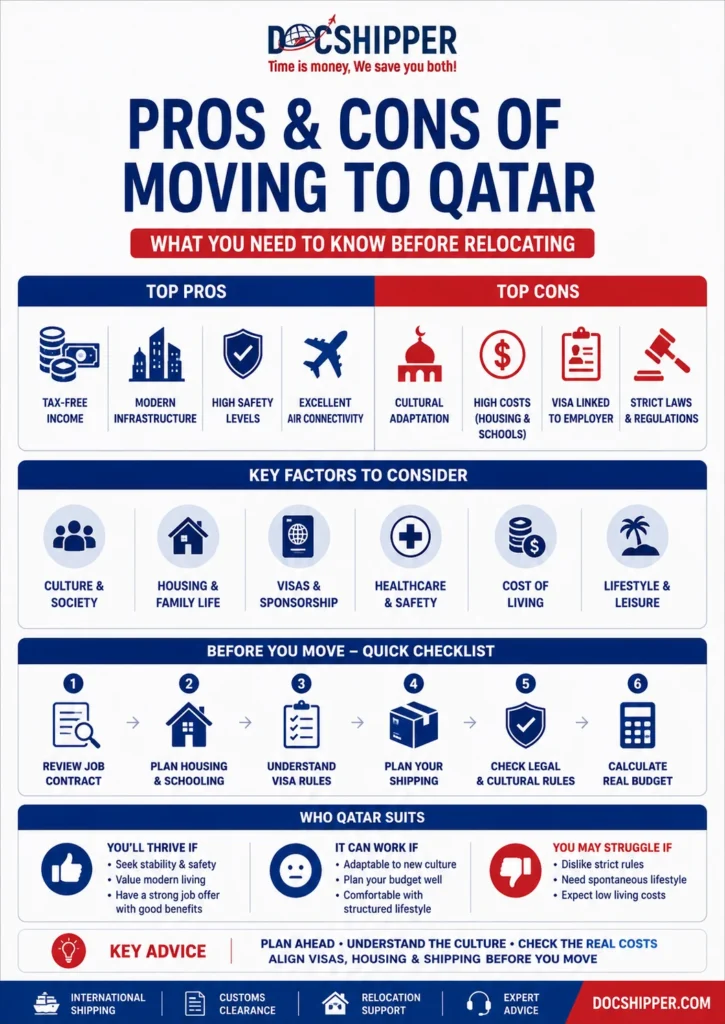
Moving to Qatar offers tax-free income, modern infrastructure, and strong personal safety, but also demands cultural adaptation, careful budgeting, and strict legal compliance.
Key factors span culture, family costs, housing, visa rules, and daily lifestyle.
- Central role of Islam, with expectations around Ramadan, dress, and public behavior
- High but variable quality of expat social life, often segmented by income and nationality
- Significant family expenses, especially private international schooling and housing
- Strict laws on alcohol, public conduct, and documentation, with no leniency for ignorance
- Visa and residency tightly linked to employer sponsorship and contract terms
We hope you’ll find this article genuinely useful, but remember, if you ever feel lost at any step, whether it’s finding a supplier, validating quality, managing international shipping or customs, DocShipper can handle it all for you!
Should you move to Qatar or just visit? key questions to ask yourself
If you’re weighing the pros and cons moving to Qatar, the first decision isn’t about neighborhoods or salaries, it’s about commitment level.
You’ll notice fast that Qatar can feel effortless for a week, then surprisingly complex for a year, especially once paperwork, housing, and daily routines kick in.
We’ve seen people arrive for “a quick look” and end up staying because the work offer is strong, and we’ve also seen others leave after two months because the lifestyle didn’t match their expectations.
Who Qatar suits (and who it doesn’t)
We once helped an expat ship a two-bedroom apartment to Doha, only for them to realize after three weeks that the biggest issue wasn’t the international shipping, it was the social rhythm.
If you like structure, clean infrastructure, and clear rules, the pros and cons moving to Qatar often skew positive.
If you need spontaneous street life, walkable chaos, or a “startup grind” vibe, Qatar can feel a bit too curated.
Here’s a quick way to sanity-check fit before you commit.
- Qatar fits you if you want stability, modern services, strong expat networks, and a workplace with defined processes.
- Qatar may frustrate you if you dislike admin steps, prefer casual norms, or need frequent nature escapes without planning.
- You’ll likely thrive if your employer handles housing and visas, because it removes the hardest friction points.
- You’ll feel stuck if you arrive without a plan for accommodation, transport, and documentation timelines.
Short stays vs long-term relocation
Direct tip: treat a short stay like a live simulation of relocation, not a vacation.
On a short visit, the pros and cons moving to Qatar are easy to misread because hotels, ride-hailing, and tourist areas hide the daily grind.
If you stay longer, you’ll deal with leases, utilities, work onboarding, and sometimes moving your goods through customs clearance with proper shipment documentation.
This is the workflow we recommend so you don’t “discover” problems after you sign a lease.
Practical decision workflow (7 steps):
- Step 1: Spend 5 to 10 days in Doha and test commute times at rush hour.
- Step 2: Visit 2 or 3 housing options, including a compound and a standard apartment.
- Step 3: Ask HR for a written list of what they sponsor, and what you pay.
- Step 4: Price schooling, healthcare coverage, and car costs with real quotes.
- Step 5: If relocating, build a shipping plan: what goes by air freight vs what can wait for ocean freight.
- Step 6: Prepare a folder for commercial invoice, packing list, and inventory photos, even for personal effects.
- Step 7: Decide based on monthly cashflow, not just headline salary.
How Qatar compares to other Gulf destinations
Is Qatar the “best” Gulf option, or just the best one for your profile?
When you compare the pros and cons moving to Qatar to Dubai, Abu Dhabi, or Saudi, you’ll see trade-offs around pace, regulation, and lifestyle variety.
We’ve watched expats choose Doha because it’s calmer and more predictable, then later switch to Dubai because they wanted more nightlife and career mobility.
To make the comparison less emotional, use a simple side-by-side view.
| Factor | Qatar (Doha) | UAE (Dubai/Abu Dhabi) | Saudi (Riyadh/Jeddah) |
| Pace of life | More measured, family-oriented | Fast, highly commercial | Varies, often intense in big cities |
| Weekend & travel | Good regional flights, fewer “quick getaways” by road | Many options, strong tourism ecosystem | Improving rapidly, but distances are huge |
| Work culture | More formal, relationship-driven | Very international, role mobility is common | Fast-changing, policy-driven sectors |
| Relocation friction | Can be smooth with employer support, admin matters | Mature expat services, still documentation-heavy | Depends on sector and sponsor, improving year to year |
Work, visas and expat packages in Qatar
Most people get stuck here, because the pros and cons moving to Qatar can flip depending on your visa sponsor and the contract details.
You’ve probably dealt with employers who promise “we’ll take care of everything”, then you discover the fine print after you land.
We’ll keep it practical so you can ask the right questions before you resign from your current job.
How Qatar work visas and sponsorship really work
We’ve seen a classic mistake: an expat shipped personal items early, then the visa timeline slipped, and their boxes sat in storage while fees piled up.
That’s why the pros and cons moving to Qatar depend heavily on timing, sponsorship, and coordination.
Your employer typically sponsors your work residence process, but you still need to manage documents, medical steps, and deadlines in a disciplined way.
For a clean process, you’ll want to align your relocation plan with your paperwork plan, like you would in supply chain management.
Here’s the checklist we recommend using before you book flights or start cargo consolidation for your belongings.
- Sponsor clarity: confirm who files what, and who pays which government fees.
- Start date realism: get a written target date and a contingency plan if onboarding shifts.
- Document readiness: degrees, police checks, and any attestations your role requires.
- Family add-ons: ask early about dependent visas and schooling timelines.
- Shipping alignment: only ship once visa milestones are confirmed, or use storage with clear terms.
Typical expat packages, allowances and benefits
Direct tip: treat your expat package like a total landed cost, not just a salary number.
The pros and cons moving to Qatar look very different if housing is covered, schooling is included, and flights are annual.
From experience, you’ll also want to confirm whether benefits are cash allowances or direct payments, because that affects your risk if rents rise.
This is the workflow we use with clients to “normalize” offers and compare apples to apples.
Package comparison workflow (6 steps):
- Step 1: Separate base salary from allowances, bonuses, and reimbursements.
- Step 2: Confirm housing: provided, allowance, or temporary only.
- Step 3: Check schooling caps per child and what’s excluded (registration fees often surprise you).
- Step 4: Verify healthcare: private insurance level, dependents, pre-existing conditions.
- Step 5: Confirm travel: number of tickets, class, and cash-in-lieu rules.
- Step 6: Ask about relocation support, including whether a logistics provider or movers are covered.
Job market realities and competition for roles
Big reality: Qatar can pay well, but you won’t always get hired just because you have international experience.
The pros and cons moving to Qatar include strong opportunities in energy, construction, aviation, education, and healthcare, but competition can be sharp for “international corporate” roles.
We’ve seen candidates lose offers because they negotiated too late, or because they couldn’t provide a document fast enough for the hiring timeline.
To position yourself well, focus on proof and speed.
- Bring measurable wins: budgets, team sizes, projects delivered, not vague responsibilities.
- Show compliance mindset: regulated sectors value process discipline.
- Be ready for fast admin: document requests can come with short deadlines.
- Negotiate early: allowances, housing, and schooling are easier to settle before final approval.
For perspective on global labor mobility and policy patterns, it’s worth noting how the ILO tracks cross-border employment conditions and worker protections across regions.
Money matters: salary, tax and cost of living in Qatar
If you’re researching the pros and cons moving to Qatar, money is probably the headline, and yes, it can be compelling.
But you’ll only feel “rich” if your costs don’t quietly expand, especially housing, school fees, and transport.
We’ve watched people with high salaries save less than expected because they chose the wrong lease, the wrong school tier, and shipped too many things they didn’t need.
High, tax-free salaries and your real take-home pay
We once saw an expat accept a strong offer, then realize the “tax-free” story didn’t cover every deduction back home, and their savings plan fell apart.
The pros and cons moving to Qatar include the appeal of tax advantages, but your real take-home depends on allowances, lifestyle, and any obligations in your home country.
Also, your relocation costs are real operational expenses, think freight rate, freight insurance, and even storage if your move doesn’t line up perfectly.
Use this short checklist to estimate your monthly net like a pro.
- Net pay: base salary plus fixed allowances you can rely on.
- Housing delta: allowance minus realistic rent, not “best case” rent.
- Transport: car purchase or lease, insurance, fuel, parking.
- Family costs: schooling, childcare, dependent healthcare.
- Move costs: international moving, temporary accommodation, setup fees.
Housing, schooling and daily expenses to budget for
Direct tip: before you sign anything, model your budget as if you’re doing inventory management, line by line, no guesswork.
The pros and cons moving to Qatar often hinge on whether your employer covers housing and education, because these are the big-ticket items that don’t feel negotiable once you’re on the ground.
We’ve seen families pick a school first, then realize the commute and rent in that catchment area forced them into a lifestyle they didn’t want.
Here’s a simple budgeting workflow you can copy into a spreadsheet.
Monthly budget workflow (5 steps):
- Step 1: Fix your non-negotiables, rent range, school range, commute time limit.
- Step 2: Add utilities, internet, mobile, and building fees where applicable.
- Step 3: Add groceries and dining out, then add a “reality buffer” for the first 90 days.
- Step 4: Add health insurance top-ups and out-of-pocket medical costs.
- Step 5: Add annual items divided monthly, flights, visas, car registration, school extras.
Saving potential and lifestyle upgrades
What if the real question isn’t “Can you save?”, but “Will you actually save once you upgrade your lifestyle?”
The pros and cons moving to Qatar include genuine saving potential, yet it’s easy to drift into premium housing, frequent brunches, and expensive weekend plans.
We’ve helped expats reduce costs quickly by treating relocation like a logistics plan, consolidate purchases, avoid duplicate furniture, and choose smart shipping modes like multimodal transport for non-urgent goods.
To keep savings on track, set simple rules that you can follow without feeling deprived.
- Choose one upgrade: great housing or frequent travel, not both in year one.
- Delay big purchases: live 60 days, then decide what you truly need.
- Use allowances strategically: prioritize rent and school stability first.
- Plan exits: keep a buffer for a move-out flight, deposits, and shipping.
For macro context on cost trends and regional economic shifts, you’ll sometimes see relevant benchmarks referenced by the World Bank in its regional economic updates.
Safety, healthcare and everyday services
Ask anyone who’s done the pros and cons moving to Qatar research, and safety usually lands on the “pro” side.
Still, day-to-day comfort depends on more than crime rates, it’s also healthcare access, driving culture, and how smoothly services work when you’re new.
You’ve probably had that feeling before, everything looks great until you need a doctor appointment or you get stuck in traffic for the third day in a row.
Crime rates, policing and feeling safe as an expat
We remember an expat who arrived anxious after reading alarming headlines online, then told us after a month that the biggest “risk” was leaving their phone on a cafe table because they forgot how safe it felt.
The pros and cons moving to Qatar often include a strong sense of public order, but you’ll still want common-sense habits, especially in crowded areas and during big events.
Use this quick checklist to avoid preventable problems while you settle in.
- Keep digital copies: ID, visa pages, and emergency contacts in a secure folder.
- Respect photography norms: avoid sensitive sites and always ask when unsure.
- Stay aware at night: even in safe cities, don’t switch off your instincts.
- Know your building rules: visitor policies can be strict in some residences.
Healthcare access, insurance and medical standards
Direct tip: don’t assume your employer’s plan covers what you consider “standard”, verify it like you’d verify a freight contract.
The pros and cons moving to Qatar include generally strong medical facilities, but your experience depends on insurance network, clinic availability, and whether dependents are included.
We’ve seen newcomers pay out-of-pocket simply because they didn’t know which hospital their plan required, and nobody explained it during onboarding.
To reduce surprises, ask targeted questions before you arrive.
- Coverage scope: inpatient, outpatient, dental, maternity, mental health.
- Network list: hospitals and clinics you’re allowed to use.
- Claims process: direct billing or reimbursement, and typical timelines.
- Emergency protocol: hotline numbers and which facility to go to.
Getting around: driving, traffic and public transport
Will you need a car right away, or can you rely on metro and ride-hailing?
The pros and cons moving to Qatar include modern roads and infrastructure, but peak traffic can test your patience, and distances make walking unrealistic in many areas.
We’ve seen newcomers underestimate commute time, sign a lease, then spend months paying for convenience through constant rides.
Think of mobility like last mile delivery, it’s where your time budget disappears if you don’t plan it.
- Test the route: do your commute at the exact hours you’ll travel.
- Check parking: at home, work, and malls you visit often.
- Use the metro smartly: it’s great for certain corridors, less useful elsewhere.
- Plan for licensing: ask HR what’s required to drive legally and when.
For transport and road safety frameworks, global reference points are often discussed by institutions like the WHO in relation to traffic injury prevention standards.
Weather, outdoor life and free-time activities
The pros and cons moving to Qatar get very real the first time you step outside in peak summer heat.
People love the sunshine, then they realize outdoor life becomes a scheduled activity for part of the year.
We’ve seen expats adapt quickly once they stop fighting the climate and start designing routines around it.
Extreme heat, air quality and how they affect daily life
We once had a client plan a moving day in July, thinking it would be “hot but manageable”, and they ended up paying extra for faster crews and more breaks because the heat slowed everything down.
The pros and cons moving to Qatar include predictable sunshine, but extreme heat changes your errands, workouts, and even how you schedule deliveries.
If you’re relocating household goods, you’ll also want heat-aware packing, especially for electronics, cosmetics, and anything sensitive.
Here are practical ways to reduce heat friction without changing your whole lifestyle.
- Shift your day: errands early morning, outdoor time after sunset.
- Choose the right home: shaded parking, good insulation, reliable AC maintenance.
- Plan moves smartly: pick cooler months for shipping and unloading if possible.
- Protect sensitive items: use proper packing materials and avoid long exposure during unloading.
Beaches, gyms, malls and realistic leisure options
Direct tip: build a “three-lane” leisure plan, one indoor, one social, one outdoors for winter.
The pros and cons moving to Qatar include excellent indoor leisure, gyms, malls, and dining, but you can get cabin-fever if you don’t diversify your routine.
We’ve watched newcomers spend heavily at first out of boredom, then settle into a balanced rhythm once they found their spots.
This is a simple checklist to make weekends feel full without burning money.
- Indoor anchor: a gym close to home or work so you actually go.
- Social anchor: a recurring meetup, sports league, or community group.
- Outdoor window: plan beaches and desert trips for the cooler season.
- Budget cap: pick a monthly “fun” number and stick to it.
Looking for a Reliable Shipping & Sourcing Partner?


Travel, weekend breaks and getting out of Doha
Clear truth: if you don’t plan travel, you’ll feel boxed in faster than you expect.
The pros and cons moving to Qatar include strong flight connectivity, but spontaneous road-trip variety is more limited than in larger countries.
We’ve helped expats coordinate international shipping around travel plans, because a mid-move vacation can create storage costs and missed delivery windows if your shipment tracking and handover dates aren’t aligned.
To keep weekends refreshing, set a travel rhythm you can maintain.
- Micro-breaks: book one local outing each month, beach, museum, desert, sports event.
- Quarterly flights: plan a long weekend abroad every 2 to 3 months if budget allows.
- Calendar discipline: avoid travel during key work milestones and visa steps.
- Relocation alignment: don’t schedule trips during delivery windows or housing handovers.
For broader context on how tourism and air connectivity shape regional mobility, insights are frequently referenced by UNWTO in its travel industry reporting.
Culture, society and life as an expat in Qatar
When you weigh the pros and cons moving to Qatar, culture and daily social life quickly move to the top of the list. Living in Qatar is not just about salary packages and tax-free income, it’s about how comfortably you adapt to local norms, social hierarchies, and legal boundaries.
You’ll probably adjust faster than you think, but only if you understand the unwritten rules as well as the official ones.
DocShipper Info
Get expert relocation guidance to align culture, housing, visas and compliance before you move
Cultural norms, religion and lifestyle differences
We once supported a European executive who loved his new role in Doha but struggled during his first Ramadan. He didn’t realize that eating or drinking in public during daylight hours could cause offense, even for non-Muslims. That small misunderstanding shaped his entire first impression of life in Qatar.
In the context of the pros and cons moving to Qatar, religion plays a central role in shaping public life. Islam influences working hours, dress expectations, and social etiquette.
You’ll notice fast that:
- Ramadan changes daily schedules significantly.
- Public behavior is expected to remain respectful and discreet.
- Family and tribal identity remain central in Qatari society.
- Friday is the main day of prayer and rest.
Qatar is modern, but it is also deeply traditional. According to the World Values Survey, Gulf societies maintain stronger religious adherence than most Western countries, and you’ll feel that difference in everyday interactions.
This does not mean you cannot live freely. It means you must understand context and adapt your behavior accordingly.
Social life, expat communities and “rich–poor” divides
Here’s a reality many newcomers don’t expect. Qatar’s population is mostly expatriate, yet social circles often remain segmented by income level, nationality, and job sector.
When discussing the pros and cons moving to Qatar, you must consider that social life can feel both vibrant and isolating at the same time.
You’ll typically find:
- Luxury-oriented expat groups tied to corporate or diplomatic circles.
- Large South Asian communities working in construction and services.
- Western professionals clustered in compounds and certain districts.
We’ve seen clients arrive expecting a fully integrated international lifestyle, only to realize that social mobility between groups is limited. Income differences are visible, sometimes stark.
That said, Doha offers active networking events, sports leagues, embassy gatherings, and hobby clubs. If you’re proactive, you’ll build your circle.
Legal rules, alcohol, dress codes and common pitfalls
Are you prepared to live under a different legal framework than the one you’re used to?
One critical dimension of the pros and cons moving to Qatar involves strict legal compliance. Qatar’s legal system blends civil law with Sharia principles, and ignorance is never accepted as an excuse.
Before relocating, review this essential compliance checklist:
- Alcohol is restricted and requires a permit for purchase.
- Public intoxication can lead to arrest.
- Dress modestly in government buildings and traditional areas.
- Photography of military or government sites is prohibited.
- Public displays of affection should remain minimal.
We’ve advised professionals who assumed “expat areas” meant relaxed enforcement. That assumption can cost you fines, job loss, or visa cancellation.
If you respect local law, you’ll rarely encounter problems. But you must stay informed.
Families, housing and buying property as a foreigner
For many people analyzing the pros and cons moving to Qatar, family life and housing conditions determine the final decision. Qatar can be exceptionally comfortable for families, but only if your package supports the lifestyle you expect.
This is where planning makes or breaks your relocation.
DocShipper Advice
Let our relocation specialists secure schools, housing and visas before costs and availability become obstacles
Moving to Qatar with children: schools and family life
We once assisted a family who secured a strong salary offer but overlooked school fees. Their annual tuition bill exceeded expectations by tens of thousands of dollars.
If you’re relocating with children, the pros and cons moving to Qatar shift significantly around education costs and availability.
Most expats enroll their children in private international schools offering:
- British, American, IB, or Indian curricula.
- Modern facilities and extracurricular activities.
- Waiting lists for top-tier institutions.
According to UNESCO data, private schooling dominates in expatriate-heavy Gulf states. You’ll need to confirm whether your employer covers tuition fully or partially.
Family life itself is generally safe and structured. Parks, malls, and compound living make daily routines predictable and secure.
Housing options, compounds and choosing an area
Location determines lifestyle.
In the framework of the pros and cons moving to Qatar, housing often represents your largest expense and biggest comfort factor.
You can choose between:
| Option | Advantages | Considerations |
| Residential compounds | Security, shared pools, gyms, family environment | Higher rent, less immersion in local culture |
| Standalone apartments in West Bay or The Pearl | Modern, central, close to offices | Premium pricing |
| Villas outside central Doha | More space | Longer commute |
We’ve seen professionals accept housing far from work to save on rent, only to regret daily traffic stress. Test commute times before signing.
Can foreigners buy property and is it worth it?
Did you know that foreigners can buy property in designated zones like The Pearl and Lusail?
When evaluating the pros and cons moving to Qatar, property ownership becomes relevant for long-term residents seeking residency privileges linked to real estate investment.
Before purchasing, consider this decision checklist:
- Length of intended stay in Qatar.
- Market volatility and resale liquidity.
- Mortgage eligibility for non-citizens.
- Residency incentives tied to property value.
We’ve advised clients who bought quickly during market peaks and struggled to exit. If your assignment is under five years, renting usually offers more flexibility.
Special situations: women, Americans and other newcomers
Some dimensions of the pros and cons moving to Qatar depend heavily on your gender, nationality, and expectations. Experiences differ, sometimes dramatically.
Understanding those nuances will prevent unnecessary surprises.
DocShipper Alert
Avoid costly cultural or legal missteps with structured pre-departure advisory tailored to your nationality and status
Life in Qatar as a foreign woman
One of our clients, a senior consultant from Europe, expected significant restrictions. Instead, she found professional respect in the workplace but adapted her dress and social behavior in public.
In the broader discussion of pros and cons moving to Qatar, women generally report high levels of safety but noticeable cultural differences.
You’ll likely experience:
- Strong public safety and low street harassment.
- Conservative dress expectations in certain settings.
- Professional environments that are often merit-based, especially in multinational firms.
Qatar ranks relatively high in regional safety metrics reported by global institutes such as the World Economic Forum. Still, cultural awareness remains essential.
Moving to Qatar from the USA and other Western countries
Expect culture shock, but not necessarily in the way you think.
For Americans and Western expats evaluating the pros and cons moving to Qatar, the biggest adjustments often involve bureaucracy and lifestyle structure rather than personal freedom.
You’ll need to adapt to:
- Sponsorship-based residency systems.
- Different labor dispute mechanisms.
- More centralized administrative processes.
We’ve supported US professionals surprised by how dependent visa status remains on employer sponsorship. Always clarify exit procedures and end-of-service benefits before arrival.
Common challenges expats report when they first arrive
What do newcomers struggle with most during the first three months?
Across dozens of relocation cases, the pros and cons moving to Qatar often become tangible through small daily frustrations.
Here’s what you should prepare for:
- Delays in obtaining residence permits.
- Opening bank accounts tied to QID issuance.
- Underestimating summer heat intensity.
- Limited walkability outside central areas.
Most of these issues stabilize after initial setup. Patience during the first 90 days makes a huge difference.
How a relocation partner can simplify your move to Qatar
If you’ve made it this far in analyzing the pros and cons moving to Qatar, you already understand how many moving parts are involved. Logistics, paperwork, housing, schooling, compliance.
This is where structured relocation support reduces risk and stress.
DocShipper Info
We manage shipping, customs, housing and documentation for a seamless Qatar relocation from origin to arrival
Shipping your belongings and avoiding moving stress
We once handled a relocation where household goods arrived before the residence permit was issued. Customs clearance stalled for weeks.
When integrating shipping into the pros and cons moving to Qatar, timing and documentation are critical.
A simplified relocation workflow typically looks like this:
- Step 1: Confirm visa approval timeline.
- Step 2: Prepare detailed packing inventory.
- Step 3: Verify prohibited or restricted items.
- Step 4: Coordinate arrival date with housing readiness.
- Step 5: Arrange customs clearance support.
We coordinate freight, documentation, and customs processes in line with international standards referenced by organizations such as the World Customs Organization.
Proper sequencing avoids storage fees and compliance headaches.
What to check before you sign a relocation or job contract
Your contract determines your real quality of life.
Before committing, evaluate how the pros and cons moving to Qatar translate into concrete terms inside your offer letter.
Review this final pre-signature checklist carefully:
- Housing allowance clarity and payment structure.
- School fee coverage caps.
- Health insurance scope and network.
- End-of-service gratuity calculation.
- Exit and visa transfer conditions.
We’ve seen highly paid professionals regret overlooking one clause about repatriation costs. Details matter more than headline salary.
Conclusion
The pros and cons moving to Qatar are real, tangible, and highly personal. You’ll find safety, tax-free income, and modern infrastructure, but also cultural adaptation, legal constraints, and climate extremes.
Your decision should align with your priorities, not just salary figures.
To summarize the key takeaways:
- Cultural awareness is essential for smooth integration.
- Family costs, especially schooling and housing, require precise budgeting.
- Legal compliance and visa structure must be fully understood.
- Social life depends heavily on initiative and income bracket.
- Careful contract review protects your long-term interests.
If you approach your relocation strategically, the advantages can outweigh the challenges. Preparation transforms uncertainty into opportunity.
FAQ | Pros and cons of moving to Qatar: what you need to know before relocating
The issues we see most aren’t extreme, they’re small “frictions” that repeat:
To avoid missteps:
- Treating Fridays like a normal weekend day: many services open later or close for prayer; plan errands around prayer times.
- Speaking loudly or arguing in public: perceived as disrespectful; keep disputes private and calm.
- Ignoring gender‑segregated spaces (queues, seating, gym areas): always look for signage and follow it.
- Assuming Western humor is fine everywhere: avoid jokes about religion, politics, or local leaders.
- Observe first in new settings (malls, offices, government buildings), then mirror local behavior.
- Ask a trusted local or senior expat what’s “fine at home but not here” in your sector.
- When unsure, choose the more conservative option in dress, language and public behavior.
You don’t need five‑star brunches to have a social life. Try to:
- Join activity‑based groups: running clubs, football leagues, diving groups, photography walks, language exchanges.
- Use expat platforms/Facebook groups for niche interests (board games, parents of toddlers, hikers, book clubs).
- Leverage your workplace: volunteer for committees, CSR projects or social events to meet people beyond your team.
- Attend embassy, chamber of commerce and professional association events for networking + friendships.
- Say “yes” aggressively in your first 2–3 months: accept most invitations, then narrow down what you enjoy.
Beyond rent and school fees, newcomers are surprised by:
When negotiating a package, translate these into monthly estimates and check if your allowance realistically covers them.
- Car ownership:
- Down payment or upfront cash for a used car
- Insurance + registration + yearly inspection
- Occasional fines (speed cameras are common)
- Utilities and services:
- Cooling-heavy electricity bills in summer
- Internet + mobile plans (often pricier than back home)
- Compound or building service fees not covered by landlord
- Lifestyle creep:
- Frequent eating out and delivery
- Weekends in malls and entertainment venues with kids
- Travel “home”:
- Annual flights for you / family, often in peak seasons
Most foreign women report feeling very safe, but a few habits help things stay that way:
These measures let you enjoy a high degree of freedom while staying aligned with local expectations.
- Clothing:
- Shoulders and knees covered in malls, government offices, traditional areas.
- Gym, compound and private gatherings can be more relaxed.
- Transport:
- At night, prefer reputable taxis or ride‑hailing apps over random street taxis.
- Share live location with a trusted contact if traveling late or long distances.
- Social settings:
- Be clear but polite when declining invitations; mixed signals can be misread.
- Avoid heated confrontations in public – disengage and move to a safer, crowded place if uncomfortable.
- Paperwork:
- Keep copies (digital + printed) of QID, visa and emergency contacts.
Problems usually come from misunderstandings, not bad intentions. To stay safe:
If there is an incident, stay calm, cooperate with authorities, and contact your embassy and employer immediately.
- At home:
- Buy alcohol only through legal channels with the proper permit.
- Keep it inside your residence; do not transport open containers.
- Outside:
- Only drink in licensed hotels, bars and restaurants.
- Plan your transport before you start drinking; never drive after.
- Behavior:
- Avoid loud, disruptive behavior around families or public spaces after events.
- Don’t post photos on social media that show others drinking without their consent.
The pain points often appear a year or two later. Watch for:
Before signing, list your “what if” scenarios (job not as promised, family emergency, health issue) and check how each is covered in writing.
- Notice periods and penalties:
- Long notice without clear exit route if things go wrong.
- Clawback clauses on relocation costs if you leave early.
- Bonus and gratuity:
- Vague or discretionary wording on performance bonuses.
- Unclear calculation base for end‑of‑service benefits.
- Family‑related clauses:
- Coverage rules for spouse and children (insurance, flights, visas).
- Conditions under which dependents might lose sponsorship.
- Repatriation:
- Who pays for tickets and shipping if the company terminates vs. if you resign.
Treat the first three months as a structured setup phase:
Structured planning in these 90 days prevents small administrative delays from turning into long‑term frustrations.
- Before arrival:
- Scan and organize all key documents (degrees, marriage/birth certificates, medical records).
- Confirm who is handling your residence permit and typical timelines.
- First month:
- Prioritize QID, bank account and local SIM – everything else depends on these.
- Keep a shared spreadsheet with key dates (visa expiry, medical check, fingerprints).
- Second month:
- Test your commute at peak times before locking in long‑term housing.
- Start building routines: gym, groceries, social activities.
- Third month:
- Review your budget against real expenses and adjust lifestyle early.
- Note any mismatches between contract and reality and raise them with HR while goodwill is high.
Need Help with
Logistics or Sourcing ?
First, we secure the right products from the right suppliers at the right price by managing the sourcing process from start to finish. Then, we simplify your shipping experience - from pickup to final delivery - ensuring any product, anywhere, is delivered at highly competitive prices.


Fill the Form
Prefer email? Send us your inquiry, and we’ll get back to you as soon as possible.
Contact us