In short ⚡
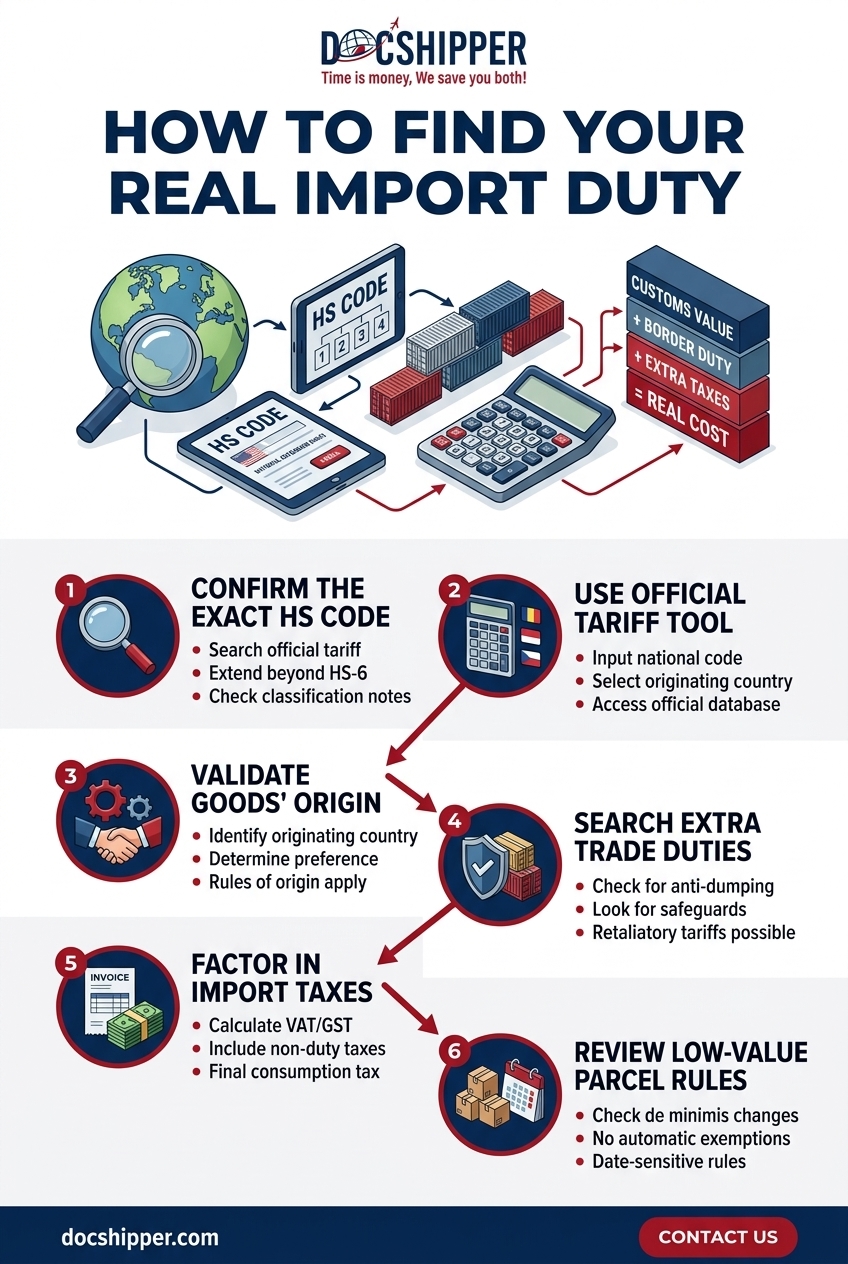
How to Check Import Duty Rates for Any Country: classify the product on the importing country’s national tariff line, verify its origin and preferential eligibility, then check the customs value, additional duties, VAT or GST, and low-value rules. Follow these steps:- Identify the product’s characteristics and find its international HS-6 code.
- Extend the code to the destination country’s national 8- to 10-digit tariff line.
- Use the importing country’s official tariff database to confirm the base rate and applicable measures.
- Verify the goods’ actual origin, trade-agreement eligibility, and required proof of origin.
- Check for anti-dumping, countervailing, safeguard, retaliatory, excise, VAT, or GST charges.
- Calculate the duty using the correct customs value and review current low-value shipment rules.
Key topics include the factors determining duty rates, national tariff tools, preferential origin, additional taxes, de minimis rules, worked origin comparisons, and common classification mistakes.
We hope you’ll find this article genuinely useful, but remember, if you ever feel lost at any step, whether it’s finding a supplier, validating quality, managing international shipping or customs, DocShipper can handle it all for you!
To check an import duty rate reliably, you need more than a product name or a supplier’s HS code. Classify the product on the importing country’s national tariff line, check its origin and preferential eligibility, then add any trade remedies, VAT or GST, and low-value rules.
The practical sequence is simple: identify the product, find the official tariff entry, verify the origin, calculate the duty on the correct customs value, and save the evidence used for your quote. This is how you find the real import cost before the shipment arrives, rather than discovering it during customs clearance.
DocShipper Info
Verify classification, origin and customs value before calculating your landed cost.
What determines your import duty rate
Your duty depends on three core factors: the product’s tariff classification, its origin, and the customs value used by the destination country. Anti-dumping duties, retaliatory tariffs, excise and VAT or GST may then increase the final amount.
The HS code describes the product, but it does not by itself determine the complete duty bill. The importing country extends the international HS-6 code into a national 8, 10 or sometimes longer tariff line, where the applicable rate and measures appear.
Most customs duties are ad valorem, meaning they are calculated as a percentage of the customs value. Some products have a specific duty, such as a fixed amount per kilogram, litre, item or pair, and some combine a percentage with a fixed amount.
Do not confuse customs duty with VAT or GST. Duty is a border charge on the import classification, while VAT or GST is a consumption tax. In many jurisdictions, the VAT or GST base includes the customs value, the duty, and certain transport or insurance costs.
| Factor | What to verify | Why it matters |
| Classification | National tariff line, not only HS-6 | Determines the base rate and product measures |
| Origin | Country where the goods qualify as originating | May determine MFN, FTA or preference treatment |
| Customs value | Transaction value and included costs | Determines the amount to which an ad valorem rate applies |
| Additional measures | Anti-dumping, safeguards, retaliatory tariffs and excise | Can apply on top of the base duty |
| Import taxes | VAT, GST or sales tax | Increase the amount payable at import |
DocShipper Tips
Confirm the national tariff line to avoid quoting the wrong duty rate.
Step 1: Find the right HS code and national tariff line
Start with the international 6-digit HS code, then extend it to the importing country’s national tariff line. The duty rate normally sits at that national level, not at HS-6.
The Harmonized System is maintained by the World Customs Organization and provides a common structure for customs classification. It contains more than 5,000 commodity groups with 6-digit codes, and is used by more than 200 countries and economies. The WCO states that over 98% of merchandise trade is classified using HS terms, based on information consulted on 14 October 2026.
Classify from the product’s objective characteristics, not from its marketing name. Record the material, composition, function, technical specifications, capacity, dimensions, method of operation, degree of processing and whether the item is presented as a component, accessory, set or finished product.
Then search the destination country’s tariff nomenclature. For example, the EU uses the Combined Nomenclature at 8 digits and TARIC can add further digits and measures; the United States uses the 10-digit Harmonized Tariff Schedule structure. A supplier may provide a useful starting point, but you remain responsible for checking whether the code fits the actual goods.
If two possible classifications produce materially different duties, request a binding decision before ordering. In the EU, this is a Binding Tariff Information decision. In the United States, importers can consult US Customs and Border Protection rulings through CROSS. A binding ruling can provide stronger certainty than an informal product search.
- Describe the product precisely. Gather technical sheets, photos, composition details, invoices and intended use.
- Search the HS nomenclature. Compare headings and subheadings based on material, function and product form.
- Confirm the destination extension. Move from HS-6 to the national 8 to 10-digit tariff line.
- Check classification notes. Read section notes, chapter notes, exclusions and explanatory information.
- Document the decision. Save the code, description, source, date and supporting product evidence.
DocShipper Tips
Use the official tariff database and save the dated result for your purchase file.
Step 2: Look up the rate in the official tariff of the destination country
Use the official tariff database of the importing country to confirm the base rate and applicable measures. Access2Markets or TARIC is appropriate for EU imports, the USITC HTS is the starting point for the United States, and the UK Trade Tariff is used for the United Kingdom.
Enter the national tariff code, select the importing country or customs territory, and identify the country of origin. Read the result beyond the first percentage displayed: the page may show a third-country or MFN rate, preferential rates, quotas, licensing requirements, anti-dumping measures and additional taxes.
Global resources such as the International Trade Centre’s Market Access Map and WTO tariff data can help compare sourcing countries or identify likely rates. They should not replace the national tariff for a final quote because national measures and updates may not appear at the same time.
| Destination | Official lookup tool | Code level to confirm | Where to check preferences |
| European Union | Access2Markets and TARIC | CN-8 and TARIC measures | Trade agreement and origin sections |
| United States | USITC HTS | HTS-10 | Special tariff provisions and additional measures |
| United Kingdom | UK Trade Tariff | UK national tariff line | Trade agreement and preference information |
| Other destinations | National customs tariff | National 8 to 10-digit line, where applicable | Customs authority or agreement database |
| Country comparison | ITC Market Access Map or WTO data | Use as a comparison layer | Confirm the result nationally |
Save a PDF, screenshot or dated export of the result for each quote. Rates change, and a tariff calculation made before purchase may not apply on the entry date if the classification, origin, valuation or legal measure changes.
DocShipper Alert
Validate origin rules and supporting documents before applying a lower duty in your quote.
Looking for a Reliable Shipping & Sourcing Partner?


Step 3: Check origin and preferential rates
If the goods qualify as originating in a country covered by a free trade agreement or preference scheme, a lower rate may apply. The lower rate is conditional: you must satisfy the agreement’s rules of origin and hold the required proof when the goods are imported.
Origin is not necessarily the country from which the parcel is shipped. It is generally the country where the goods were wholly obtained or underwent the required substantial transformation. Simple packing, labelling or resale usually does not change origin.
Check the agreement’s product-specific rule for the tariff line. It may require a change in tariff classification, a maximum percentage of non-originating materials, a specific manufacturing operation or a combination of conditions.
Evidence may include an EUR.1 movement certificate, a statement on origin under the relevant EU arrangement, a REX-based declaration or another document required by the agreement. A Form E may be relevant in certain preference systems, but the accepted document depends on the destination, agreement and shipment value.
Without valid proof of origin, customs may apply the normal MFN rate even when the goods were shipped from a partner country. For example, an apparel line cited by Apparel Resources was reported as moving from a 9.6% GSP rate to 12% MFN for certain Indian exports to the EU after the reported suspension of preferences from 1 January 2026.
- Identify the actual originating country, not only the dispatch country.
- Find the trade agreement or preference scheme covering that origin and tariff line.
- Read the product-specific origin rule.
- Request the required supplier declaration and manufacturing evidence.
- Apply the preferential rate only when the evidence is available and valid.
DocShipper Alert
Check trade remedies, VAT, GST and excise before calling a shipment duty-free.
Step 4: Add extra duties and taxes
After finding the base rate, check for anti-dumping, countervailing, safeguard and retaliatory measures. These measures may depend on both the product and its origin, so searching only by HS code is not enough.
In the United States, for example, additional tariff programmes can sit alongside the ordinary HTS rate. A secondary source reported a 12.5% Section 301 tariff on Vietnamese goods from 24 July 2026, but the brief identifies this rate as requiring verification against CBP or USTR on the publication date. Treat changing US measures as date-sensitive and confirm them in the official tool before quoting.
Next, calculate VAT, GST or sales tax. The taxable base often includes more than the product invoice: it may include the customs value, international freight, insurance, duty and certain ancillary charges. The exact formula depends on the destination country.
Do not describe a shipment as “duty-free” when import VAT remains payable. A preferential duty rate of zero can still leave VAT, GST, excise, brokerage, handling or other import charges due.
| Charge | Check | Typical dependency |
| Base customs duty | National tariff line | Product classification and origin |
| Anti-dumping duty | Trade-remedy measure | Product, producer and origin |
| Countervailing duty | Subsidy-related measure | Product and exporting country |
| Safeguard or retaliatory tariff | Temporary or policy measure | Product, origin and effective date |
| VAT or GST | Import tax rules | Tax base and importer status |
| Excise | Product-specific tax | Alcohol, tobacco, fuel or other controlled goods |
DocShipper Alert
Check current de minimis rules for the destination before choosing your shipping method.
Small shipments: de minimis rules have changed
Do not assume that a low-value parcel is automatically exempt from duty or import formalities. De minimis treatment depends on the destination, the shipment date, the goods and the applicable entry method.
For the United States, KPMG reported that duty-free de minimis treatment was suspended for all countries from 29 August 2025. Shipments valued at USD 800 or less must be entered using an appropriate entry type in ACE, while postal shipments follow specific rules.
For the European Union, a reported rule introduces a flat customs duty of EUR 3 per item, per tariff line rather than per parcel, for items with an intrinsic value of EUR 150 or less from 1 July 2026 until July 2028. Confirm the implementation and the treatment of your product in the applicable EU system before relying on it.
Low-value VAT programmes, such as IOSS where applicable, do not automatically eliminate customs duty or every import charge. Separate the questions: does the shipment qualify for simplified entry, is duty payable, is import VAT collected at checkout, and who is responsible for the customs formalities?
| Market | Low-value point to check | Effective information in the brief |
| United States | De minimis entry and duty treatment | Duty-free treatment suspended from 29 August 2025, subject to applicable entry rules |
| European Union | Flat duty and VAT treatment for low-value goods | EUR 3 per item on items of EUR 150 or less from 1 July 2026, as reported |
| United Kingdom | Current low-value and VAT rules | Verify in the UK Trade Tariff and HMRC guidance before quoting |
DocShipper Platform
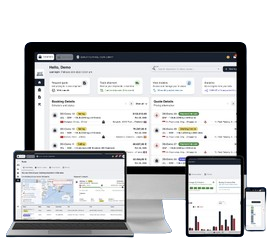
One platform. Your entire supply chain
Sourcing, freight, customs & documents — all centralised, all visible, 24/7.
Worked example: one product and two origins
A two-origin comparison shows why the origin field must be checked after classification. The calculation below uses a hypothetical product because the correct EU TARIC line, customs value and rates must be confirmed for the actual goods on the day of writing.
Assume the same product is imported into the EU from China and Vietnam. First, classify the product to the correct TARIC line. Then retrieve the Chinese third-country rate, the Vietnamese preferential rate under the relevant agreement, and any additional measures. Do not insert a rate merely because the product appears similar to another item.
| Calculation line | China origin | Vietnam origin with valid proof |
| Product | Same product | Same product |
| Destination | European Union | European Union |
| National tariff line | Actual TARIC line required | Same actual TARIC line required |
| Customs value | Actual customs value required | Same customs value if transaction terms match |
| Base duty rate | Retrieve China/MFN rate in TARIC | Retrieve Vietnam preferential rate in TARIC |
| Duty calculation | Customs value × confirmed China rate | Customs value × confirmed Vietnam rate |
| Proof of origin | Not applicable to an FTA preference in this comparison | Required before claiming preference |
| Extra duties | Check by product and China origin | Check by product and Vietnam origin |
| Import VAT | Apply the relevant EU VAT formula | Apply the same formula to the applicable tax base |
| Total import taxes | Duty + extra duties + VAT or other taxes | Duty + extra duties + VAT or other taxes |
For a real quote, replace every placeholder with the dated TARIC result and retain the product description, origin evidence and customs valuation documents. If the Vietnamese proof is missing or invalid, calculate the conservative scenario using the applicable non-preferential rate instead.
The same method applies to the reported India apparel example: identify the tariff line, verify whether the preference is available on the entry date, confirm the origin document, then compare the applicable 9.6% GSP rate with the 12% MFN rate cited by the source. The difference is not created by changing the product. It comes from the preference status and its legal conditions.
DocShipper Tips
Use a final verification checklist before approving the purchase order.
Common mistakes when checking duty rates
The most frequent errors occur before the calculation itself. Importers use a supplier’s code without validation, stop at HS-6, apply a shipping country as origin, or copy a rate from a commercial calculator without checking the national tariff.
- Using the supplier’s code automatically. Ask for the reasoning and compare it with the product’s composition, function and technical documents.
- Stopping at HS-6. Extend the code to the importing country’s national tariff line before recording the duty rate.
- Confusing dispatch country with origin. Verify where the goods were manufactured or substantially transformed.
- Claiming a preference without proof. A trade agreement does not create a lower rate automatically.
- Ignoring trade remedies. Search for anti-dumping, countervailing, safeguard and additional tariff measures by origin.
- Applying duty to the wrong value. Confirm whether freight, insurance and other costs belong in the customs value.
- Calling VAT duty. Separate customs duty, import VAT or GST, excise and clearance charges.
- Relying on an old result. Save the source date and check the official database again before shipment.
- Assuming small parcels are exempt. Review current de minimis, low-value VAT and entry rules for the destination.
- Failing to escalate uncertain classifications. Consider a binding ruling when the financial impact is material.
Use this final verification checklist before approving a purchase order:
- Product description and technical evidence are complete.
- National tariff line is confirmed, not only the HS-6 code.
- Destination tariff tool and access date are recorded.
- Origin is supported by supplier and manufacturing evidence.
- Preference conditions and proof of origin are confirmed.
- Additional duties have been searched by product and origin.
- Customs value and included transport costs are documented.
- VAT, GST, excise and low-value rules are included.
- Final result has been reviewed against the official source.
Conclusion
To check an import duty rate accurately, follow the complete chain rather than searching for a percentage in isolation.
- The duty rate lives on the importing country’s national 8 to 10-digit tariff line, not only on the HS-6 code.
- Always confirm the result in the official tariff tool of the importing country.
- Preferential rates require qualifying origin and valid proof of origin.
- Anti-dumping, safeguards and other additional tariffs can apply on top of the base rate.
- Customs duty, VAT or GST, excise and clearance charges are separate parts of the landed cost.
- Low-value shipments are no longer automatically duty-free in the United States or the European Union under the rules and dates cited above.
Not sure your HS code or duty rate is right? Send us your product details and destination. We can support the classification review, check the applicable duties and taxes, and prepare a door-to-door shipment quote before you order.
FAQ | How to Check Import Duty Rates Before You Order
The shipping term does not change the tariff classification or the amount legally due. It determines which party arranges and pays the import formalities. Under DDP, the seller generally handles import clearance and duties; under DAP or FOB, the buyer usually acts as importer of record and pays them. Confirm the Incoterm, importer-of-record details and whether the quote includes customs clearance before accepting the supplier’s price.
Customs may still require a declared value even when no normal sale has taken place. Depending on the destination’s valuation rules, customs may use the value of identical or similar goods, a resale-based method, a cost-based method or another approved method. Do not declare a nominal value simply because the goods are free. Keep the commercial invoice, transfer-pricing documents, production-cost evidence and a clear explanation of the shipment’s purpose.
They can be. Costs connected with producing or selling the imported goods may need to be added to the invoice price, including certain buyer-provided materials, tooling, design work, royalties or licence fees. Review the purchase contract and payment structure before finalising the customs value. If the treatment is unclear, ask your customs broker or authority for a valuation opinion rather than relying only on the supplier’s invoice.
A kit is not always classified according to its most expensive or most prominent component. Customs may consider the kit’s essential character, retail presentation, intended use and whether the components are designed to work together. A mixed shipment may require separate tariff lines. Provide a packing list showing each component, quantity, material, value and intended use, especially when the items could be sold separately.
Possibly, but relief is usually conditional. Customs may require proof that the exported and returned goods are the same, evidence of the original import entry, repair invoices and compliance with a specific returned-goods or outward-processing procedure. A replacement shipment is not automatically duty-free. Notify the broker before shipping the goods back and confirm the required procedure in advance.
Not necessarily. A VAT- or GST-registered business may be able to recover import tax through its return or use a postponed-accounting mechanism, depending on local rules and the importer’s status. The tax can still create a cash-flow burden, and recovery may fail if the import declaration, importer details or supporting records are incorrect. Separate recoverable tax from the true landed cost when comparing suppliers.
Need Help with
Logistics or Sourcing ?
First, we secure the right products from the right suppliers at the right price by managing the sourcing process from start to finish. Then, we simplify your shipping experience - from pickup to final delivery - ensuring any product, anywhere, is delivered at highly competitive prices.


Fill the Form
Prefer email? Send us your inquiry, and we’ll get back to you as soon as possible.
Contact us