


In short ⚡
ACROSS (Accelerated Commercial Release Operations Support System) is a U.S. Customs and Border Protection (CBP) electronic platform that enables pre-clearance of commercial goods before arrival. This system reduces cargo release time by allowing importers to submit entry documentation and pay duties electronically, facilitating faster border processing and improving supply chain efficiency.Introduction
Many importers struggle with cargo delays at U.S. ports due to customs clearance bottlenecks. Traditional paper-based processes create unnecessary waiting times, storage costs, and supply chain disruptions. Understanding ACROSS is essential for businesses seeking to optimize their import operations and reduce time-to-market.
In international trade, speed matters. Every hour goods sit at the border represents lost revenue and increased logistics costs. ACROSS addresses this challenge by enabling pre-arrival processing through digital integration with CBP systems.
- Pre-clearance capability: Submit entry documentation before cargo arrives at U.S. ports
- Electronic payment system: Pay duties and fees digitally through ACH or other approved methods
- Real-time status tracking: Monitor clearance progress through integrated CBP portals
- Reduced dwell time: Minimize cargo storage at ports through faster release
- Compliance enhancement: Automated validation reduces documentation errors and penalties
Technical Framework & Regulatory Implications
ACROSS operates within the Automated Commercial Environment (ACE), CBP’s primary system for trade processing. Importers must be enrolled in the Automated Broker Interface (ABI) or work with licensed customs brokers who have ABI access. The system requires electronic filing of entry summaries before cargo arrival.
The legal foundation stems from 19 CFR Part 143, which governs entry documentation requirements. ACROSS compliance mandates accurate Harmonized Tariff Schedule (HTS) classification, proper valuation according to 19 USC 1401a, and adherence to all applicable admissibility regulations. Incorrect filings can trigger intensive examinations or penalties.
Three critical technical requirements enable ACROSS functionality. First, data transmission standards must follow CBP’s EDIFACT or XML formats. Second, security protocols require two-factor authentication and encrypted connections. Third, continuous bond coverage ensures financial responsibility for duties and fees.
The system integrates with Partner Government Agencies (PGAs) including FDA, EPA, and USDA. Single-window processing through ACE allows simultaneous submission of requirements for multiple agencies. This integration reduces redundant data entry and accelerates multi-agency clearances.
At DocShipper, we handle ACROSS submissions for clients through our network of licensed customs brokers, ensuring proper classification and documentation to prevent clearance delays. Our compliance team verifies all regulatory requirements before transmission to CBP systems.
For authoritative guidance, consult the official CBP ACE portal which provides technical specifications and regulatory updates.
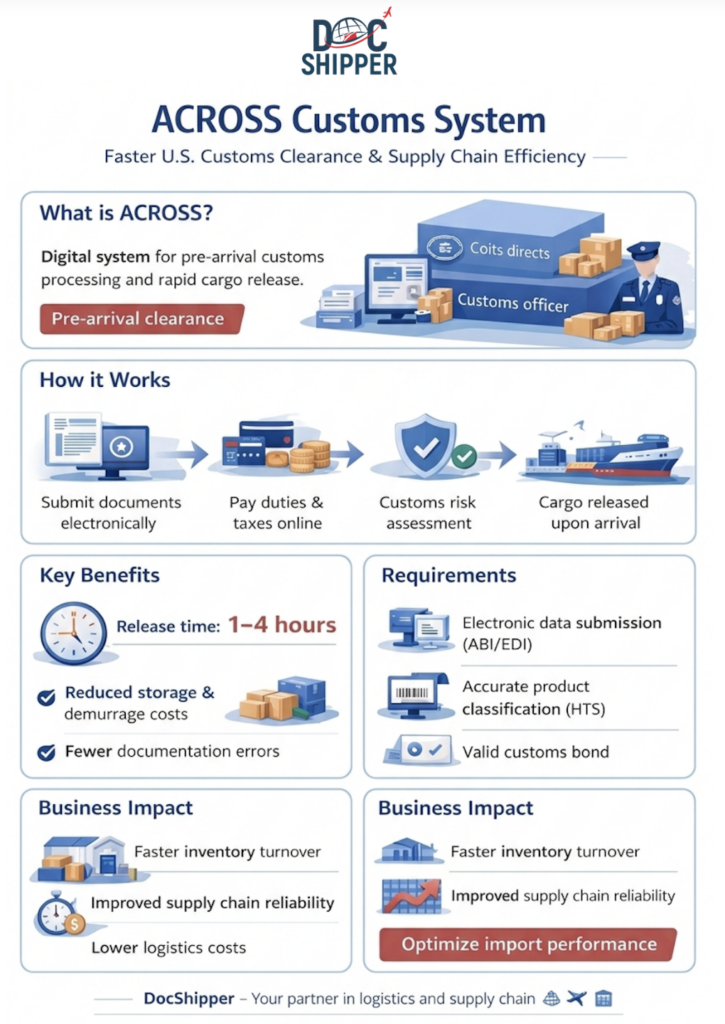
Practical Implementation & Performance Data
Implementation success depends on proper preparation and understanding of operational metrics. CBP data shows ACROSS users achieve cargo release within 1-4 hours compared to 24-48 hours for traditional processing. This efficiency translates directly to cost savings and competitive advantages.
| Processing Method | Average Release Time | Documentation Errors | Port Storage Costs |
|---|---|---|---|
| ACROSS (Pre-clearance) | 1-4 hours | 2-3% | Minimal |
| Traditional Paper Filing | 24-48 hours | 12-15% | $150-300/day |
| ACE without Pre-clearance | 8-12 hours | 5-7% | $50-100/day |
Use Case: Electronics Importer — A California-based electronics distributor importing smartphones from China reduced their border clearance time from 36 hours to 2 hours using ACROSS. By submitting entry documentation 48 hours before vessel arrival, they eliminated $2,400 in monthly port storage fees and improved inventory turnover by 18%.
Five critical success factors determine ACROSS effectiveness:
- Advance documentation preparation: Submit entry summaries 24-72 hours before arrival
- Accurate HTS classification: Prevents post-release audits and duty adjustments
- Proper valuation methodology: Transaction value must reflect actual commercial terms
- Complete PGA compliance: All partner agency requirements submitted simultaneously
- Continuous bond maintenance: Ensure sufficient coverage for all entries
Performance metrics show importers using ACROSS experience 40% fewer examinations due to improved data quality. Electronic validation catches errors before submission, reducing CBP intervention rates. The system’s audit trail also simplifies compliance reviews and reduces penalties during post-entry verifications.
Conclusion
ACROSS represents a fundamental shift in U.S. customs processing, transforming border clearance from a reactive bottleneck into a proactive efficiency tool. Mastering this system provides measurable competitive advantages through reduced costs and faster market access.
Need assistance implementing ACROSS for your import operations? Contact DocShipper for expert guidance on customs clearance optimization.
📚 Quiz
Test Your Knowledge: ACROSS
Q1 — What is the primary purpose of ACROSS (Accelerated Commercial Release Operations Support System)?
Q2 — A common misconception about ACROSS is that it is a completely separate system from ACE. What is the correct interpretation?
Q3 — A California electronics importer wants to use ACROSS to clear a shipment of smartphones arriving by ocean vessel. When should they submit their entry documentation to maximize pre-clearance benefits?
🎯 Your Result
📞 Free Quote in 24hFAQ | ACROSS (Accelerated Commercial Release Operations Support System): Definition, Process & Practical Examples
ACROSS is the operational support system within ACE (Automated Commercial Environment). ACE is the broader CBP platform, while ACROSS specifically handles accelerated commercial release functions through pre-clearance capabilities.
Not necessarily, but most importers work with licensed brokers who have ABI access. Direct filing requires substantial compliance expertise, software investment, and continuous bond coverage. Brokers typically provide cost-effective access to ACROSS functionality.
CBP recommends submitting entry summaries 24-72 hours before cargo arrival. Earlier submission allows time to resolve discrepancies and complete PGA requirements. Ocean shipments typically require longer lead times than air freight.
CBP sends electronic rejection notices through ACE with specific error codes. Corrections must be submitted promptly to maintain pre-clearance status. Repeated rejections may trigger manual review or examination upon arrival.
Most commercial shipments qualify, but certain commodities require additional processing. Regulated goods (food, drugs, agriculture) need PGA clearances. High-risk items or first-time importers may face additional scrutiny regardless of ACROSS participation.
ACROSS itself is a CBP service with no separate fee. Costs include customs broker fees (typically $100-200 per entry), continuous bond premiums ($300-500 annually for $50k coverage), and standard CBP processing fees like MPF and HMF.
Electronic validation catches data errors before submission, improving entry quality. Complete pre-arrival documentation allows CBP risk assessment before cargo arrives. Higher data integrity results in fewer random examinations and faster release decisions.
Importers need an Importer of Record number, continuous customs bond, and either direct ABI access or a licensed broker relationship. ACE portal registration and two-factor authentication are mandatory for security compliance.
Yes, ACE's single-window functionality allows concurrent submission to FDA, EPA, USDA, and other agencies. This eliminates sequential processing delays and provides unified status tracking for all regulatory clearances.
Essential documents include commercial invoice, packing list, bill of lading, entry summary (CBP Form 7501), and any required certificates or permits. All documents must be electronically transmitted through ABI-certified software.
Electronic payment through ACH or periodic monthly statements allows duty settlement before cargo release. This accelerates clearance compared to traditional payment methods that delay release until funds clear.
Frequent errors include incorrect HTS classification, incomplete manufacturer information, improper valuation methodology, missing PGA requirements, and insufficient bond coverage. These mistakes trigger rejections and eliminate pre-clearance benefits.
Need Help with Logistics or Sourcing ?
First, we secure the right products from the right suppliers at the right price by managing the sourcing process from start to finish. Then, we simplify your shipping experience - from pickup to final delivery - ensuring any product, anywhere, is delivered at highly competitive prices.


Fill the Form
Prefer email? Send us your inquiry, and we’ll get back to you as soon as possible.
Contact us


