


In short ⚡
Adventure in logistics refers to unforeseen events or incidents during transport that may result in damage, loss, or delays to cargo. This maritime insurance term encompasses perils like storms, collisions, theft, or accidents requiring immediate response and proper documentation for claims processing.
Introduction
Many importers mistakenly believe their cargo is automatically protected during international transit. The reality is starkly different. Without understanding what constitutes an adventure in shipping terms, businesses face substantial financial exposure when incidents occur.
In international trade, the concept of adventure directly impacts insurance coverage, liability determination, and compensation procedures. Every shipment crossing borders encounters potential perils that fall under this classification.
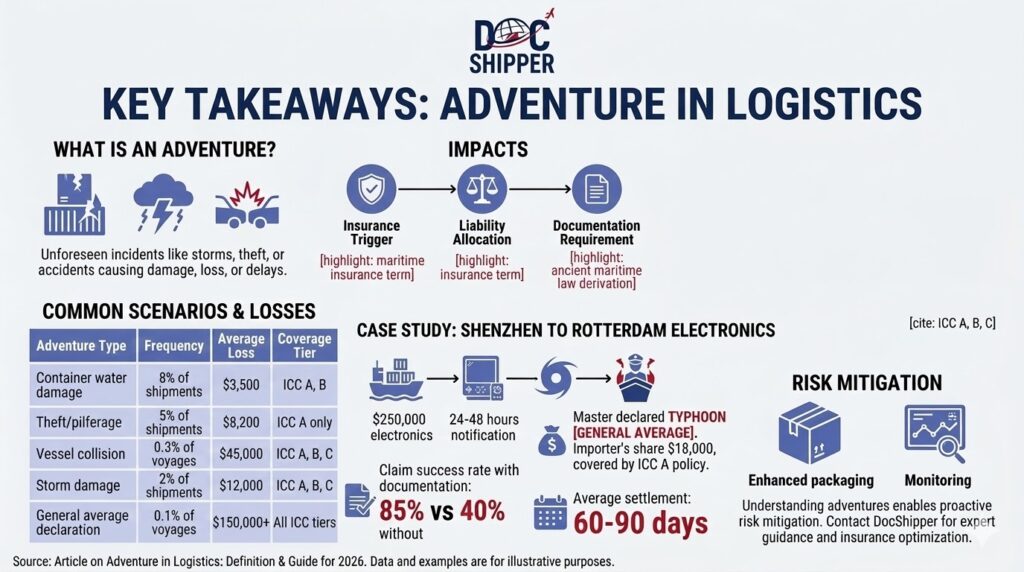
- Maritime origin: The term derives from ancient maritime law governing sea voyages
- Insurance trigger: Adventures activate specific clauses in cargo insurance policies
- Documentation requirement: Proper recording of adventures is essential for claims
- Liability allocation: Determines which party bears financial responsibility
- Prevention protocols: Understanding adventures enables proactive risk mitigation
Legal Framework & Risk Management
The legal definition of adventure traces back to the York-Antwerp Rules, internationally recognized guidelines governing general average in maritime transport. These rules, maintained by the Comité Maritime International, establish how losses from adventures are distributed among stakeholders.
Adventures are classified into two primary categories under marine insurance law. Particular average refers to partial losses affecting only the insured party’s cargo, while general average involves deliberate sacrifices made to save the entire voyage, with costs shared proportionally.
The Institute Cargo Clauses (ICC A, B, C) define which adventures are covered under different insurance tiers. ICC A provides all-risk coverage for most adventures except those explicitly excluded. ICC B and C offer progressively narrower protection, covering only named perils like fire, collision, or vessel stranding.
Modern logistics requires meticulous adventure documentation. The master’s protest, survey reports, and contemporaneous records establish the factual basis for insurance claims. Missing or inadequate documentation frequently results in claim denials, regardless of actual loss.
At DocShipper, we systematically verify insurance coverage and adventure protocols before shipment departure. Our risk assessment identifies potential exposure points and ensures clients maintain appropriate protection levels throughout the supply chain.
The Hamburg Rules and subsequent conventions establish carrier liability limits for adventures occurring during their custody period. Understanding these thresholds helps shippers determine whether supplemental insurance is necessary beyond carrier-provided coverage.
For authoritative guidance on maritime insurance principles, consult the International Maritime Organization, which publishes updated conventions and best practices for adventure management in international shipping.
Comparative Adventure Scenarios
| Adventure Type | Frequency | Average Loss | Coverage Tier |
|---|---|---|---|
| Container water damage | 8% of shipments | $3,500 | ICC A, B |
| Theft/pilferage | 5% of shipments | $8,200 | ICC A only |
| Vessel collision | 0.3% of voyages | $45,000 | ICC A, B, C |
| Storm damage | 2% of shipments | $12,000 | ICC A, B, C |
| General average declaration | 0.1% of voyages | $150,000+ | All ICC tiers |
Use Case: Electronics Shipment Adventure
A European importer shipped $250,000 worth of consumer electronics from Shenzhen to Rotterdam. During transit through the South China Sea, the vessel encountered a typhoon classified as an adventure under maritime law.
The master declared general average, requiring all cargo interests to contribute proportionally to emergency expenses. The importer’s share totaled $18,000, but their ICC A policy covered this exposure. Without proper insurance, they would have faced cargo detention until posting a bond.
This case demonstrates why understanding adventure classifications matters. The importer’s documentation included timestamped photos, survey reports, and the master’s protest—all critical for successful claim resolution within 45 days.
- Response time: Adventures require immediate notification to insurers (typically within 24-48 hours)
- Survey costs: Independent surveyors charge $800-$2,500 per inspection, but this investment protects larger claims
- Claim success rate: Properly documented adventures have 85% approval rates versus 40% for inadequate documentation
- Settlement timeline: Average adventure claims resolve in 60-90 days with complete documentation
- Prevention investment: Enhanced packaging and monitoring reduce adventure frequency by up to 40%
Conclusion
Understanding adventure in logistics transforms abstract insurance concepts into actionable risk management strategies. Proper preparation, documentation, and coverage selection protect businesses from financial exposure during international transport.
Need expert guidance on adventure risk assessment or insurance optimization? Contact DocShipper for comprehensive logistics support tailored to your supply chain requirements.
DocShipper Platform
One platform. Your entire supply chain
Sourcing, freight, customs & documents — all centralised, all visible, 24/7.
📚 Quiz
Test Your Knowledge: Adventure in Logistics
1. What does the term "adventure" refer to in a logistics and maritime insurance context?
2. A vessel encounters a severe storm and the captain deliberately jettisons some cargo to save the ship and remaining goods. All cargo owners must share the financial loss proportionally. Which type of adventure does this scenario describe?
3. An importer's shipment is stolen during transit. Their cargo insurance policy is ICC B. Will this adventure be covered?
🎯 Your Result
📞 Free Quote in 24hFAQ | Adventure: Definition, Types & Practical Examples in Logistics
An adventure is any unforeseen incident during transit causing potential loss or damage, including storms, collisions, theft, fire, or vessel grounding. It must be documented through official maritime protocols to trigger insurance coverage.
No. Coverage depends on your policy tier. ICC A covers most adventures except exclusions like war or strikes. ICC B and C cover only named perils. Review your certificate of insurance for specific adventure coverage details.
Most policies require notification within 24-48 hours of discovering the adventure. Delays can jeopardize claims. Immediate reporting allows surveyors to assess damage while evidence remains fresh and preserves your rights under the policy.
Particular average affects only your cargo, with losses borne solely by your insurance. General average involves sacrifices benefiting all parties on the voyage, with costs shared proportionally among all cargo interests regardless of individual damage.
Carrier liability depends on the adventure's cause and applicable conventions. They're responsible for negligence but not for perils beyond their control like storms. Liability is typically capped at specific amounts per kilogram under international law.
Essential documents include the master's protest, independent surveyor reports, contemporaneous photographs, bill of lading notations, and witness statements. Complete documentation significantly increases claim approval rates and accelerates settlement.
Yes. Routes through piracy zones, typhoon-prone regions, or areas with port congestion show higher adventure frequencies. The Malacca Strait, Gulf of Aden, and South China Sea during monsoon season present elevated risks requiring enhanced coverage.
Adventures typically delay shipments by 5-30 days depending on severity. General average declarations can extend delays to 60-90 days while adjusters calculate contributions. Time-sensitive cargo should include contingency planning for potential adventure-related delays.
Without insurance, you bear all losses directly. In general average situations, you must post a bond or cash deposit before cargo release, potentially freezing working capital for months. Uninsured adventures frequently result in total financial loss.
Absolutely. Maritime-grade packaging, moisture barriers, and shock-absorbing materials reduce damage severity by 40-60% during adventures. Investment in proper packaging often costs less than deductibles on adventure-related insurance claims.
Air cargo faces different adventure types—turbulence damage, ground handling incidents, or emergency landings. While less frequent than maritime adventures, air shipment incidents require similar documentation and insurance protocols for successful claims processing.
Frequent adventure claims signal higher risk, potentially increasing premiums by 15-40%. However, claims resulting from documented uncontrollable events typically have minimal impact. Maintaining strong loss prevention records helps negotiate favorable renewal terms despite occasional adventures.
Need Help with
Logistics or Sourcing ?
First, we secure the right products from the right suppliers at the right price by managing the sourcing process from start to finish. Then, we simplify your shipping experience - from pickup to final delivery - ensuring any product, anywhere, is delivered at highly competitive prices.


Fill the Form
Prefer email? Send us your inquiry, and we’ll get back to you as soon as possible.
Contact us

01


