


In short ⚡
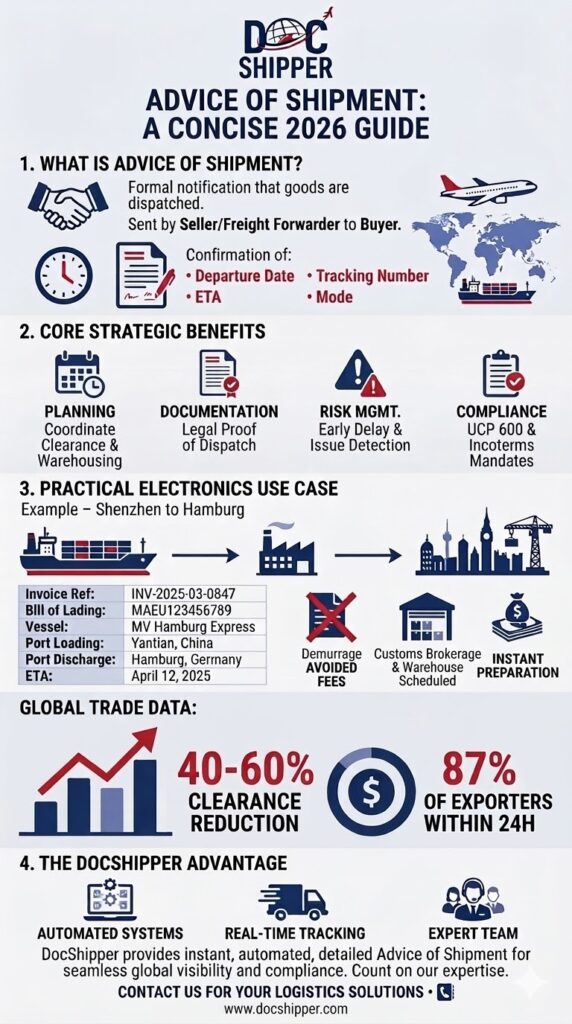
Advice of Shipment is a formal notification sent by the seller or freight forwarder to the buyer confirming that goods have been dispatched. This document includes shipment details such as departure date, transport mode, tracking number, and expected delivery time, enabling buyers to prepare for customs clearance and receipt.
Introduction
In international trade, one of the most common frustrations buyers face is uncertainty about shipment status. Without timely communication, importers cannot prepare warehousing, arrange customs brokerage, or plan inventory management.
The Advice of Shipment solves this problem by providing critical visibility in the supply chain. It acts as the bridge between order confirmation and physical delivery, ensuring all parties remain synchronized throughout the logistics process.
- Transparency: Confirms actual departure, not just intent to ship
- Planning: Enables buyers to coordinate customs clearance and final delivery
- Documentation: Serves as proof of shipment for financial and contractual purposes
- Risk management: Allows early detection of delays or routing issues
- Compliance: Required under certain Incoterms and Letter of Credit terms
In-Depth Analysis & Legal Framework
The Advice of Shipment is not merely a courtesy—it carries contractual and legal significance in international commerce. Its issuance is often mandated by payment terms, particularly in documentary credit transactions governed by ICC’s UCP 600.
Under Incoterms 2020, the obligation to notify varies by term. For example, under FOB (Free On Board), the seller must notify the buyer once goods are loaded. Under DDP (Delivered Duty Paid), notification timing differs as the seller retains responsibility until final delivery.
The document typically contains five essential elements: commercial invoice reference, bill of lading or airway bill number, vessel or flight details, port of loading and discharge, and estimated time of arrival. Missing any of these can delay customs clearance or trigger penalty clauses.
From a compliance perspective, customs authorities in jurisdictions like the European Union and United States increasingly require advance shipment data. The Advice of Shipment feeds into systems like the EU’s Import Control System (ICS2) and the U.S. Automated Commercial Environment (ACE), where pre-arrival information is mandatory for security screening.
At DocShipper, we systematically issue detailed Advice of Shipment notifications to our clients, ensuring all regulatory requirements are met and customs clearance can proceed without delays. Our automated systems track shipments in real-time and trigger notifications at critical milestones.
For authoritative guidance on documentary requirements, consult the ICC Incoterms® 2020 and the WTO Trade Facilitation Agreement.
Practical Examples & Data
Understanding the Advice of Shipment becomes clearer through real-world scenarios. Consider a European importer receiving electronics from Shenzhen, China.
Use Case: Electronics Import from China to Germany
Scenario: A German retailer orders 5,000 smartphones (HS Code 8517.12) under CIF Hamburg terms. The Chinese supplier ships via ocean freight on March 15, 2025.
Advice of Shipment issued: March 15, 2025 (same day as vessel departure)
| Information Type | Details Provided |
|---|---|
| Invoice Reference | INV-2025-03-0847 |
| Bill of Lading | MAEU123456789 |
| Vessel Name | MV Hamburg Express |
| Port of Loading | Yantian, China |
| Port of Discharge | Hamburg, Germany |
| ETA | April 12, 2025 |
Impact: Upon receiving this advice, the German buyer immediately instructs their customs broker to prepare import documentation. They arrange warehouse space for April 13 and schedule quality inspection for April 14. Without this notification, the buyer would face demurrage charges (typically €150–300 per day) for delayed container pickup.
Key Data Points in Global Trade
- Notification timing: 87% of professional exporters issue Advice of Shipment within 24 hours of departure
- Cost of delays: Late notification causes average demurrage costs of $250–500 per container in major ports
- Customs efficiency: Pre-arrival data submission reduces clearance time by 40–60%
- Letter of Credit compliance: 23% of LC discrepancies relate to missing or late shipment advice
- Digital adoption: 68% of Fortune 500 importers now require electronic Advice of Shipment via EDI or API integration
At DocShipper, we leverage automated shipment tracking systems that generate Advice of Shipment notifications instantly upon vessel departure or flight takeoff, ensuring our clients maintain full supply chain visibility and avoid costly delays.
Conclusion
The Advice of Shipment is a fundamental document in international logistics, bridging the gap between order and delivery while enabling efficient customs clearance and supply chain coordination. Proper issuance and management of this notification directly impact cost control and operational efficiency.
Need expert support managing your international shipments and documentation? Contact DocShipper for comprehensive freight forwarding and customs brokerage services.
📚 Quiz
Test Your Knowledge: Advice of Shipment
Q1 — What is the primary purpose of an Advice of Shipment?
Q2 — What happens if an Advice of Shipment is NOT provided to the buyer?
Q3 — A Chinese supplier ships electronics to Germany under FOB Yantian terms. The vessel departs on March 15. Which scenario correctly reflects best practice for the Advice of Shipment?
🎯 Your Result
📞 Free Quote in 24hFAQ | Advice of Shipment: Definition, Purpose & Practical Examples
Advice of Shipment is a notification document confirming departure, while the Bill of Lading is a legal title document proving ownership and contract of carriage. The advice precedes the B/L and serves as early notification.
Not universally mandatory, but required under specific Incoterms (like FOB), Letter of Credit terms, and customs pre-arrival filing requirements in many jurisdictions including the EU and USA.
Typically within 24 hours of actual departure (vessel sailing or flight takeoff). Some contracts specify exact timing requirements, often linked to payment or LC presentation deadlines.
Yes, electronic transmission via email, EDI, or API integration is increasingly standard and preferred for speed. Digital formats also facilitate integration with customs pre-clearance systems.
Buyers cannot prepare for arrival, risking demurrage charges, delayed customs clearance, and potential LC discrepancies. It may also constitute breach of contract depending on agreed terms.
Typically the seller or their freight forwarder. Under certain Incoterms, the carrier may also issue notification, but contractual responsibility usually lies with the exporting party.
Yes, it should include tracking references such as Bill of Lading number, container numbers, vessel name, or airway bill number, enabling buyers to monitor shipment progress independently.
Different Incoterms impose varying notification obligations. FOB requires notification upon loading, while DDP may require notification at multiple stages. Always verify specific term requirements.
Yes, if shipment details change (vessel substitution, route changes), an amended advice should be issued immediately. Timely updates prevent customs and logistics disruptions.
Essential elements include invoice reference, transport document number, carrier details, departure date, ports/airports of loading and discharge, and estimated arrival time. Additional details may include cargo description and packaging information.
The terms are often used interchangeably, though "Advice of Shipment" is more formal and commonly used in international trade documentation, while "shipping notice" may be used in domestic contexts.
It provides advance information enabling customs brokers to prepare import declarations, calculate duties, and submit pre-arrival data to customs systems, significantly reducing clearance time upon arrival.
Need Help with Logistics or Sourcing ?
First, we secure the right products from the right suppliers at the right price by managing the sourcing process from start to finish. Then, we simplify your shipping experience - from pickup to final delivery - ensuring any product, anywhere, is delivered at highly competitive prices.


Fill the Form
Prefer email? Send us your inquiry, and we’ll get back to you as soon as possible.
Contact us


