


In short ⚡
The Administrative Monetary Penalty System (AMPS) is Canada's enforcement framework used by the Canada Border Services Agency (CBSA) to impose financial penalties for non-compliance with customs regulations. It applies graduated sanctions based on violation severity, ranging from minor administrative errors to serious infractions involving prohibited goods or fraud.
Introduction
Importers frequently underestimate the financial risks associated with customs non-compliance in Canada. A single documentation error or misclassification can trigger penalties reaching tens of thousands of dollars.
The Administrative Monetary Penalty System serves as the CBSA’s primary enforcement mechanism. It replaces criminal prosecution for most customs violations, offering a structured penalty framework that balances deterrence with proportionality.
Understanding AMPS is critical for businesses engaged in cross-border trade because:
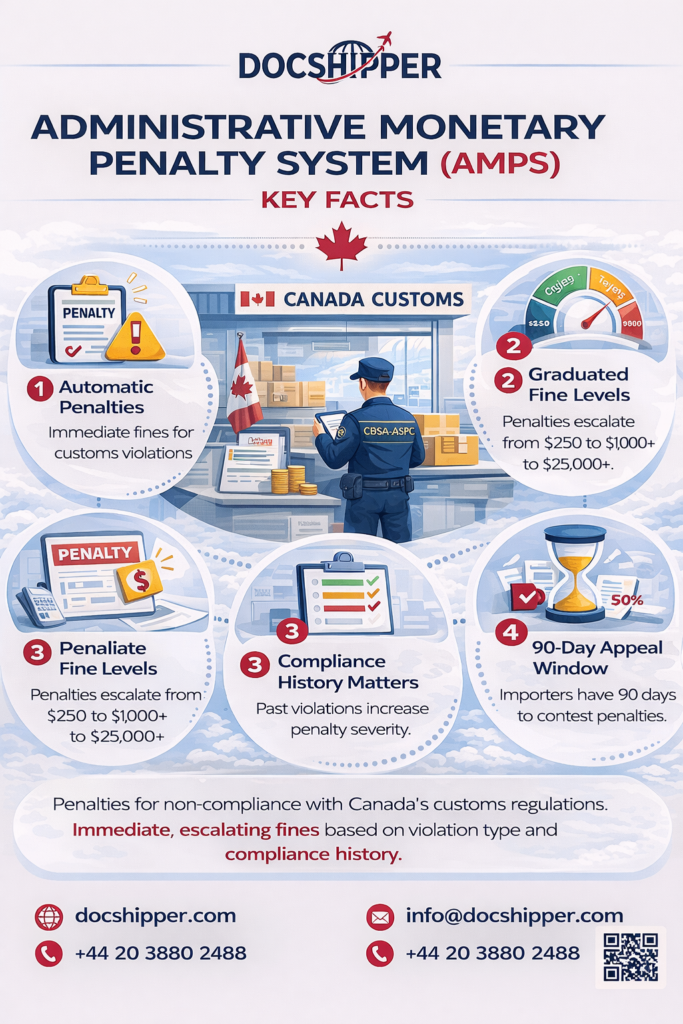
- Penalties are automatic: Violations trigger immediate financial sanctions without requiring court proceedings.
- Amounts escalate rapidly: Repeat offenses or serious infractions carry significantly higher penalties.
- Compliance history matters: The CBSA tracks violations over a five-year period, affecting penalty calculations.
- Administrative burden increases: Penalties often come with enhanced scrutiny and additional compliance requirements.
- Business reputation is at stake: Repeated violations can damage relationships with customs authorities and trading partners.
In-Depth Analysis & Regulatory Framework
AMPS operates under the Customs Act and applies to violations of customs legislation, including the Customs Act, Customs Tariff, and related regulations. The system categorizes infractions into five penalty levels (A through E), with severity determined by factors such as intent, potential revenue loss, and threat to public safety.
Penalty classification follows a structured approach. Level A violations represent minor administrative errors like incomplete documentation. Level E violations involve serious offenses such as smuggling prohibited goods or deliberate misrepresentation. The CBSA applies a base penalty amount corresponding to each level, then adjusts based on compliance history and aggravating factors.
The penalty calculation methodology incorporates three key components. First, the base penalty reflects the violation category. Second, a compliance factor multiplies the base amount if previous violations occurred within five years. Third, aggravating circumstances—such as obstruction of CBSA officers or involvement of prohibited goods—can double or triple penalties.
Due process protections exist within AMPS. Importers receive a Notice of Penalty Assessment detailing the violation, penalty amount, and payment deadline. Recipients have 90 days to request a Ministerial Review, presenting evidence or arguments for penalty reduction or cancellation. If unsatisfied with the review outcome, further appeal to the Federal Court remains available.
According to the CBSA’s official AMPS guidance, the system aims to encourage voluntary compliance rather than punish honest mistakes. At DocShipper, we systematically review customs declarations and supporting documentation to ensure compliance with AMPS requirements, minimizing penalty exposure for our clients.
Voluntary disclosure provisions offer penalty mitigation. When importers proactively report errors before CBSA detection, penalties may be reduced by 90% or waived entirely. This mechanism rewards transparency and allows businesses to correct mistakes while avoiding severe financial consequences.
Practical Examples & Penalty Calculations
Understanding AMPS through concrete scenarios helps importers recognize risk areas and implement preventive measures. The following examples illustrate penalty application across different violation types and compliance histories.
| Violation Type | AMPS Level | Base Penalty (CAD) | First Offense | Repeat Offense (5-year period) |
|---|---|---|---|---|
| Incomplete commercial invoice | A | $250 | $250 | $500 (2x multiplier) |
| Incorrect tariff classification | C | $2,500 | $2,500 | $5,000 (2x multiplier) |
| Undervaluation of goods | D | $5,000 – $25,000 | $10,000 (typical) | $20,000 (2x multiplier) |
| Failure to report prohibited goods | E | $25,000 – $100,000 | $50,000 (typical) | $100,000+ (3x multiplier) |
| Late payment of duties (30-60 days) | B | $1,000 | $1,000 | $2,000 (2x multiplier) |
Case Study: Tariff Misclassification
A Montreal-based electronics importer classified LED lighting fixtures under HS code 8539 (light bulbs) instead of 9405 (lighting fixtures). The error resulted in underpaid duties of $8,400.
Penalty calculation:
- Violation level: C (incorrect classification)
- Base penalty: $2,500
- Compliance history: No prior violations
- Total AMPS penalty: $2,500
- Additional requirement: Payment of $8,400 in duties owed plus interest
- Total financial impact: $10,900+
Case Study: Voluntary Disclosure Benefit
A Vancouver importer discovered they had underreported the value of textile shipments over six months, resulting in $15,000 in unpaid duties. They filed a voluntary disclosure before CBSA audit.
Outcome comparison:
- Without voluntary disclosure: Level D penalty ($10,000) + duties ($15,000) + interest = $25,000+
- With voluntary disclosure: 90% penalty reduction ($1,000) + duties ($15,000) + interest = $16,000+
- Savings: $9,000
At DocShipper, we conduct regular compliance audits for clients, identifying potential discrepancies before they trigger AMPS penalties. Our proactive approach has helped numerous importers utilize voluntary disclosure provisions, achieving penalty reductions exceeding 85% on average.
Key Risk Factors
- Product complexity: Technical goods requiring specialized classification knowledge carry higher misclassification risk.
- Valuation ambiguity: Related-party transactions and royalty payments often trigger undervaluation penalties.
- Documentation gaps: Missing certificates of origin or incomplete commercial invoices represent common Level A violations.
- Regulatory changes: Tariff updates and new trade agreements create compliance challenges for unprepared importers.
- Volume scaling: Businesses experiencing rapid growth often lack systems to maintain compliance standards across increased shipment volumes.
Conclusion
The Administrative Monetary Penalty System represents a significant financial risk for Canadian importers, but understanding its structure enables effective compliance strategies. Proactive documentation review, accurate classification, and voluntary disclosure when errors occur minimize penalty exposure.
Need expert guidance on AMPS compliance or customs risk management? Contact DocShipper for a comprehensive compliance assessment tailored to your import operations.
📚 Quiz
Test Your Knowledge: Administrative Monetary Penalty System (AMPS)
Q1 — What is the primary purpose of the Administrative Monetary Penalty System (AMPS)?
Q2 — A Canadian importer discovers they have underreported the value of shipments before the CBSA launches an audit. If they file a voluntary disclosure, what is the typical penalty outcome?
Q3 — An importer receives a Notice of Penalty Assessment for an incorrect tariff classification. They believe the penalty is unjustified. What is the correct first step to challenge it?
🎯 Your Result
📞 Free Quote in 24hFAQ | Administrative Monetary Penalty System (AMPS): Definition, Calculation & Practical Examples
Level E violations can result in penalties up to $100,000 or more for serious offenses involving prohibited goods, fraud, or repeated non-compliance. Aggravating factors can increase amounts further.
The CBSA maintains a five-year compliance history. Violations within this period affect penalty multipliers, with repeat offenses typically doubling or tripling base penalty amounts.
Yes. Importers can request a Ministerial Review within 90 days of receiving the Notice of Penalty Assessment. Further appeal to Federal Court is possible if the review outcome is unsatisfactory.
Voluntary disclosure typically reduces penalties by 90% and may waive them entirely for first-time, minor violations. However, duties owed plus interest must still be paid regardless of disclosure timing.
Level A covers minor administrative errors like incomplete paperwork. Level E involves serious offenses such as smuggling, deliberate misrepresentation, or importing prohibited goods with intent to evade regulations.
Payment is typically due within 30 days of the Notice of Penalty Assessment. Late payment can result in additional penalties and interest charges, plus potential enforcement actions.
Generally no. Penalties imposed for regulatory violations are not considered deductible business expenses under Canadian tax law. Consult a tax professional for specific circumstances.
The importer of record bears primary responsibility. However, brokers providing inaccurate information or failing to exercise due diligence may face professional liability or separate AMPS penalties.
Commercial invoices, packing lists, certificates of origin, laboratory test results, correspondence demonstrating good faith efforts, and records of internal compliance procedures all support penalty reduction requests.
AMPS primarily governs imports. Export violations fall under different enforcement mechanisms, though some AMPS provisions apply to export-related documentation failures or prohibited goods violations.
AMPS provides administrative penalties without criminal proceedings for most violations. Criminal prosecution remains reserved for egregious cases involving organized crime, large-scale smuggling, or threats to national security.
Yes. A single shipment with multiple infractions (e.g., incorrect classification plus incomplete documentation) can trigger separate penalties for each violation, significantly increasing total financial exposure.
Need Help with Logistics or Sourcing ?
First, we secure the right products from the right suppliers at the right price by managing the sourcing process from start to finish. Then, we simplify your shipping experience - from pickup to final delivery - ensuring any product, anywhere, is delivered at highly competitive prices.


Fill the Form
Prefer email? Send us your inquiry, and we’ll get back to you as soon as possible.
Contact us


:%20Definition,%20Calculation%20&%20Practical%20Examples)