


In short ⚡
ASC X12 is an American National Standards Institute (ANSI) accredited standards organization that develops and maintains electronic data interchange (EDI) standards for cross-industry exchange of business transactions. The X12 format enables automated communication between trading partners, eliminating paper-based processes and ensuring data consistency across supply chains.Introduction
Miscommunication between shippers, carriers, and customs brokers costs the logistics industry billions annually. Manual data entry errors, incompatible formats, and delayed information exchange create bottlenecks that impact delivery times and customer satisfaction.
ASC X12 addresses these challenges by providing a standardized language for business documents. From purchase orders to shipping notices, this EDI standard ensures that critical information flows seamlessly between systems, regardless of the software platforms involved.
Key characteristics of ASC X12:
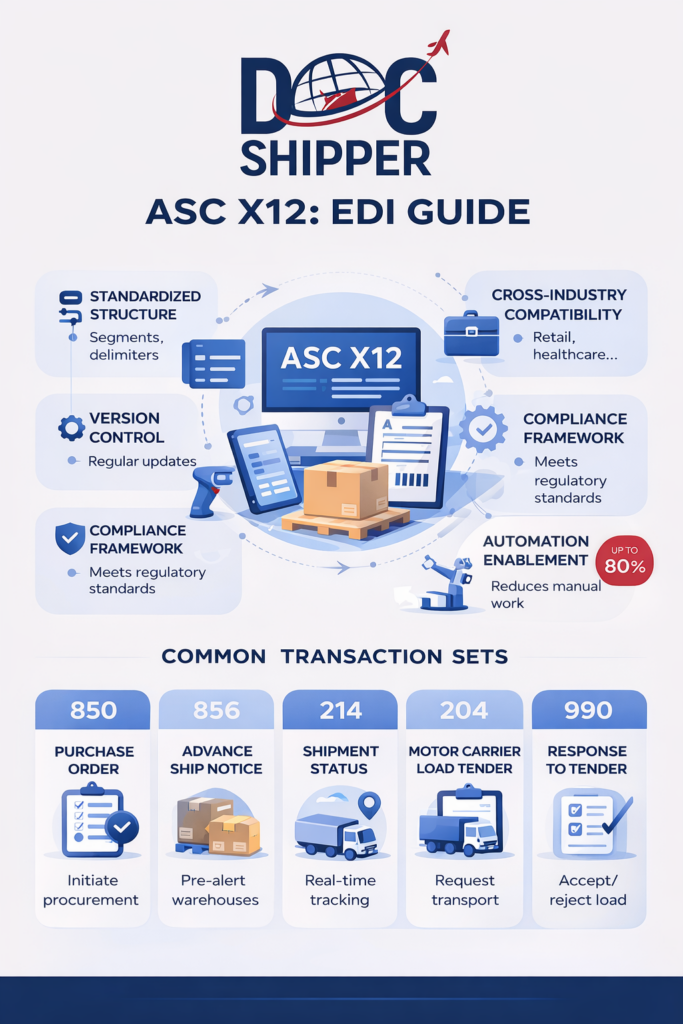
- Standardized structure – Segments, elements, and delimiters follow strict formatting rules
- Cross-industry compatibility – Used in retail, healthcare, transportation, finance, and manufacturing
- Version control – Regular updates maintain relevance with evolving business needs
- Compliance framework – Supports regulatory requirements for data exchange
- Automation enablement – Reduces manual processing by up to 80% in logistics operations
Technical Framework & Industry Applications
The ASC X12 architecture consists of hierarchical components that organize business data into machine-readable formats. Each transaction set begins with an ST (transaction set header) and ends with an SE (transaction set trailer), containing segments that represent specific data elements.
The segment structure uses delimiters to separate data elements. A typical segment might look like: N1*SF*DocShipper*92*12345~, where the asterisk (*) separates elements and the tilde (~) marks the segment terminator. This precise formatting allows automated systems to parse information without human intervention.
In international logistics, the 214 Transportation Carrier Shipment Status Message enables real-time tracking updates. Carriers transmit location data, estimated delivery times, and exception alerts directly to shipper systems. At DocShipper, we integrate X12 214 transactions to provide clients with automated shipment visibility across ocean, air, and ground transport.
The 856 Advance Ship Notice (ASN) revolutionized warehouse operations by transmitting detailed packing information before physical arrival. This transaction set includes item descriptions, quantities, carton configurations, and carrier details—allowing receiving facilities to prepare dock space and labor resources efficiently.
Customs compliance benefits significantly from X12 standards. The 350 Customs Status Information transaction facilitates communication between brokers and government agencies. According to U.S. Customs and Border Protection, automated X12 submissions reduce clearance times by an average of 40% compared to manual filings.
The version management system ensures backward compatibility while introducing enhancements. Current implementations use versions ranging from 4010 to 8020, with trading partners negotiating which version to adopt. DocShipper maintains compatibility across multiple X12 versions to accommodate diverse client requirements.
Practical Implementation & Transaction Sets
Understanding common transaction sets helps logistics professionals identify which X12 documents apply to their operations. The following table compares frequently used sets in international trade:
| Transaction Set | Purpose | Logistics Application |
|---|---|---|
| 850 | Purchase Order | Initiates procurement from overseas suppliers |
| 856 | Advance Ship Notice | Pre-alerts warehouses of incoming shipments |
| 214 | Shipment Status | Provides real-time tracking updates |
| 204 | Motor Carrier Load Tender | Requests carrier to transport freight |
| 990 | Response to Load Tender | Carrier accepts or rejects shipment |
Implementation case study: A mid-sized electronics importer reduced order processing time from 48 hours to 15 minutes by deploying X12 integration. Their system automatically converts supplier 850 purchase orders into factory-readable formats, then receives 856 ASNs that trigger warehouse management system (WMS) preparations. The result: 99.2% inventory accuracy and 30% faster order fulfillment.
The data element dictionary defines over 1,800 standardized fields. Element 373 (date) uses CCYYMMDD format, while element 355 (unit of measurement) employs codes like “LB” for pounds or “KG” for kilograms. This precision eliminates ambiguity—a critical factor when coordinating international shipments across time zones and measurement systems.
Trading partner agreements establish technical parameters before X12 exchange begins. Partners must agree on delimiters, character sets (ASCII vs. EBCDIC), communication protocols (AS2, SFTP, VAN), and acknowledgment requirements. DocShipper assists clients in negotiating these agreements to ensure smooth EDI onboarding with carriers and suppliers.
The 997 Functional Acknowledgment confirms receipt and validates syntax of transmitted documents. When a shipper sends an 856 ASN, the receiving system returns a 997 indicating successful processing or detailing errors. This closed-loop communication prevents data loss and enables rapid troubleshooting.
Cost-benefit analysis shows compelling ROI for X12 adoption. Industry data indicates companies processing 500+ monthly transactions save $12-18 per document compared to manual methods. For a logistics provider handling 10,000 shipments annually, this translates to $150,000+ in operational savings—not including reduced error rates and faster payment cycles.
Conclusion
ASC X12 standards form the backbone of modern supply chain automation, enabling precise, rapid communication between trading partners worldwide. Mastering these transaction sets reduces costs, accelerates processing, and enhances compliance.
Need assistance implementing X12 EDI for your logistics operations? Contact DocShipper for expert guidance on integration, partner onboarding, and process optimization.
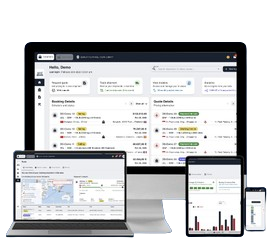
DocShipper Platform
One platform. Your entire supply chain
Sourcing, freight, customs & documents — all centralised, all visible, 24/7.
📚 Quiz
Test Your Knowledge: ASC X12
Q1 — What is ASC X12?
Q2 — When an X12 transmission contains errors, what does the receiving system send back to the sender?
Q3 — A warehouse needs to prepare dock space and labor before a shipment physically arrives. Which X12 transaction set should the supplier send?
🎯 Your Result
📞 Free Quote in 24hFAQ | ASC X12: Definition, Structure & Practical Examples in EDI
ASC X12 is primarily used in North America, while EDIFACT (Electronic Data Interchange For Administration, Commerce and Transport) dominates in Europe and Asia. Both achieve similar goals but use different syntax and segment structures.
Identify your most frequent business documents (purchase orders, invoices, shipping notices). Map these to corresponding X12 transaction sets. The 850, 810, and 856 cover 70% of logistics scenarios.
Absolutely. Cloud-based EDI solutions now offer affordable entry points for SMEs. Companies processing just 100 monthly transactions often see ROI within 6-9 months through reduced errors and faster processing.
You need EDI translation software (to convert X12 to/from internal formats), communication software (AS2, SFTP), and integration with your ERP/WMS. Many providers offer all-in-one platforms.
The ASC X12 committee releases new versions annually. However, adoption lags—many industries standardize on specific versions (like 4010 or 5010) for 5-10 years to maintain compatibility.
A VAN acts as an intermediary that receives, stores, and forwards X12 transactions between trading partners. It handles protocol translation, security, and delivery confirmation—useful when partners use incompatible systems.
Modern X12 implementations use AS2 protocol with encryption (AES-256) and digital signatures. This meets HIPAA, PCI-DSS, and other compliance standards for data protection.
Standard X12 uses ASCII, which limits non-English characters. Extended versions support UTF-8 encoding for international names and addresses, though trading partners must agree on character set usage.
The receiving system generates a 997 Functional Acknowledgment detailing syntax errors. The sender must correct and retransmit. Some systems automatically retry failed transmissions up to three times.
Yes. Transaction sets like 350 (Customs Status) and 309 (Customs Manifest) facilitate automated filing with government agencies. This integration reduces clearance times and improves compliance accuracy.
For a single trading partner connection, expect 4-8 weeks: 1 week for agreement negotiation, 2-3 weeks for system configuration, 1-2 weeks for testing, and 1-2 weeks for parallel operation before go-live.
Transaction sets like 204 (Load Tender) and 214 (Status) accommodate ocean, air, rail, and truck segments. Carriers transmit mode-specific data (container numbers, flight details, railcar IDs) within standardized segment structures.
Need Help with
Logistics or Sourcing ?
First, we secure the right products from the right suppliers at the right price by managing the sourcing process from start to finish. Then, we simplify your shipping experience - from pickup to final delivery - ensuring any product, anywhere, is delivered at highly competitive prices.


Fill the Form
Prefer email? Send us your inquiry, and we’ll get back to you as soon as possible.
Contact us


