Astern: Maritime Definition & Guide for 2026

  • admin 7 Min
  • Published on March 5, 2026 Updated on March 10, 2026
img

In short ⚡

Astern is a nautical term indicating movement or position toward the rear (stern) of a vessel. In maritime logistics, this directional command guides vessel maneuvering during docking, loading operations, and navigation in confined spaces. Understanding astern operations is critical for cargo handling efficiency and port safety protocols.

Introduction

Confusion between directional maritime terms causes thousands of docking incidents annually. Astern operations represent one of the most fundamental yet misunderstood aspects of vessel maneuvering in international trade.

In global shipping logistics, precise directional control determines port turnaround times, cargo safety, and operational costs. The astern command directly impacts vessel positioning during critical loading and unloading phases.

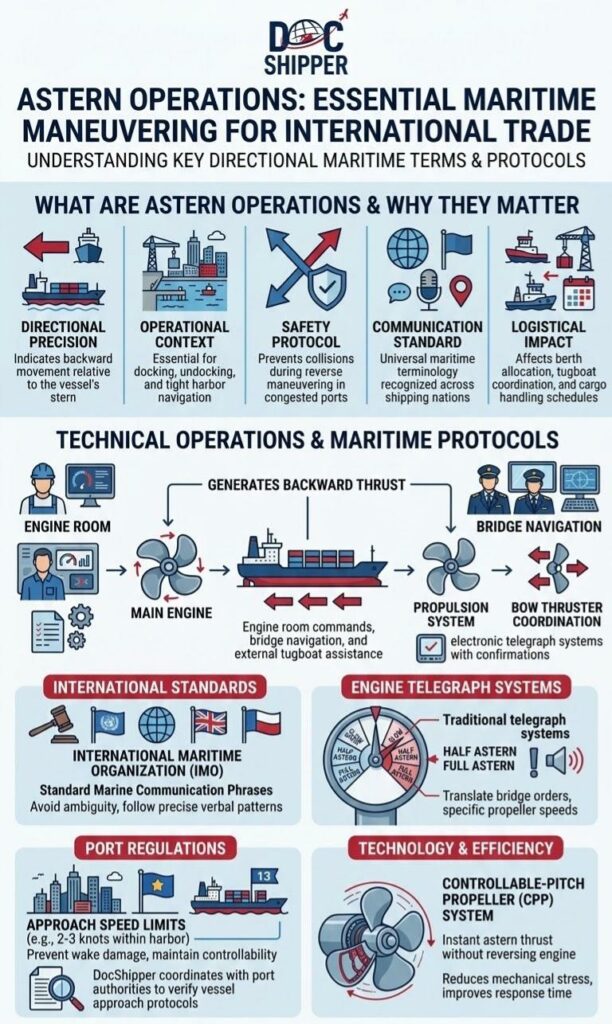
  • Directional precision: Astern indicates backward movement relative to the vessel’s stern
  • Operational context: Essential for docking, undocking, and tight harbor navigation
  • Safety protocol: Prevents collisions during reverse maneuvering in congested ports
  • Communication standard: Universal maritime terminology recognized across all shipping nations
  • Logistical impact: Affects berth allocation, tugboat coordination, and cargo handling schedules

Technical Operations & Maritime Protocols

Astern operations involve reversing the vessel’s propulsion system to generate backward thrust. This maneuver requires coordinated control between engine room commands, bridge navigation, and external tugboat assistance in larger vessels.

The International Maritime Organization (IMO) establishes standardized communication protocols for astern commands. Bridge officers use specific terminology to avoid ambiguity during critical maneuvering phases. According to IMO Standard Marine Communication Phrases, astern commands must follow precise verbal patterns to ensure crew comprehension across multilingual teams.

Engine telegraph systems translate bridge commands into engine room actions. Modern vessels use electronic telegraph systems with visual and audible confirmations for astern orders. Traditional telegraph positions include “slow astern,” “half astern,” and “full astern,” each corresponding to specific propeller rotation speeds.

Bow thruster coordination complements astern propulsion during docking operations. While the main engine drives the vessel backward, lateral thrusters maintain directional control. This combination enables precise positioning alongside cargo berths without requiring extensive tugboat support.

Port regulations often mandate specific astern approach speeds. Most international container terminals limit astern movement to 2-3 knots within harbor limits to prevent wake damage and ensure controllability. At DocShipper, we coordinate with port authorities to verify vessel approach protocols before cargo operations begin, ensuring compliance with local maritime regulations.

Propeller pitch control in controllable-pitch propeller (CPP) systems allows instant astern thrust without reversing engine rotation. This technology reduces mechanical stress and improves response time during emergency maneuvering situations in crowded anchorages.

astern operations

Practical Applications & Real-World Scenarios

Understanding astern operations through concrete examples demonstrates their impact on international shipping efficiency and cost management.

Comparative Docking Scenarios

Vessel TypeAstern DurationTugboat RequirementTypical Speed
Container Ship (8,000 TEU)12-18 minutes2-3 tugs1.5 knots
Bulk Carrier (75,000 DWT)8-12 minutes1-2 tugs2 knots
Ro-Ro Vessel5-8 minutes0-1 tug2.5 knots
Feeder Vessel (1,500 TEU)4-6 minutes0 tugs3 knots

Real-World Case: Port Congestion Management

A 10,000 TEU container vessel arriving at Rotterdam experienced unexpected berth unavailability. The vessel executed astern maneuvering to maintain position 500 meters from the designated berth for 3 hours. Fuel consumption during astern holding operations: approximately 2.8 metric tons of heavy fuel oil per hour, totaling 8.4 tons. At $450 per ton, this delay cost $3,780 in additional fuel expenses alone.

Key Operational Data Points

  • Response time: Modern vessels achieve full astern thrust within 45-60 seconds from bridge command
  • Stopping distance: A laden container ship at 12 knots requires 1.2-1.8 nautical miles when going full astern
  • Cost differential: Astern maneuvering consumes 15-20% more fuel than equivalent forward propulsion
  • Safety margin: International port regulations require minimum 50-meter clearance during astern approaches
  • Communication frequency: VHF channel 12 or 14 typically used for astern operation coordination in European ports

At DocShipper, we monitor vessel positioning data during cargo operations to anticipate astern maneuvering requirements. This proactive coordination reduces demurrage risks and optimizes container loading sequences based on actual vessel positioning capabilities.

Conclusion

Astern operations form the foundation of safe vessel maneuvering in modern port logistics. Mastering these directional protocols directly impacts cargo handling efficiency, operational costs, and maritime safety compliance.

Need expert guidance on maritime logistics coordination? Contact DocShipper for comprehensive shipping solutions tailored to your international trade requirements.

📚 Quiz
Test Your Knowledge: Astern

FAQ | Astern: Definition, Maritime Usage & Practical Examples

Astern refers to movement or direction toward the rear of the vessel, while aft describes a location at or near the stern. Astern is a dynamic term; aft is positional.

Ask us anything!

Need Help with Logistics or Sourcing ?

First, we secure the right products from the right suppliers at the right price by managing the sourcing process from start to finish. Then, we simplify your shipping experience - from pickup to final delivery - ensuring any product, anywhere, is delivered at highly competitive prices.

Live Chat

Get instant assistance from our team—just click and start chatting!

Live Chat Now
image

Fill the Form

Prefer email? Send us your inquiry, and we’ll get back to you as soon as possible.

Contact us
image

Call us

Reach out to us on WhatsApp for quick, convenient, and personal support.

Call us
image