


In short ⚡
Athwartships refers to a directional term in maritime logistics indicating a transverse orientation across the width of a vessel, perpendicular to the ship's centerline. This positioning is critical for cargo stowage, stability calculations, and structural integrity during international shipping operations.Introduction
Many importers and freight forwarders encounter confusion when reviewing vessel stowage plans or loading instructions that reference “athwartships” positioning. This maritime directional term directly impacts cargo security, weight distribution, and vessel safety during ocean transport.
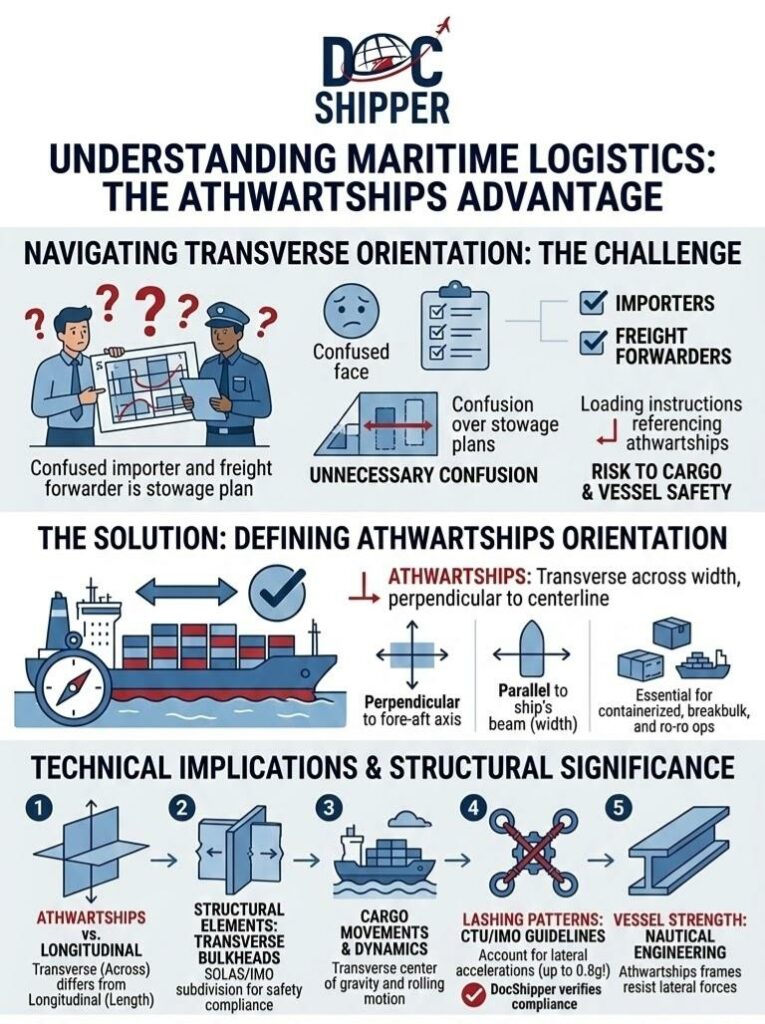
Understanding athwartships orientation is essential for anyone involved in containerized shipping, breakbulk cargo, or ro-ro operations. The term defines how cargo, equipment, or structural elements are positioned relative to the ship’s beam rather than its length.
Key characteristics of athwartships positioning include:
- Perpendicular alignment to the vessel’s fore-aft axis
- Parallel orientation to the ship’s beam (width)
- Critical role in transverse stability and metacentric height calculations
- Impact on lashing requirements and securing methods
- Influence on cargo accessibility during loading/unloading operations
Technical Implications & Structural Significance
The athwartships direction fundamentally differs from fore-and-aft (longitudinal) orientation. While longitudinal positioning runs parallel to the keel, athwartships placement extends from port to starboard across the vessel’s width. This distinction affects structural loading patterns and stress distribution.
Transverse bulkheads represent the most visible athwartships structural elements. These watertight partitions divide the vessel into compartments, providing essential subdivision for safety compliance under SOLAS regulations. According to the International Maritime Organization, proper bulkhead spacing directly influences damage stability calculations.
For cargo operations, athwartships stowage creates specific challenges and advantages. Containers or cargo units positioned transversely may experience different motion dynamics during rolling compared to longitudinally stowed items. The transverse center of gravity becomes critical when calculating the ship’s metacentric height (GM).
Lashing patterns must account for athwartships movement. Transverse securing requires different tension calculations than longitudinal lashing, as lateral accelerations during rolling can exceed 0.8g in rough seas. At DocShipper, we verify that all athwartships cargo arrangements comply with the CTU Code and IMO guidelines to prevent shifting during transit.
The athwartships strength of a vessel’s structure differs from longitudinal strength. Naval architects design transverse frames and floor plates to resist lateral forces, while longitudinal girders handle bending moments. This engineering principle explains why certain heavy-lift cargo must be positioned with specific athwartships considerations to avoid localized overstressing.
Practical Applications & Cargo Examples
Real-world shipping scenarios demonstrate why athwartships orientation matters for operational efficiency and safety. Different cargo types require specific athwartships considerations based on their dimensions, weight distribution, and handling requirements.
| Cargo Type | Athwartships Consideration | Typical Impact |
|---|---|---|
| Standard 40ft Containers | Rarely stowed athwartships due to length constraints | Reduced slot efficiency, special securing needed |
| Breakbulk Steel Coils | Often positioned athwartships in lower holds | Optimizes weight distribution, requires cradles |
| Vehicles (Ro-Ro) | May be parked athwartships on wider decks | Maximizes deck space, complicates drive-on/off |
| Project Cargo (Turbines) | Athwartships placement for balanced loading | Reduces list risk, requires engineered seafastenings |
| Bulk Grain | Athwartships shifting boards prevent transverse movement | Critical for grain stability per IMO Code |
Case Study: A manufacturer shipping five industrial generators (each 18 tons, 6m length) from Rotterdam to Santos faced a critical stowage decision. Longitudinal placement would have created excessive trim, while athwartships positioning distributed weight evenly across three transverse sections. The solution required custom-welded athwartships stool foundations and calculated lashing angles of 45° to resist 0.6g lateral acceleration. DocShipper coordinated with the vessel’s chief officer to verify that local deck strength could support 90 tons distributed athwartships over the designated area.
For container vessels, athwartships slots exist primarily in specialized areas like hatch covers or weather deck positions where standard bay configurations cannot accommodate certain cargo. These positions typically incur higher freight rates due to reduced stowage efficiency and additional securing requirements.
Measurement considerations: When cargo extends athwartships, shippers must verify that the maximum beam does not exceed the vessel’s available transverse space between hatch coamings or cell guides. A standard Panamax vessel offers approximately 32 meters of athwartships space at main deck level, while larger Neo-Panamax ships provide up to 49 meters.
The rolling period of a vessel influences athwartships cargo behavior. Ships with shorter rolling periods (8-12 seconds) generate higher transverse accelerations, requiring more robust athwartships lashings. At DocShipper, we calculate these forces using actual vessel stability data to ensure compliance with cargo securing manuals approved by flag state administrations.
Conclusion
Athwartships orientation represents more than a directional term—it fundamentally affects cargo safety, vessel stability, and operational efficiency in international shipping. Proper understanding prevents costly mistakes in stowage planning and securing arrangements.
Need expert guidance on athwartships cargo positioning or specialized stowage solutions? Contact DocShipper for professional freight forwarding support tailored to your specific shipping requirements.
DocShipper Platform
Cut logistics costs. Not corners.
See exactly where your logistics costs are bleeding — and how to fix it. Book your expert demo.

📚 Quizz
Test Your Knowledge: Athwartships
Q1 — What does "athwartships" mean in maritime logistics?
Q2 — A common misconception is that athwartships lashings use the same specifications as longitudinal lashings. What is the correct interpretation?
Q3 — A shipper needs to transport five 18-ton industrial generators from Rotterdam to Santos. Longitudinal placement would cause excessive trim. Which approach correctly applies athwartships principles?
🎯 Your Result
📞 Free Quote in 24hFAQ | Athwartships: Definition, Applications & Concrete Examples in Shipping
The opposite directional term is "fore-and-aft" or "longitudinal," which refers to alignment parallel to the vessel's centerline from bow to stern, rather than across the beam.
While technically possible, 20ft and 40ft containers are rarely positioned athwartships on cellular container ships due to cell guide design. Athwartships container stowage occurs mainly on multipurpose vessels or specialized deck cargo arrangements.
Athwartships cargo placement directly influences the transverse center of gravity and metacentric height (GM). Heavy athwartships cargo positioned high above the centerline reduces GM and increases rolling amplitude, requiring careful stability calculations.
Transverse (athwartships) bulkheads provide watertight subdivision, structural support against transverse forces, and compartmentalization for damage stability. They are mandatory under SOLAS regulations for passenger and cargo vessels.
Yes, athwartships lashings must resist lateral accelerations during rolling, which often exceed longitudinal forces. The IMO CSS Code provides specific calculation methods for transverse securing based on vessel rolling characteristics and cargo weight.
Athwartships placement of breakbulk cargo optimizes weight distribution across the vessel's beam, prevents excessive list when loading asymmetrical cargo, and may facilitate crane access during discharge operations at certain port configurations.
Athwartships clearance refers to the transverse space available between structural elements like hatch coamings, cell guides, or tank boundaries. This measurement determines the maximum beam width of cargo that can fit in a specific stowage location.
Transverse strength is calculated using frame spacing, web frame dimensions, and floor plate thickness. Finite element analysis models lateral loading scenarios including cargo weight, sea pressure, and dynamic forces from rolling motions.
The IMO Code of Safe Practice for Cargo Stowage and Securing (CSS Code) addresses athwartships securing methods, particularly for non-standardized cargo. The Grain Code specifically regulates athwartships shifting boards for bulk grain transport.
Cargo stowage plans, loading manuals, and cargo securing manuals routinely specify athwartships positions. Bills of lading may reference athwartships stowage when it affects freight calculation or requires special handling notation.
Generally no—athwartships positioning typically increases costs due to reduced stowage efficiency and additional securing requirements. However, for oversized project cargo, athwartships placement may be the only viable option, making cost comparison irrelevant.
Beam seas (waves striking the vessel's side) create maximum athwartships motion, generating high lateral forces on transversely stowed cargo. Proper securing must account for rolling angles up to 30° and lateral accelerations exceeding 0.8g in severe conditions.
Need Help with
Logistics or Sourcing ?
First, we secure the right products from the right suppliers at the right price by managing the sourcing process from start to finish. Then, we simplify your shipping experience - from pickup to final delivery - ensuring any product, anywhere, is delivered at highly competitive prices.


Fill the Form
Prefer email? Send us your inquiry, and we’ll get back to you as soon as possible.
Contact us


