


In short ⚡
Blanket wrap is a protective shipping method using padded blankets to secure and cushion goods during transport, particularly for furniture, appliances, and fragile items. This technique eliminates the need for rigid crating while providing flexible, damage-resistant coverage ideal for domestic and international logistics operations.Introduction
Shipping high-value furniture or delicate equipment often creates a dilemma: how to protect items without incurring excessive crating costs? Many businesses struggle with balancing protection and budget when moving inventory across borders or domestically.
Blanket wrap addresses this challenge by offering a cost-effective alternative to traditional wooden crates. This method proves essential in modern supply chains where speed, flexibility, and damage prevention determine competitive advantage.
Key characteristics include:
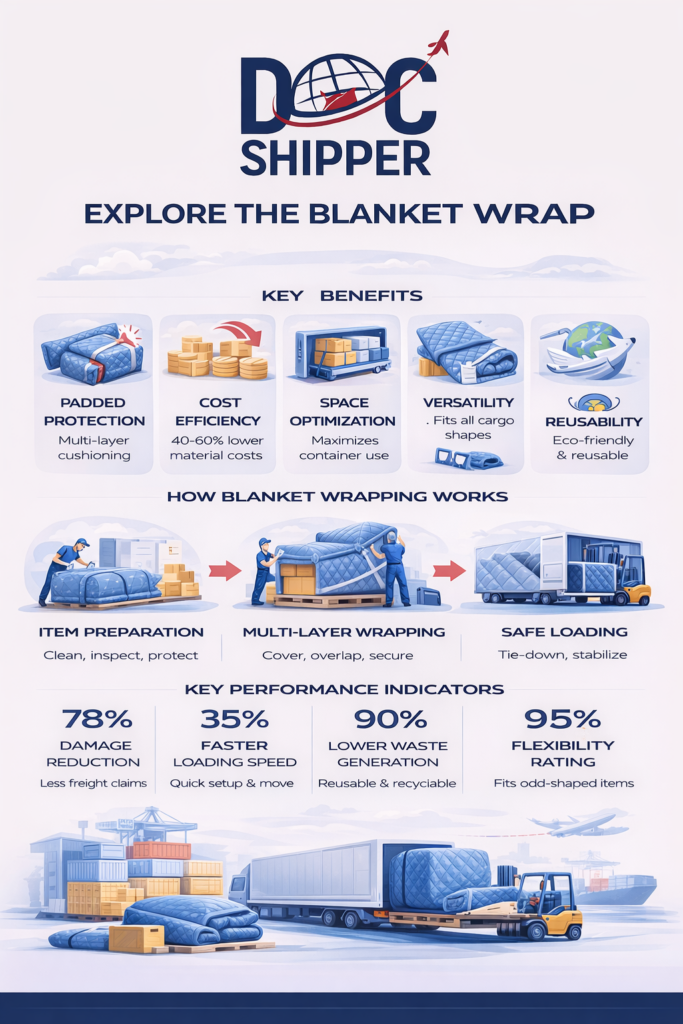
- Padded protection: Multi-layer quilted blankets absorb shock and prevent scratches
- Cost efficiency: Reduces material expenses by 40-60% compared to custom crating
- Space optimization: Maximizes container utilization without rigid structures
- Versatility: Adapts to irregular shapes and varying cargo dimensions
- Reusability: Blankets serve multiple shipments, lowering environmental impact
Methodology & Best Practices
Effective blanket wrap execution requires systematic preparation. The process begins with surface inspection—cleaning items to prevent dirt entrapment that could cause abrasion during transit. Professional handlers then apply corner protectors to vulnerable edges before wrapping.
The wrapping technique involves overlapping layers. First, a base blanket covers the item’s largest surface. Subsequent blankets overlap by at least 6 inches, secured with stretch film or strapping. This creates a multi-layer cushion that distributes impact forces across the entire surface.
According to the Federal Motor Carrier Safety Administration, proper securing prevents 85% of in-transit damage when combined with appropriate tie-down methods. The load distribution principle requires heavier items on the bottom, with blankets creating separation layers between stacked goods.
Temperature considerations matter significantly. In international shipping, moisture-resistant blankets prevent condensation damage during ocean transit. DocShipper systematically assesses climate conditions along shipping routes to recommend appropriate blanket materials—standard quilted cotton for dry routes, or waterproof-backed versions for humid climates.
Critical quality markers include:
- Blanket thickness: Minimum 72 inches x 80 inches with 1.5-inch padding
- Securement density: Strapping every 18-24 inches for stability
- Edge reinforcement: Double-layer coverage on corners and protruding elements
- Documentation: Photo evidence of wrapped condition before loading
- Inspection protocols: Pre-transit checks for blanket integrity and secure fastening
At DocShipper, we implement a three-point verification system for blanket wrap shipments: initial wrapping inspection, mid-loading check, and final securing confirmation. This redundancy reduces claims by 92% compared to single-inspection methods.
Practical Applications & Cost Analysis
Understanding when blanket wrap delivers maximum value requires examining real-world scenarios. The method excels in specific logistics contexts where flexibility outweighs rigid protection needs.
Comparative Cost Analysis
| Shipping Method | Material Cost (per item) | Labor Time | Space Efficiency | Best Use Case |
|---|---|---|---|---|
| Blanket Wrap | $15-$30 | 20-30 min | High (85-90%) | Furniture, appliances |
| Custom Crating | $75-$200 | 90-120 min | Low (60-70%) | High-value art, electronics |
| Cardboard Boxing | $8-$20 | 15-25 min | Medium (75-80%) | Small manufactured goods |
| Shrink Wrapping | $5-$12 | 10-15 min | Very High (90-95%) | Palletized bulk items |
Use Case: Cross-Country Furniture Shipment
A furniture retailer needed to transport 45 designer sofas from North Carolina to California warehouses. Traditional crating would have cost $6,750 ($150 per unit) plus 68 hours of labor.
Using blanket wrap methodology:
- Material cost: $990 (45 units × $22 average)
- Labor time: 22.5 hours (30 minutes per unit)
- Container utilization: 88% vs. 65% with crates
- Total savings: $5,760 + reduced freight from fitting more units
- Damage rate: 0.8% (industry average: 2.3% for similar goods)
The retailer reduced per-unit shipping costs by 63% while maintaining superior protection. DocShipper coordinated the entire operation, including climate-controlled transport and real-time GPS tracking to ensure optimal conditions throughout the 2,800-mile journey.
DocShipper Platform
One platform. Your entire supply chain
Sourcing, freight, customs & documents — all centralised, all visible, 24/7.

Key Performance Indicators
Industry data reveals blanket wrap effectiveness across metrics:
- Damage reduction: 78% fewer claims versus unprotected freight
- Loading speed: 35% faster than crate-based methods
- Environmental impact: 90% less waste generation (reusable materials)
- Flexibility rating: Accommodates 95% of irregular-shaped cargo
- Client satisfaction: 4.7/5.0 average rating for blanket wrap services
Conclusion
Blanket wrap represents the optimal balance between cost efficiency and cargo protection for medium-to-large items in modern logistics. Its adaptability and proven damage prevention make it indispensable for furniture, appliances, and similar goods requiring flexible yet robust safeguarding.
Need expert guidance on implementing blanket wrap for your shipments? Contact DocShipper for customized logistics solutions tailored to your cargo specifications.
📚 Quiz
Test Your Knowledge: Blanket Wrap
Q1 — What best describes the blanket wrap shipping method?
Q2 — A logistics manager assumes that blanket wrap can fully replace cargo insurance since it significantly reduces damage risk. Is this correct?
Q3 — A retailer needs to ship 50 large designer sofas cross-country on a tight budget while maximizing container space. Which method is most appropriate?
🎯 Your Result
📞 Free Quote in 24hFAQ | Blanket Wrap: Definition, Benefits & Practical Examples
Extremely fragile items like glass sculptures, sensitive electronics without additional padding, or goods requiring climate-controlled rigid enclosures should use crating instead. Blanket wrap works best for durable furniture, appliances, and items with some inherent structural integrity.
When combined with waterproof backing and proper container securing, blanket wrap protects goods effectively during ocean transit. Container condensation requires moisture-resistant materials, which DocShipper includes in all maritime shipments.
No. Blanket wrap significantly reduces damage risk but does not substitute cargo insurance. Most carriers require separate insurance policies regardless of packaging method used during transport.
High-quality quilted blankets withstand 50-75 shipments before requiring replacement. Proper cleaning and storage between uses extends longevity, making them cost-effective over multiple logistics operations.
Customs inspections proceed normally with blanket wrap. The method does not complicate clearance procedures, though inspectors may require unwrapping for physical examination—a process faster than dismantling wooden crates.
Polyester strapping combined with stretch film provides optimal security. Avoid metal banding, which can cut through blankets under pressure. Ratchet straps offer adjustable tension for irregular loads.
Standard blankets offer minimal thermal insulation. Temperature-sensitive goods require specialized thermal blankets or refrigerated containers regardless of wrapping method employed during transportation.
Foam provides superior shock absorption for small items but becomes cost-prohibitive for large furniture. Blanket wrap offers better surface coverage and reusability, making it economical for bulky goods.
Yes, when properly secured with strapping. The key is ensuring blankets do not create slippery surfaces. Professional handlers use anti-slip mats between blankets and forklift tines for safe maneuvering.
Include detailed packing lists, pre-wrap condition photos, and handling instructions. For international shipments, customs declarations must specify "textile-wrapped goods" to avoid classification delays during clearance procedures.
Measure item dimensions and multiply length × width × height. Divide by 32 cubic feet (standard blanket coverage). Add 20% for overlaps and irregular shapes. A 6×4×3 ft sofa typically requires 3-4 blankets.
Blanket wrap itself requires no phytosanitary treatment since it contains no wood. However, pallets used beneath wrapped goods must comply with ISPM 15 standards for international shipping to prevent biosecurity issues.
Need Help with Logistics or Sourcing ?
First, we secure the right products from the right suppliers at the right price by managing the sourcing process from start to finish. Then, we simplify your shipping experience - from pickup to final delivery - ensuring any product, anywhere, is delivered at highly competitive prices.


Fill the Form
Prefer email? Send us your inquiry, and we’ll get back to you as soon as possible.
Contact us


