


In short ⚡
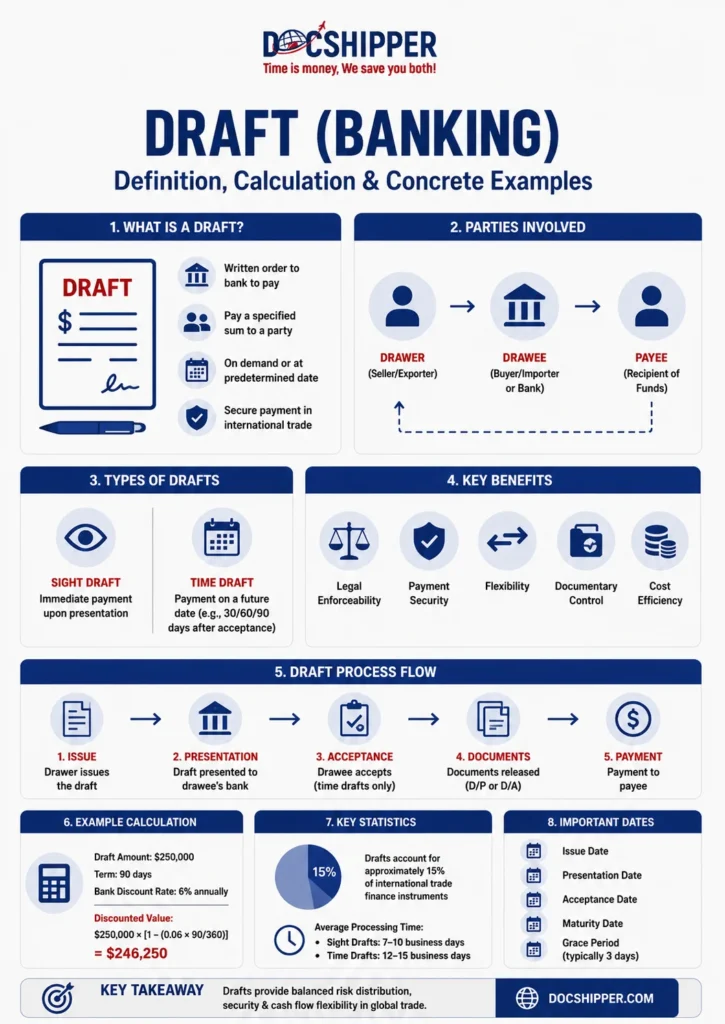
A draft is a written order instructing a bank to pay a specified sum to a designated party on demand or at a predetermined date. Commonly used in international trade, drafts serve as secure payment instruments ensuring funds transfer between buyer and seller across borders.
Introduction
In international logistics, confusion between drafts, bills of exchange, and letters of credit causes costly payment disputes. Payment timing uncertainties disrupt cash flow planning for both importers and exporters.
Drafts represent one of the oldest and most reliable payment mechanisms in cross-border trade. Understanding their mechanics prevents transaction failures and strengthens business relationships.
- Legal enforceability: Drafts constitute negotiable instruments under commercial law
- Payment security: Bank involvement reduces counterparty risk
- Flexibility: Available in sight or time draft formats
- Documentary control: Often paired with shipping documents for conditional payment
- Cost efficiency: Lower fees compared to letters of credit for established relationships
In-Depth Understanding & Expertise
The draft mechanism involves three parties: the drawer (seller/exporter), the drawee (buyer/importer or their bank), and the payee (recipient of funds, usually the drawer). The drawer creates the instrument, the drawee accepts payment obligation, and funds flow to the payee.
Sight drafts demand immediate payment upon presentation. Time drafts specify a future payment date, typically 30, 60, or 90 days after acceptance. This distinction fundamentally impacts working capital management for both parties.
Under ICC Uniform Rules, drafts must contain specific elements: unconditional payment order, fixed amount, identified parties, payment date or demand instruction, and drawer signature. Missing elements may invalidate the instrument.
Documentary drafts attach commercial invoices, bills of lading, and certificates of origin. Banks release these documents only after payment (D/P – Documents against Payment) or acceptance (D/A – Documents against Acceptance). This mechanism protects both buyer and seller interests.
The acceptance process transforms a draft into a binding obligation. When a bank accepts a time draft, it becomes a banker’s acceptance—a highly tradable instrument in secondary markets. At DocShipper, we systematically verify draft terms before shipment to prevent documentation mismatches at destination ports.
Concrete Examples & Data
Consider a German machinery exporter shipping €500,000 equipment to a Brazilian importer. Using a 60-day time draft provides the buyer working capital while guaranteeing the seller’s payment.
| Payment Method | Seller Risk | Buyer Cost | Timeline |
|---|---|---|---|
| Sight Draft | Low | Immediate payment | 0 days |
| 60-Day Time Draft | Medium | Deferred payment | 60 days |
| Letter of Credit | Minimal | Higher bank fees (1.5-3%) | Variable |
Real-world calculation: An Asian textile manufacturer issues a $250,000 draft with 90-day terms. Bank discount rate: 6% annually. Discounted value = $250,000 × [1 – (0.06 × 90/360)] = $246,250. The exporter receives immediate funds while the buyer gains payment deferral.
According to SWIFT data, drafts account for approximately 15% of international trade finance instruments, with highest usage in Asia-Pacific manufacturing corridors. Average processing time: 7-10 business days for sight drafts, 12-15 days for time drafts.
Critical dates in draft lifecycle:
- Issue date: When the drawer creates the draft
- Presentation date: When presented to the drawee’s bank
- Acceptance date: When the drawee formally accepts obligation (time drafts only)
- Maturity date: Final payment due date
- Grace period: Typically 3 days post-maturity before default
Conclusion
Drafts provide balanced risk distribution in international transactions, offering security without the complexity of letters of credit. Proper structuring prevents disputes and optimizes cash flow management.
Need assistance structuring payment terms for your international shipments? Contact DocShipper’s trade finance specialists for customized solutions.
📚 Quiz
Test Your Knowledge: Draft (Banking)
What is the primary defining characteristic of a draft in banking?
What happens when a drawee refuses to accept a time draft?
A Chinese exporter issues a $300,000 draft with 90-day terms to a U.S. importer. The bank discount rate is 8% annually. The exporter needs immediate funds and decides to discount the draft. Which statement correctly applies?
🎯 Your Result
📞 Free Quote in 24hFAQ | Draft (Banking): Definition, Calculation & Concrete Examples
While both are payment orders, a check is drawn on the payer's own bank account, whereas a draft is drawn by one party instructing another (typically a bank) to pay. Drafts often involve three parties and are more common in international trade, providing stronger payment guarantees through bank involvement.
Before acceptance, a drawer may cancel a draft by notifying the presenting bank. After acceptance by the drawee, cancellation requires consent from all parties. Once negotiated to a third party, cancellation becomes nearly impossible without purchasing back the instrument.
Non-acceptance constitutes dishonor of the draft. The presenting bank notifies the drawer, who may pursue legal remedies under the underlying commercial contract. Goods remain under the exporter's control if shipping documents are held pending acceptance, protecting seller interests.
Banks examine signature specimens, validate authorized signatories, check for alterations, verify consistency with underlying documentation, and may employ SWIFT authentication codes for electronic transmissions. Advanced systems use blockchain verification for enhanced security in high-value transactions.
Despite digital alternatives, drafts remain crucial for transactions requiring documentary control, particularly in developing markets with limited banking infrastructure. They cost less than letters of credit while providing more security than open account terms—ideal for mid-trust business relationships.
Drafts may be denominated in any freely convertible currency. USD, EUR, GBP, JPY, and CNY are most common. Currency choice affects exchange rate risk—typically borne by the party whose native currency differs from the draft currency, unless hedging mechanisms are employed.
Sight drafts typically clear within 7-10 business days after presentation. Time drafts add the specified tenor period. Transit time between banks, document examination, and local clearing procedures all impact total duration. Expedited processing is available for premium fees.
Yes, multiple drafts corresponding to partial shipment values are common in large contracts. Each draft accompanies its respective shipping documents. This arrangement improves cash flow for both parties but requires meticulous coordination to match payments with specific cargo lots.
Typical costs include issuance fees (0.1-0.5% of face value), collection fees charged by presenting and collecting banks ($50-200 per transaction), discounting fees for early payment (based on prevailing interest rates), and amendment fees if terms change after issuance.
Draft receipts constitute taxable income when received or accrued, depending on accounting method. Cross-border drafts may trigger withholding tax obligations. Proper documentation is essential for VAT/GST treatment, particularly when drafts accompany goods subject to customs duties.
Electronic bills of exchange (e-BOE) under frameworks like eUCP and UNCITRAL Model Law increasingly replace paper instruments. However, legal recognition varies by jurisdiction. Many countries still require original paper instruments for negotiability, though digitalization accelerates globally.
Legal remedies include filing suit on the underlying contract, pursuing payment under acceptance (if applicable), claiming against endorsers through recourse provisions, and engaging collection agencies. International enforcement requires understanding jurisdictional complexities and may involve arbitration under ICC rules.
Need Help with
Logistics or Sourcing ?
First, we secure the right products from the right suppliers at the right price by managing the sourcing process from start to finish. Then, we simplify your shipping experience - from pickup to final delivery - ensuring any product, anywhere, is delivered at highly competitive prices.


Fill the Form
Prefer email? Send us your inquiry, and we’ll get back to you as soon as possible.
Contact us




