


In short ⚡
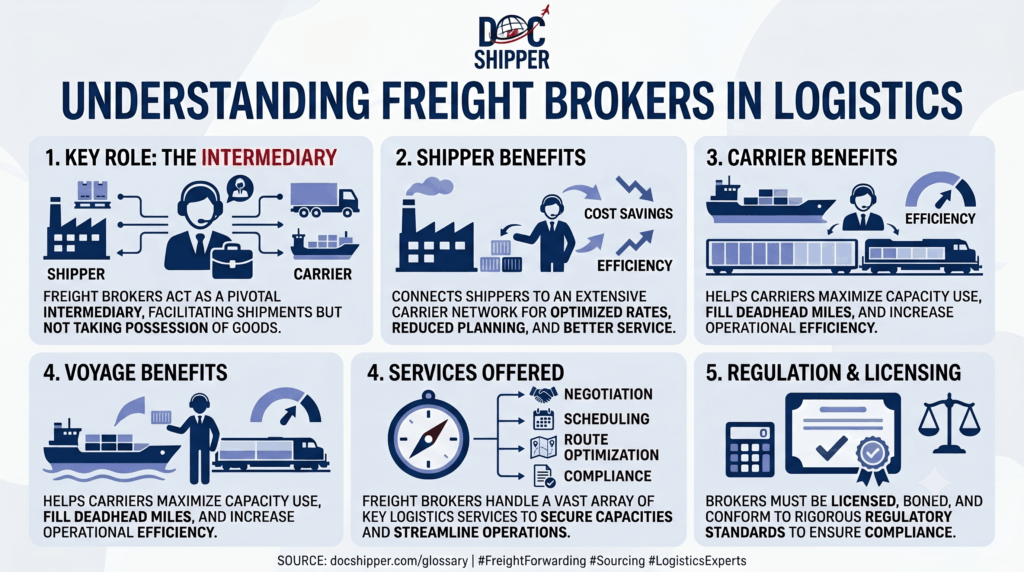
A freight broker is a licensed intermediary who connects shippers with carriers to facilitate the transportation of goods. Unlike freight forwarders, brokers do not take possession of cargo or own transportation assets. They act as neutral matchmakers, negotiating rates and ensuring smooth logistics coordination between parties in the supply chain.
Introduction
Many businesses confuse freight brokers with freight forwarders, leading to mismatched expectations and logistical inefficiencies. The distinction is critical: brokers facilitate connections without handling cargo, while forwarders assume custody and liability.
In international trade, freight brokers play a vital role in optimizing transportation costs, especially for businesses lacking direct carrier relationships. Their expertise becomes particularly valuable when navigating complex multi-modal shipments or volatile freight markets.
Key characteristics of freight brokerage include:
- Non-asset-based operations – No ownership of trucks, vessels, or warehouses
- Regulatory compliance – Licensed by national transportation authorities (FMCSA in the U.S., for example)
- Commission-based revenue model – Earning margins between shipper and carrier rates
- Liability limitations – Responsibility typically limited to broker negligence, not cargo damage
- Technology-driven matching – Using load boards and TMS platforms to connect supply and demand
Brokerage Mechanics & Legal Framework
The freight broker operates within a tightly regulated environment. In the United States, the Federal Motor Carrier Safety Administration (FMCSA) mandates that brokers obtain operating authority, maintain a surety bond ($75,000 minimum), and register with the Unified Carrier Registration system.
The brokerage process follows a structured workflow. First, the shipper submits load specifications including origin, destination, weight, dimensions, and timeline. The broker then queries their carrier network through digital load boards or established partnerships. Once a suitable carrier is identified, the broker negotiates rates on both ends, earning the spread between what the shipper pays and what the carrier receives.
Critical to this arrangement is the broker-carrier agreement, which defines liability, payment terms, and service standards. Most brokers issue a rate confirmation document that serves as the contractual foundation for each shipment. Unlike freight forwarders, brokers do not issue bills of lading as principals; the carrier remains the party responsible for cargo transportation.
The liability framework distinguishes brokers from forwarders. Brokers are generally liable only for negligent selection of carriers or misrepresentation of services. They do not assume responsibility for cargo loss or damage unless their actions directly caused the issue. This legal distinction makes broker services more cost-effective but requires shippers to maintain adequate cargo insurance.
At DocShipper, we collaborate with certified freight brokers when clients need specialized carrier networks beyond our direct partnerships. This hybrid approach ensures optimal routing while maintaining our quality control standards throughout the supply chain.
Technology has transformed brokerage operations. Modern brokers utilize Transportation Management Systems (TMS) integrating real-time tracking, automated rate calculation, and predictive analytics. Machine learning algorithms now match loads with carriers based on historical performance, geographic proximity, and equipment availability—reducing empty miles and improving efficiency.
Practical Examples & Market Data
The global freight brokerage market reached $58.7 billion in 2023, with North America accounting for 42% of total revenue. The industry demonstrates resilience even during economic fluctuations, as businesses increasingly outsource logistics coordination to specialized intermediaries.
Case Study: Seasonal Agricultural Shipping
A California almond producer needs to ship 22 pallets (44,000 lbs) to a distributor in New Jersey during harvest season. Direct carrier rates spike to $8,500 due to high demand. A freight broker leverages their network to secure a carrier returning empty from the East Coast, negotiating a backhaul rate of $6,200. The shipper pays $7,000, the carrier earns profitable return freight, and the broker nets $800 in commission—a win-win-win scenario.
| Service Type | Asset Ownership | Cargo Liability | Licensing Requirement | Typical Margin |
|---|---|---|---|---|
| Freight Broker | None | Limited (negligence only) | FMCSA authority + $75K bond | 10-20% of shipment cost |
| Freight Forwarder | Optional (may own warehouses) | Full liability as principal | FMC license (ocean) or FMCSA | 15-30% of shipment cost |
| Third-Party Logistics (3PL) | Warehouses, technology platforms | Contractually defined | Varies by services offered | Variable (includes value-added services) |
Market Dynamics: Broker margins fluctuate with market conditions. During the 2021 capacity crunch, average broker margins reached 18.2%, compared to historical norms of 14-16%. Conversely, in oversupplied markets like mid-2023, margins compressed to 11.3% as carriers competed more aggressively for loads.
Small to mid-sized businesses represent the fastest-growing segment of broker clientele. According to industry data, 67% of companies with annual revenues under $50 million use freight brokers rather than maintaining in-house logistics teams—a cost-effective solution for variable shipping volumes.
Digital brokerage platforms like Uber Freight and Convoy have disrupted traditional models by offering instant quoting and automated carrier matching. These platforms reduced average booking time from 4-6 hours to under 15 minutes while maintaining competitive pricing through algorithmic optimization.
Conclusion
Freight brokers provide essential connectivity in fragmented transportation markets, offering cost optimization and carrier access without capital-intensive asset ownership. Understanding their role, limitations, and legal framework enables informed logistics decisions.
Need expert guidance on selecting the right logistics partner for your supply chain? Contact DocShipper for tailored solutions combining brokerage networks, forwarding capabilities, and end-to-end supply chain management.
📚 Quiz
Test Your Knowledge: Freight Broker
What best defines a freight broker's primary function?
Under what circumstances is a freight broker typically liable for cargo damage?
A California business needs to ship 22 pallets to New Jersey during harvest season. Direct carrier rates are $8,500. A freight broker finds a backhaul carrier willing to accept $6,200 and charges the shipper $7,000. Which statement is correct?
🎯 Your Result
📞 Free Personalized QuoteFAQ | Freight Broker: Definition, Role & Practical Examples
A freight broker arranges transportation without taking possession of goods or assuming liability beyond negligence. A freight forwarder acts as a principal, assuming responsibility for cargo and often consolidating shipments. Forwarders may own warehouses or equipment, while brokers operate purely as intermediaries connecting shippers with carriers.
Yes. In the United States, freight brokers must register with the FMCSA, obtain broker authority, and maintain a $75,000 surety bond or trust fund. International regulations vary—EU brokers may need national transport licenses, while some jurisdictions require bonding or financial guarantees to protect shippers and carriers.
Brokers earn the margin between what they charge shippers and what they pay carriers. For example, if a shipper pays $5,000 and the broker negotiates a carrier rate of $4,200, the broker's gross profit is $800. Margins typically range from 10-20% depending on market conditions and service complexity.
Generally, no. Brokers are liable only for negligent carrier selection or misrepresentation. The carrier holds primary responsibility for cargo damage under their cargo liability insurance. Shippers should maintain their own cargo insurance when using brokers, as broker liability is limited compared to freight forwarders who assume principal liability.
Absolutely. Small businesses often lack the shipping volume to negotiate competitive carrier contracts. Freight brokers aggregate demand across multiple clients, accessing better rates and carrier availability. This model eliminates the need for in-house logistics staff while providing access to nationwide or global carrier networks.
You'll need origin and destination addresses, pickup/delivery dates, cargo weight and dimensions, commodity description (for classification), packaging type, and any special requirements like liftgate service or temperature control. Accurate information ensures proper carrier matching and prevents pricing disputes or service delays.
Timeframes vary by market conditions and shipment complexity. Standard truckload shipments can often be booked within 1-4 hours. Specialized equipment (flatbeds, refrigerated trailers) or remote locations may require 24-48 hours. Digital brokerage platforms offer instant quotes and automated booking for common lanes.
Some do, but most specialize in domestic transportation. International shipments typically involve freight forwarders who manage customs clearance, documentation, and multi-modal coordination. However, brokers may handle the inland portion (trucking to/from ports) while forwarders manage ocean or air segments.
The carrier-shipper contract remains valid, as the carrier is the actual transportation provider. However, payment disputes may arise. This risk underscores the importance of verifying broker credentials, checking FMCSA bond status, and reviewing financial stability before engaging services—especially for high-value shipments.
Yes. Broker margins are negotiable, especially for repeat business or high-volume shippers. Provide multiple quotes as leverage, demonstrate consistent shipping patterns, and consider longer-term agreements. Transparency about budget constraints often leads brokers to identify creative routing or timing solutions that reduce costs.
Digital brokers use algorithmic matching, instant online quoting, and automated carrier vetting. Traditional brokers rely more on personal relationships and manual negotiation. Digital platforms often offer lower margins due to reduced overhead, while traditional brokers may provide more hands-on problem-solving for complex shipments.
This contract defines the terms between the broker and the carrier, including payment schedules, liability limits, insurance requirements, and service standards. It protects both parties and establishes legal recourse if disputes arise. Shippers should verify that brokers use comprehensive agreements with reputable carriers to minimize service failures.
Need Help with
Logistics or Sourcing ?
First, we secure the right products from the right suppliers at the right price by managing the sourcing process from start to finish. Then, we simplify your shipping experience - from pickup to final delivery - ensuring any product, anywhere, is delivered at highly competitive prices.


Fill the Form
Prefer email? Send us your inquiry, and we’ll get back to you as soon as possible.
Contact us




