


In short ⚡
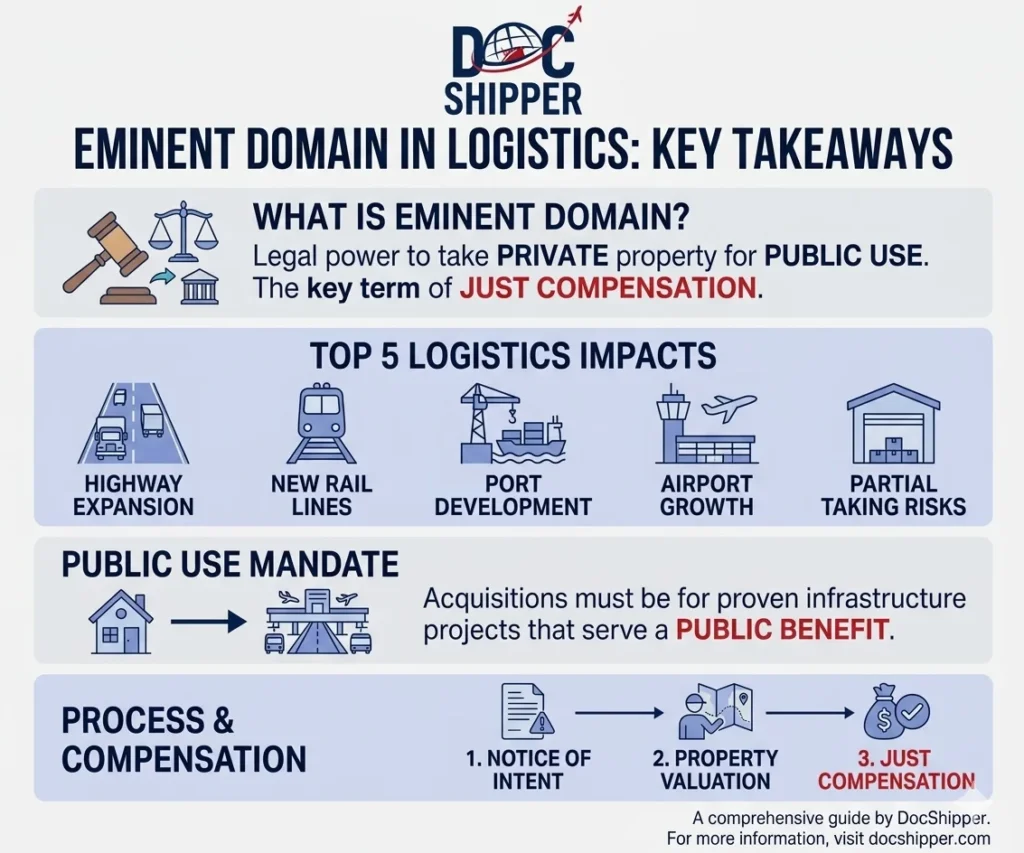
Eminent domain is the sovereign power of a government to compulsorily acquire private property for public use, subject to fair compensation. In international logistics, this legal mechanism can impact warehouses, ports, transport corridors, and distribution centers, potentially disrupting supply chains when infrastructure projects or national security priorities override private property rights.
Introduction
Logistics operators investing in fixed assets abroad face a critical yet often overlooked risk: governmental expropriation through eminent domain. When a host country decides to expand a port, build a highway, or repurpose land for strategic purposes, private warehouses and distribution facilities may be seized—regardless of lease agreements or ownership structures.
This power exists in virtually every jurisdiction worldwide, from the United States’ Fifth Amendment “takings clause” to similar provisions in European civil law systems and emerging market legal frameworks. For international supply chains, understanding eminent domain is essential to risk management, site selection, and insurance planning.
Key characteristics of eminent domain in logistics contexts include:
- Universal jurisdiction: Nearly all nations possess statutory expropriation authority
- Compensation requirement: “Just” or “fair market value” payment is legally mandated but often disputed
- Public purpose threshold: Definitions vary—from infrastructure to economic development
- Operational disruption: Forced relocation creates supply chain bottlenecks and cost overruns
- Investment treaty protections: Bilateral agreements may provide additional recourse for foreign investors
Legal Framework & Logistical Implications
The doctrine of eminent domain (also termed “compulsory purchase” in Commonwealth systems or “expropriation” in international law) stems from the principle that the state retains ultimate ownership of territory. Private property rights exist subject to this sovereign prerogative, activated when public interest demands override individual entitlements.
In the United States, the Fifth Amendment establishes that property cannot be taken “without just compensation.” Similar constitutional protections appear in Germany’s Grundgesetz (Article 14), France’s Code de l’expropriation, and Japan’s Land Expropriation Act. The European Convention on Human Rights (Protocol 1, Article 1) balances property rights against public interest across 46 member states.
For logistics operators, three scenarios commonly trigger eminent domain procedures:
Port expansion projects frequently target adjacent warehousing zones. When maritime authorities acquire land to deepen channels, build container terminals, or expand intermodal facilities, private storage operators face forced sales. Valuation disputes center on whether compensation reflects replacement costs or merely book value.
Transport corridor development affects cross-border logistics hubs. Highway widening, rail network expansion, and dedicated freight routes may bisect existing distribution centers. The Trans-European Transport Network (TEN-T) program has exercised eminent domain across multiple EU states to complete priority corridors.
Strategic national interests increasingly justify expropriation in sectors deemed critical. Governments may reclaim logistics assets near military installations, designate zones for domestic food security, or nationalize supply chain infrastructure during geopolitical tensions. China’s 2020 amendments to its Civil Code clarified expropriation procedures while maintaining broad state authority.
At DocShipper, we conduct comprehensive due diligence on property rights and expropriation risk when establishing warehousing facilities for clients. Our legal team reviews municipal master plans, infrastructure roadmaps, and historical precedents to flag potential eminent domain exposure before capital deployment.
Compensation mechanisms vary substantially across jurisdictions. Anglo-American systems typically require fair market value based on comparable sales and highest-best-use analysis. Continental European frameworks may mandate additional payments for relocation costs, business disruption, and goodwill loss. Developing nations often provide statutory rates below market prices, creating significant recovery gaps for foreign investors.
Case Studies & Industry Impact
Real-world applications of eminent domain demonstrate both the mechanism’s universality and its disruptive potential for international logistics. Examining specific cases reveals patterns that inform risk mitigation strategies.
| Jurisdiction | Project Type | Compensation Timeline | Logistics Impact |
|---|---|---|---|
| Netherlands (Rotterdam) | Maasvlakte 2 port expansion | 18-24 months negotiation | 12 warehouse operators relocated |
| United States (New Jersey) | Turnpike widening | 36+ months litigation | Cold storage facility fully condemned |
| India (Mumbai) | Dedicated freight corridor | 48+ months delays | 23 distribution centers affected |
| Vietnam (Haiphong) | Deep-water terminal construction | 12 months statutory process | Full compensation at 70% market rate |
A particularly instructive case occurred in Singapore during the Tuas Mega Port development. Between 2015 and 2020, the Maritime and Port Authority exercised eminent domain to consolidate all container operations at a single super-terminal. Over 40 logistics service providers operating warehouses and transshipment facilities received compulsory purchase notices.
Compensation negotiations followed Singapore’s Land Acquisition Act, which bases valuations on market prices as of the acquisition date. Most operators received payments within 18 months, but relocation costs—including new facility construction and temporary storage arrangements—averaged 30% above compensation amounts. Supply chain disruptions during the transition period cost affected companies an estimated SGD 200 million collectively.
The European Union’s experience with cross-border infrastructure projects highlights procedural variations. The Rail Baltica initiative, connecting Poland, Lithuania, Latvia, and Estonia, required eminent domain procedures in four legal systems. Compensation timelines ranged from 9 months in Estonia to 36 months in Poland, creating coordination challenges for logistics operators managing pan-European networks.
Key data points for logistics risk assessment:
- Average compensation timeline: 18-36 months from notice to payment in OECD countries
- Litigation rate: Approximately 35-40% of commercial expropriations result in court challenges
- Relocation cost ratio: Actual moving expenses typically exceed initial estimates by 25-40%
- Business interruption: Temporary capacity loss averages 6-9 months during forced relocations
- Insurance gaps: Standard property policies exclude 80% of eminent domain-related losses
DocShipper’s approach to eminent domain risk includes political risk insurance arrangements through specialized underwriters covering expropriation, forced abandonment, and business interruption. We also structure lease agreements with landlords that allocate condemnation proceeds and establish alternative site protocols in master service agreements.
Conclusion
Eminent domain represents an unavoidable sovereign power that international logistics operators must account for in site selection, investment planning, and insurance structuring. While compensation mechanisms exist across jurisdictions, the operational disruption and financial gaps between statutory payments and actual costs demand proactive risk management strategies.
Need support navigating property rights and expropriation risks in your supply chain network? Contact DocShipper for comprehensive due diligence and mitigation planning.
📚 Quiz
Test Your Knowledge: Eminent Domain
What is the primary legal requirement when governments exercise eminent domain over private logistics facilities?
In international logistics, which scenario most commonly triggers eminent domain procedures?
A foreign logistics operator faces warehouse expropriation in a host country offering compensation below market value. What recourse option is available under international investment law?
🎯 Your Result
📞 Free Quote in 24hFAQ | Eminent Domain: Definition, Application & Concrete Examples in International Logistics
Yes, through multiple mechanisms. Foreign investors may invoke protections under bilateral investment treaties (BITs), which often provide international arbitration rights for expropriation disputes. The International Centre for Settlement of Investment Disputes (ICSID) has adjudicated numerous cases where logistics operators contested inadequate compensation or procedural violations. Additionally, investment insurance through agencies like MIGA (Multilateral Investment Guarantee Agency) can provide financial protection and dispute resolution support.
International law standards require compensation to be prompt, adequate, and effective. For logistics facilities, this typically includes fair market value based on comparable sales, replacement cost for specialized infrastructure (cold storage, hazmat handling), business goodwill, relocation expenses, and temporary operational losses. However, definitions vary significantly—common law jurisdictions emphasize market transactions, while civil law systems may apply statutory formulas that yield lower amounts.
Timelines range from 6 months in jurisdictions with streamlined processes (Singapore, UAE) to 3-5 years in systems with extensive appeals (United States, India). Emergency provisions for national security or disaster response may compress timelines to weeks. Logistics operators should monitor published infrastructure plans, zoning amendments, and transport ministry roadmaps to gain early warning of potential expropriations, typically 12-36 months before formal notices.
Partially. Leaseholders typically receive compensation for leasehold improvements, unexpired lease terms, and relocation costs, but not underlying land value. This reduces capital at risk but may complicate recovery if landlords contest tenant compensation claims. Long-term lease agreements should include condemnation clauses specifying payment allocation and early termination rights. Some operators use sale-leaseback structures to transfer property risk while maintaining operational control.
Risk correlates with infrastructure development intensity, governance transparency, and legal system maturity. High-growth markets undergoing rapid port, rail, and highway expansion (Vietnam, Indonesia, Kenya) present elevated expropriation probability but often with improving compensation frameworks. Countries with opaque judicial systems or weak property rights enforcement (certain Central Asian and sub-Saharan African jurisdictions) pose greater recovery risk despite potentially lower expropriation frequency.
Standard policies cover direct expropriation (full government takeover) and "creeping expropriation" (regulatory actions that effectively confiscate value) but exclude many consequential losses. Specialized logistics property policies can add business interruption coverage, customer contract penalties, and alternative site establishment costs. Coverage typically ranges from 80-95% of assessed value, with deductibles of 10-20%. Premiums vary from 0.3% to 2.5% of insured value annually based on country risk ratings.
Key signals include publication of transport master plans identifying expansion corridors, legislative proposals amending land acquisition laws, public consultations on infrastructure projects near logistics zones, increased surveying activity or preliminary site assessments by government contractors, and zoning reclassifications from industrial to public-use designations. Monitoring municipal planning departments and infrastructure ministry announcements provides 12-24 months' advance notice in most transparent jurisdictions.
Special economic zones (SEZs) and free trade zones often provide enhanced property protections through zone-specific legislation and international arbitration clauses. However, host governments retain ultimate eminent domain authority even within zones. Some jurisdictions (Dubai, Shenzhen) offer 99-year leaseholds with contractual restrictions on expropriation, while others (India, Philippines) maintain standard condemnation powers. Zone developers may provide additional compensation beyond statutory minimums to preserve investor confidence.
BITs provide substantive protections (fair and equitable treatment, protection against uncompensated expropriation) and procedural rights (international arbitration, investor-state dispute settlement). Approximately 2,600 BITs globally cover logistics investments, though effectiveness varies. The Energy Charter Treaty and USMCA contain specific provisions for transportation infrastructure. Operators should structure investments through jurisdictions with robust BIT networks—Netherlands and Luxembourg are common choices for treaty shopping to access favorable protections.
Limited effectiveness. While landlords can contractually commit to compensation above statutory minimums or priority re-housing, they cannot prevent government expropriation. More practical provisions include automatic lease termination with prepaid rent refunds, landlord obligations to contest condemnations, allocation of government compensation payments, and alternative site options within the landlord's portfolio. In some jurisdictions, master leases with government agencies provide explicit protection against eminent domain during lease terms.
Properties near planned infrastructure projects or within probable expansion corridors trade at discounts of 15-30% compared to similar assets in stable locations. Appraisers apply "condemnation probability adjustments" based on proximity to ports, airports, and transport nodes. Conversely, properties benefiting from improved access post-construction may command premiums of 20-40%. Institutional investors typically exclude high-risk parcels from logistics REITs, concentrating vulnerability among smaller operators and owner-occupiers.
International arbitration under ICSID, UNCITRAL, or ICC rules provides neutral forums when domestic judiciaries lack independence or expertise. Regional bodies like the European Court of Human Rights review expropriation compliance with property rights treaties. Trade agreement dispute panels (WTO, USMCA) may address discriminatory takings affecting foreign logistics providers. Investors should also consider local ombudsman offices, which in some countries (Scandinavia, Australia) effectively mediate compensation disputes before litigation.
Need Help with
Logistics or Sourcing ?
First, we secure the right products from the right suppliers at the right price by managing the sourcing process from start to finish. Then, we simplify your shipping experience - from pickup to final delivery - ensuring any product, anywhere, is delivered at highly competitive prices.


Fill the Form
Prefer email? Send us your inquiry, and we’ll get back to you as soon as possible.
Contact us




