


In short ⚡
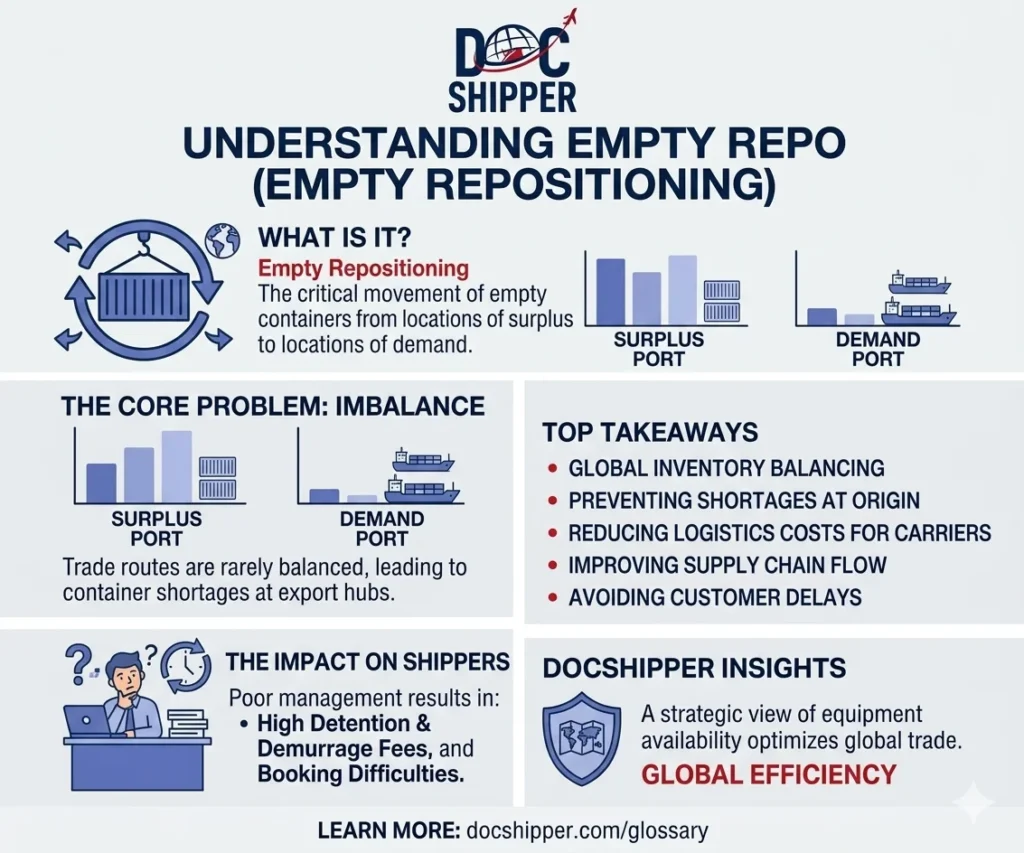
Empty Repo (short for Empty Repositioning) refers to the process of moving empty shipping containers from surplus locations to deficit areas where they are needed for new cargo shipments. This critical logistical operation ensures container availability across the global supply chain, optimizing fleet utilization and reducing operational costs for shipping lines and logistics providers.
Introduction
In international shipping, container imbalances create a persistent challenge. Major exporting nations accumulate empty containers while importing regions face shortages. This geographical mismatch forces carriers to reposition thousands of empty units daily.
Empty repo directly impacts freight rates, port congestion, and supply chain efficiency. Understanding this process helps importers and exporters negotiate better terms and anticipate capacity issues.
Key characteristics of empty repositioning include:
- Non-revenue movements that generate costs without direct income
- Global coordination between shipping lines, depots, and terminals
- Predictive logistics based on trade lane patterns and seasonal demand
- Environmental impact from unnecessary vessel movements and trucking
- Cost allocation through detention fees and repositioning charges
Operational Mechanics & Strategic Importance
Empty repositioning occurs when trade imbalances create container surpluses in certain regions. For example, Asia exports far more containerized goods to Europe and North America than it imports, leaving millions of empty boxes at destination ports annually.
Shipping lines employ sophisticated predictive algorithms to forecast container demand weeks in advance. These systems analyze historical booking data, seasonal trends, and economic indicators to determine optimal repositioning routes. The goal is minimizing empty moves while ensuring adequate equipment availability.
The cost structure involves multiple components. Ocean carriers pay terminal handling charges, inland transport fees, and storage costs. When repositioning via vessel, they sacrifice space that could carry revenue cargo. This explains why empty repo costs can reach $300-800 per container depending on distance and mode.
Container leasing companies add complexity to the equation. Approximately 50% of global container fleet is leased rather than owned. Lessors impose strict rules about where containers can be returned, often requiring specific depot locations. Violating these terms triggers significant penalty fees.
Technology platforms now enable container sharing agreements between competing carriers. These “grey box” programs allow one shipping line to use another’s empty containers in deficit locations, reducing unnecessary repositioning. However, implementation remains limited due to operational and commercial barriers.
At DocShipper, we monitor container availability patterns across major trade lanes to help clients avoid detention fees and secure equipment during peak seasons. Our team coordinates with multiple carriers to optimize pickup and return locations.
Cost Analysis & Real-World Scenarios
The financial impact of empty repo varies dramatically by trade lane. Consider the following comparative analysis:
| Trade Lane | Imbalance Ratio | Avg Repo Cost/TEU | Annual Empty Moves |
|---|---|---|---|
| Asia to Europe | 2.5:1 (export:import) | $450-650 | 3.2M TEU |
| Asia to North America | 3:1 (export:import) | $500-800 | 4.8M TEU |
| Europe to Asia | 0.4:1 (export:import) | $200-350 | 1.1M TEU |
| Intra-Asia | 1.2:1 (export:import) | $150-280 | 2.6M TEU |
Use Case: Electronics Importer in Rotterdam
A European electronics importer receives 40 containers monthly from Shenzhen. After unloading, they must return empty containers to the carrier’s designated depot within 7 free days. Missing this window costs €80-120 per day in detention fees.
The carrier charges €450 per container for inland repositioning from Rotterdam to Hamburg, where surplus empties are needed. By negotiating a “merchant haulage” arrangement, the importer reduces this cost to €280 by using their own trucking partner, saving €6,800 monthly.
Industry data reveals five critical patterns:
- Seasonal volatility: Empty repo costs spike 40-60% during pre-holiday shipping peaks (August-October)
- Container type matters: Refrigerated containers cost 3-4x more to reposition than standard dry boxes
- Regional efficiency: Intra-regional moves (within Asia or Europe) average 35% lower costs than intercontinental repositioning
- Environmental toll: Empty repositioning generates approximately 15 million tons of CO2 annually across global shipping
- Hidden fees: Carriers may embed repo costs into base freight rates, making true total costs opaque
Conclusion
Empty repo represents both a logistical necessity and a significant cost driver in international trade. Optimizing container return strategies and understanding carrier policies directly impacts landed costs. As trade patterns evolve and sustainability pressures mount, innovative solutions like container sharing and predictive positioning will reshape this critical process.
Need assistance managing container logistics and avoiding unnecessary repositioning fees? Contact DocShipper’s team for expert guidance on your specific trade lanes.
📚 Quiz
Test Your Knowledge: Empty Repo
What is the primary purpose of empty repositioning in container shipping?
A European importer believes they won't pay any costs related to empty repositioning since carriers absorb these expenses. Is this understanding correct?
Your company imports 30 containers monthly from Asia to Los Angeles. The carrier's standard free time for empty returns is 7 days, after which detention fees of $95/day apply. Which strategy would most effectively minimize your repositioning-related costs?
🎯 Your Result
📞 Free Quote in 24hFAQ | Empty Repo: Definition, Logistics Process & Practical Examples
Shipping lines typically absorb direct repositioning expenses as operational costs. However, these costs are indirectly recovered through overall freight rate structures, Equipment Imbalance Surcharges (EIS), or Peak Season Surcharges (PSS). Shippers may also incur charges if they return containers to non-standard locations or exceed free time allowances, triggering detention and per diem fees.
EIS is a fee applied by carriers on specific trade lanes with severe container imbalances. For example, westbound shipments from Europe to Asia often include EIS charges ranging from $200-500 per container. This surcharge compensates carriers for the cost of repositioning excess empty containers back to high-demand export regions. The fee fluctuates based on seasonal supply-demand dynamics.
Carriers use advanced forecasting software that analyzes booking trends, seasonal patterns, vessel schedules, and depot capacity. Algorithms calculate the optimal balance between repositioning costs and potential revenue loss from equipment shortages. Priority goes to high-volume export hubs with strong booking pipelines. Strategic depots in cities like Shanghai, Los Angeles, and Hamburg serve as redistribution centers.
Yes, especially for high-volume shippers. Negotiation points include extended free time for returns, flexibility on drop-off locations, and merchant haulage options where you arrange inland transport. Annual contracts may include provisions for reduced detention fees or waived repositioning charges. Building relationships with account managers and demonstrating consistent volume strengthens negotiating leverage.
Containers stranded at inland depots far from ports accumulate storage fees (typically $5-15 per day). Carriers must arrange trucking or rail transport to coastal terminals, adding $300-1,200 per box depending on distance. In extreme cases, especially for specialized containers like reefers, carriers may lease space long-term or temporarily remove units from active circulation until demand justifies retrieval costs.
Trade lanes with severe imbalances see higher rates in the empty-surplus direction. For instance, Asia-Europe eastbound rates average 40-60% higher than westbound backhaul rates. Carriers price aggressively on backhaul routes to generate some revenue while repositioning equipment. During capacity crunches, shippers on balanced or deficit lanes may face allocation challenges as carriers prioritize repositioning over lower-rate cargo.
Grey box initiatives allow competing shipping lines to temporarily use each other's empty containers in deficit locations. Instead of repositioning empties cross-ocean, Carrier A might "borrow" Carrier B's surplus containers in Hamburg for Asia-bound cargo. Compensation mechanisms vary—some programs use per-use fees while others operate on reciprocal volume balancing. Adoption remains limited due to operational complexity and competitive concerns.
Approximately 50% of global container fleet is leased from companies like Triton, Textainer, and CAI. Lease agreements specify authorized return locations—often restricted to major hubs. Returning a leased container to an off-lease depot triggers penalty fees of $500-2,000. This forces carriers to reposition leased units even when owned containers might be available locally, reducing operational flexibility and increasing costs.
Several programs aim to minimize empty repositioning's carbon footprint. Digital platforms like Container xChange facilitate peer-to-peer container sharing between freight forwarders. Some carriers experiment with collapsible containers that reduce transport volume when empty. Blockchain-based tracking improves visibility, enabling better coordination. However, fundamental trade imbalances mean empty repositioning will remain necessary until global import-export patterns significantly shift.
Empty repo moves containers without cargo to needed locations. Container triangulation strategically routes boxes through three points to maximize utilization. Example: a container ships goods from Shanghai to Los Angeles, then repositions empty to Vancouver for a load to Europe, before finally returning empty to Asia. Triangulation reduces pure empty moves by adding a revenue leg, though it requires precise coordination and willing shippers on each segment.
Request extended free time during contract negotiations—10-14 days instead of standard 5-7. Establish relationships with nearby container depots for quick returns. Use carrier mobile apps to schedule drop-offs and avoid queues. For consistent volumes, negotiate on-site pickup services where the carrier retrieves empties from your facility. Monitor container status daily to track approaching free time deadlines and avoid unexpected charges that can exceed $100 per day.
Yes, depot storage fees typically begin after 3-5 free days and range from $8-25 per container daily, varying by location and depot ownership. Carriers often negotiate bulk storage agreements with depots, but those costs ultimately factor into their operational expenses. During capacity shortages, some depots impose temporary surcharges or refuse additional empties until space clears. Monitoring depot congestion reports helps anticipate potential return delays.
Need Help with
Logistics or Sourcing ?
First, we secure the right products from the right suppliers at the right price by managing the sourcing process from start to finish. Then, we simplify your shipping experience - from pickup to final delivery - ensuring any product, anywhere, is delivered at highly competitive prices.


Fill the Form
Prefer email? Send us your inquiry, and we’ll get back to you as soon as possible.
Contact us




