


In short ⚡
The ECCN (Export Control Classification Number) is a five-character alphanumeric code assigned by the U.S. Commerce Department to classify items subject to export controls under the Export Administration Regulations (EAR). This classification determines whether an export license is required and helps identify items with dual-use potential (civilian and military applications).
Introduction
Exporters frequently struggle with a critical question: “Does my product require an export license?” The answer lies in correctly identifying your product’s ECCN classification. Misclassification can result in severe penalties, shipment delays, or even criminal prosecution.
In international trade, the ECCN serves as the cornerstone of U.S. export compliance. This classification system ensures that sensitive technologies, materials, and equipment don’t reach prohibited destinations or end-users without proper authorization. Understanding ECCN codes is essential for manufacturers, freight forwarders, and compliance officers involved in cross-border transactions.
The ECCN system addresses several critical compliance needs:
- Dual-use technology control: Identifies items with both commercial and military applications
- License determination: Establishes whether export authorization is required based on destination and end-use
- Legal compliance: Ensures adherence to U.S. export regulations and international security agreements
- Risk assessment: Helps exporters evaluate potential compliance risks before shipping
- Customs clearance: Facilitates accurate documentation and smooth border processing
ECCN Classification Structure & Legal Framework
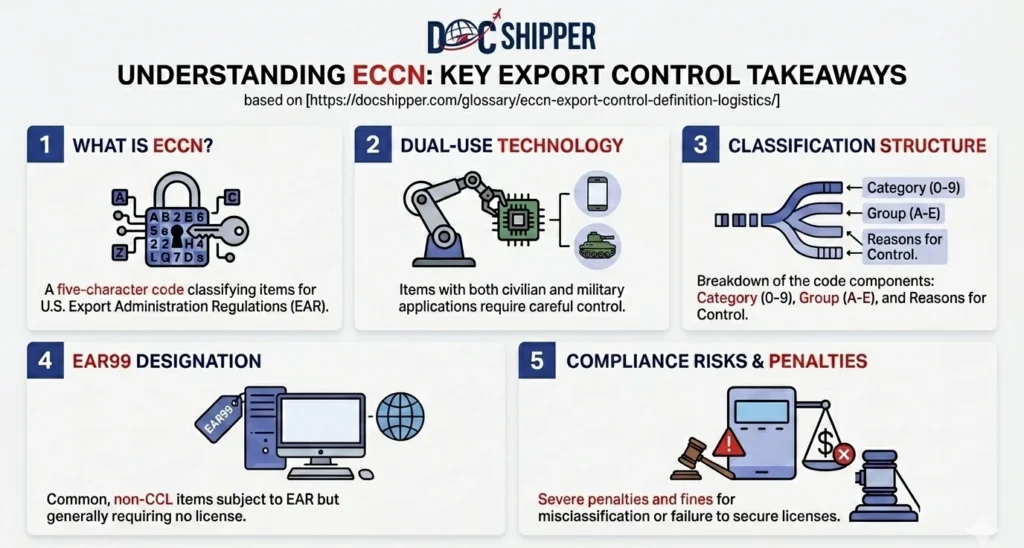
The ECCN code follows a precise five-character structure where each element conveys specific regulatory information. The first character represents the category (0-9), indicating the general type of item. Categories include nuclear materials, aerospace, electronics, computers, telecommunications, information security, sensors, navigation, marine technology, and propulsion systems.
The second character designates the product group (A-E): A for equipment/assemblies, B for test/production equipment, C for materials, D for software, and E for technology. The remaining three digits identify the specific reason for control, such as national security, nuclear proliferation, chemical/biological weapons, or regional stability concerns.
Items not listed on the Commerce Control List (CCL) receive the designation EAR99, meaning they’re subject to EAR but generally don’t require a license for most destinations. However, EAR99 items may still require licensing to embargoed countries or denied parties. At DocShipper, we systematically verify ECCN classifications against the latest CCL updates to ensure our clients maintain full regulatory compliance.
The legal framework governing ECCNs stems from the Export Administration Regulations (EAR), administered by the Bureau of Industry and Security (BIS). The EAR implements the Export Control Reform Act and works alongside the International Traffic in Arms Regulations (ITAR) to control different categories of items. According to the official BIS Commerce Control List, over 2,300 ECCNs currently exist, each with specific licensing requirements.
Exporters must perform self-classification by comparing their product’s technical specifications against CCL entries. This requires detailed technical knowledge and careful analysis of product capabilities. The classification process involves five key steps:
- Technical specification review: Gather complete product documentation including performance parameters
- CCL comparison: Match product characteristics against CCL category descriptions
- Control parameter evaluation: Determine if product meets or exceeds technical thresholds
- Documentation: Maintain classification rationale and supporting technical data
- Licensing assessment: Determine if a license is required based on destination and end-use
Practical Applications & Classification Examples
Understanding ECCN classification becomes clearer through real-world examples. The complexity varies significantly based on technology level and intended application. Here’s a comparative analysis of common export scenarios:
| Product Category | Example Item | ECCN Code | Control Reason | License Requirement |
|---|---|---|---|---|
| Encryption Software | Commercial VPN with 256-bit encryption | 5D002 | Information Security | License Exception ENC available |
| Industrial Machinery | Standard CNC milling machine | EAR99 | Not on CCL | No license for most destinations |
| Semiconductor Equipment | Wafer stepper (sub-45nm capability) | 3B001 | National Security | License required for most destinations |
| Telecommunications | Commercial smartphones | 5A992 | Anti-terrorism | License required only to embargoed countries |
| Aerospace Components | Navigation systems with GPS accuracy <1m | 7A003 | National Security | License required for specified countries |
Consider a practical case: A U.S. manufacturer exports high-performance oscilloscopes capable of bandwidth exceeding 1 GHz. After technical review, this product classifies under ECCN 3A002.a.1 (Electronic Test Equipment). The company must determine licensing requirements based on destination country and end-user.
For a shipment to Germany (a NATO ally), the manufacturer can utilize License Exception CIV (civil end-users). However, the same oscilloscope destined for China would require a full export license application due to national security concerns. This scenario illustrates how ECCN classification is only the first step—destination and end-use analysis are equally critical.
According to BIS enforcement data, approximately 37% of export violations involve incorrect classification or failure to obtain required licenses. The financial consequences are severe: civil penalties can reach $300,000 per violation, while criminal penalties include up to 20 years imprisonment and $1 million in fines.
Key compliance factors affecting ECCN application include:
- Destination country: Different licensing requirements apply based on Country Groups (A, B, D, E)
- End-user screening: Verify against the Denied Persons List, Entity List, and Specially Designated Nationals
- End-use statement: Document intended application to prevent military diversion
- License exceptions: Identify available exceptions (CIV, TSU, ENC, GBS) that may eliminate license requirements
- Deemed exports: Technology transfers to foreign nationals within the U.S. also require classification
At DocShipper, our compliance specialists maintain current ECCN databases and utilize automated screening tools to cross-reference product classifications against destination-specific requirements, ensuring your shipments clear customs without regulatory issues.
Conclusion
Accurate ECCN classification is fundamental to legal international trade and national security compliance. Mastering this system protects your business from costly penalties while facilitating efficient global commerce. The classification process demands technical expertise, regulatory knowledge, and ongoing monitoring of regulatory updates.
Need assistance with ECCN classification or export compliance? Contact DocShipper’s compliance experts for professional guidance tailored to your products and destinations.
📚 Quiz
Test Your Knowledge: ECCN Classification
What is the primary purpose of the ECCN classification system?
A U.S. company exports standard office furniture to Canada. Which classification most likely applies?
Your electronics manufacturer classifies a new product under ECCN 5A002. What is the most critical compliance step before exporting to China?
🎯 Your Results
📞 Free Compliance Consultation in 24hFAQ | ECCN (Export Control Classification Number): Definition, Classification & Practical Examples
Incorrect ECCN classification constitutes an export control violation, potentially resulting in civil penalties up to $300,000 per violation, criminal penalties including imprisonment, and shipment seizure. You may also face debarment from exporting,损害 your company's reputation, and lose export privileges. Always conduct thorough technical analysis or consult with export compliance specialists to ensure accurate classification.
Yes, products that don't meet the technical parameters of any ECCN are classified as EAR99, but this doesn't mean they're license-free. EAR99 items still require licenses when exported to embargoed countries, denied parties, or for prohibited end-uses like weapons development. Additionally, EAR99 classification requires documentation proving the item doesn't meet CCL thresholds, so proper analysis is still essential.
The Commerce Control List undergoes regular revisions, typically multiple times per year. The Bureau of Industry and Security publishes rule changes in the Federal Register and updates the online CCL database. Subscribe to BIS email updates, monitor regulatory bulletins, and review quarterly compliance reports. Many companies implement annual classification reviews to ensure ongoing accuracy as products evolve and regulations change.
Yes, software and hardware typically receive different ECCNs even if they perform identical functions. Software falls under "D" product groups, while hardware uses "A" groups. For example, encryption hardware might be classified 5A002, while encryption software would be 5D002. Each requires separate classification analysis based on technical specifications, and licensing requirements may differ significantly between the two forms.
A Commodity Classification (also called CCATS - Commodity Classification Automated Tracking System) is an official classification determination from BIS. Submit one when your product's classification is unclear, when significant penalties exist for misclassification, or when customers request official documentation. BIS typically responds within 60 days, providing an official ECCN that offers legal protection if classification questions arise later.
Generally yes. Individual components may have different ECCNs than the finished assembly. For example, a communication system might be ECCN 5A001, but individual circuit boards within it could be EAR99. You must classify each exported item separately. However, the "specially designed" rule means components designed exclusively for controlled items may inherit the parent item's classification even if they don't independently meet technical thresholds.
ECCNs and HTS codes serve different purposes and operate independently. HTS codes determine customs duties and are used by customs authorities worldwide for import processing. ECCNs control exports based on national security and foreign policy. A single product requires both: HTS for customs clearance and duty calculation, ECCN for U.S. export control compliance. Neither code determines the other, and both must be accurately assigned.
No. ECCN classification is product-based, not company-based, and follows the item regardless of which entity exports it. If a foreign subsidiary manufactures items containing U.S.-origin controlled technology, or if products were developed with U.S. technical assistance, they remain subject to U.S. export controls and require the same ECCN classification. This is called "extraterritorial reach" and applies through the De Minimis Rule and foreign direct product rules.
Maintain comprehensive records including: product technical specifications, CCL comparison worksheets, engineering drawings, test results, classification rationale documents, communications with BIS (if any), and any CCATS determinations. Retain records for five years from export date. This documentation proves due diligence during audits and protects against penalties if classification is questioned. Systematic recordkeeping demonstrates good-faith compliance efforts.
Absolutely. Technology and software exports (including electronic transmission, cloud access, and verbal technical exchanges) require ECCN classification just like physical products. "Deemed exports"—technology disclosures to foreign nationals within the U.S.—also require classification and may need licenses. This includes technical documents, blueprints, source code, and know-how related to controlled items. Many violations occur because companies overlook technical data transfers.
You can and should reclassify products when technical specifications change, regulations are updated, or when you discover the original classification was incorrect. However, reclassification doesn't retroactively legitimize past exports under incorrect classifications. When specifications change (upgrades, performance enhancements), conduct fresh classification analysis. Document the reclassification rationale and timing. Proactive reclassification demonstrates compliance commitment and prevents continuing violations.
License Exceptions are regulatory provisions allowing exports without individual licenses despite ECCN controls. Each ECCN entry specifies which License Exceptions apply. For example, ECCN 5A002 encryption items may qualify for License Exception ENC if specific criteria are met. You must still classify the item correctly, then evaluate applicable exceptions based on destination, end-user, and end-use. Exceptions don't eliminate classification requirements—they provide conditional licensing relief for properly classified items.
Need Help with
Logistics or Sourcing ?
First, we secure the right products from the right suppliers at the right price by managing the sourcing process from start to finish. Then, we simplify your shipping experience - from pickup to final delivery - ensuring any product, anywhere, is delivered at highly competitive prices.


Fill the Form
Prefer email? Send us your inquiry, and we’ll get back to you as soon as possible.
Contact us




:%20Definition,%20Classification%20&%20Practical%20Examples)