


In short ⚡
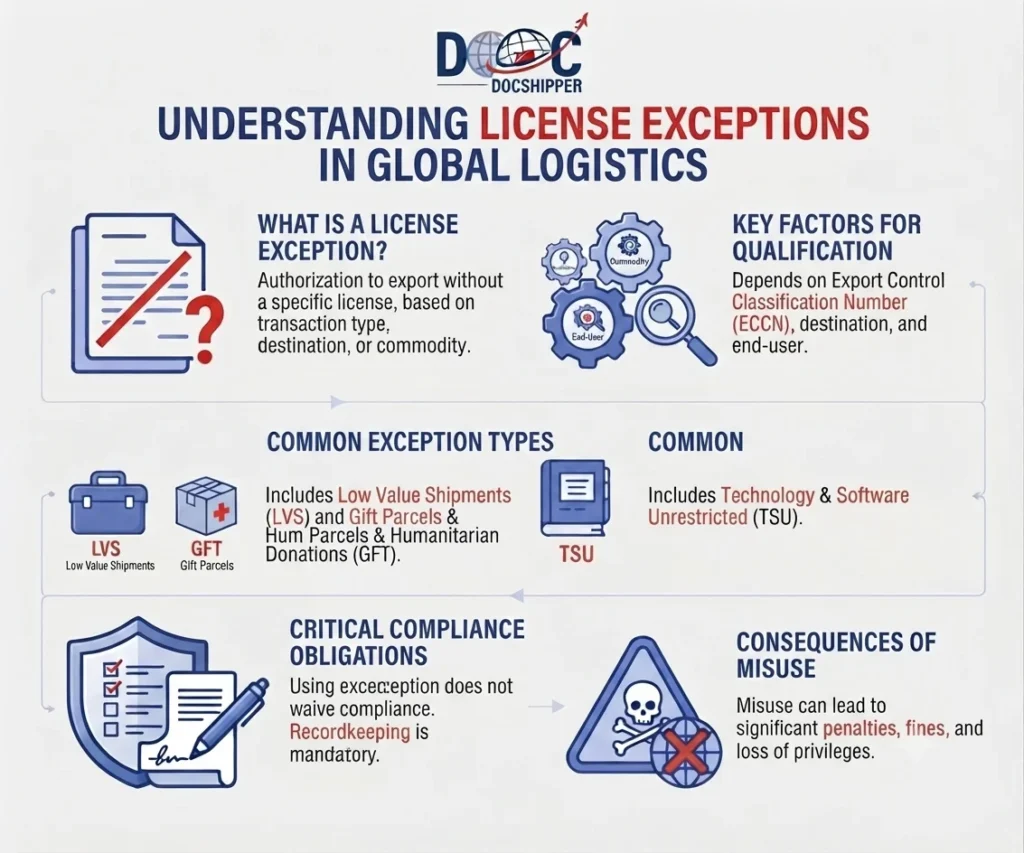
A License Exception is a regulatory provision allowing exporters to ship controlled goods or technologies without a specific export license, provided strict conditions are met. Governed primarily by U.S. export control regulations (EAR), these exceptions streamline international trade while maintaining national security and foreign policy objectives.
Introduction
Many exporters mistakenly believe that all controlled items require individual export licenses, leading to unnecessary delays and administrative burdens. In reality, the U.S. Export Administration Regulations (EAR) provide multiple License Exceptions that can significantly expedite legitimate trade flows.
Understanding License Exceptions is crucial for international logistics professionals because they directly impact shipment timelines, compliance costs, and operational efficiency. Misapplication or ignorance of these provisions can result in shipment rejections, regulatory penalties, or criminal prosecution.
Key characteristics of License Exceptions include:
- Authorization scope: Each exception applies to specific Export Control Classification Numbers (ECCNs), destinations, and end-users
- Conditional approval: Eligibility depends on item classification, destination country, end-use, and party screening
- Documentation requirements: Proper recordkeeping and shipment declarations remain mandatory
- Revocability: The Bureau of Industry and Security (BIS) can suspend or modify exceptions without prior notice
- Complementary regulations: ITAR, OFAC sanctions, and other regulations may still apply regardless of EAR exceptions
Regulatory Framework & Compliance Requirements
License Exceptions are codified in Part 740 of the Export Administration Regulations (15 CFR §740). The most commonly utilized exceptions include LVS (Limited Value Shipments), GBS (Group B Shipments), TMP (Temporary Imports/Exports), RPL (Repair and Replacement Parts), and TSR (Technology and Software-Restricted).
Each exception establishes precise eligibility criteria that must be verified before shipment. For LVS, the total value threshold is $1,500 for most items to most destinations, excluding embargoed countries. GBS permits unlimited value for certain low-level technology exports to approved countries.
Critical compliance elements include proper ECCN classification, destination screening against BIS Entity Lists, end-use verification, and accurate Automated Export System (AES) filing. Exporters must cite the specific License Exception symbol (e.g., “LVS”) in shipping documentation and maintain comprehensive records for five years.
The Commerce Country Chart (Supplement No. 1 to Part 738) cross-references ECCNs with destination countries to determine License Exception availability. A single “X” in the chart column corresponding to an exception indicates that particular exception cannot be used for that country-ECCN combination.
At DocShipper, we systematically verify License Exception eligibility during export documentation preparation, ensuring your shipments comply with the latest regulatory updates and avoiding costly compliance failures. Our team maintains current knowledge of Bureau of Industry and Security regulations to protect your supply chain operations.
Important limitations include prohibited destinations (Cuba, Iran, North Korea, Syria, Russia, Belarus), restricted end-users (military entities, sanctioned parties), and sensitive end-uses (weapons development, nuclear proliferation). Even when an exception technically applies, exporters must conduct diligence to ensure no red flags exist.
Practical Scenarios & Data-Driven Examples
Consider a U.S. technology company shipping laptop computers (ECCN 4A994) to Germany. Without understanding License Exceptions, they might assume individual licenses are required. However, ENC (Encryption Commodities, Software, and Technology) permits most commercial encryption items to NATO countries without licensing.
| License Exception | Primary Use Cases | Value/Quantity Limits | Key Restrictions |
|---|---|---|---|
| LVS | Low-value commercial shipments | $1,500 per shipment | Not for Group E countries |
| GBS | Certain technology/software to approved destinations | No limit | Country Group B destinations only |
| TMP | Trade shows, demonstrations, temporary exports | Must return within 1 year | Requires re-export notification |
| RPL | Replacement parts for defective items | Equal value/quantity replacement | Original item must return within 3 years |
| BAG | Personal baggage exports | Personal use quantities | Must accompany traveler |
Use Case: A manufacturing company needs to ship $45,000 worth of precision measuring equipment (ECCN 2B996) from Houston to Mexico for a customer demonstration. Instead of pursuing a standard export license (processing time: 30-90 days), they utilize TMP exception, reducing authorization time to same-day documentation preparation.
The company must ensure the equipment returns to the U.S. within 12 months, maintain detailed tracking records, and provide DocShipper with demonstration schedules and customer information. This approach saved approximately $3,200 in licensing fees and expedited project timelines by 8 weeks.
Another scenario involves semiconductor testing equipment (ECCN 3B992) valued at $850 per unit being shipped weekly to Canada. Rather than filing individual license applications, the exporter uses LVS exception, provided each shipment remains below the $1,500 threshold. By splitting orders strategically, the company maintains continuous supply chain operations without regulatory interruptions.
Data from BIS enforcement actions reveals that approximately 40% of export control violations involve misapplication or fraudulent use of License Exceptions. Common errors include exceeding value thresholds, shipping to ineligible destinations, or failing to maintain proper documentation demonstrating exception eligibility.
Best practices include implementing automated screening systems that cross-reference ECCNs with destination countries, conducting quarterly compliance audits, and establishing clear escalation procedures when exception criteria are not clearly met. At DocShipper, our compliance specialists conduct pre-shipment reviews to validate License Exception applications and prevent regulatory violations.
Conclusion
License Exceptions represent essential tools for streamlining compliant international trade in controlled commodities and technologies. Proper classification, destination verification, and documentation practices ensure both regulatory adherence and operational efficiency.
Need expert guidance on License Exception applicability for your specific export scenarios? Contact DocShipper for comprehensive compliance support and logistics solutions tailored to your international shipping requirements.
📚 Quiz
Test Your Knowledge: License Exception
A License Exception allows exporters to ship controlled items without an individual export license under what condition?
Which statement correctly describes the relationship between License Exceptions and embargoed countries?
Your company ships precision measuring equipment worth $45,000 to Mexico for a temporary demonstration. Which License Exception would appropriately expedite this export?
🎯 Your Results
📞 Free Personalized QuoteFAQ | License Exception: Definition, Application & Practical Examples
NLR applies when items are either not controlled (EAR99 classification) or when the specific destination-item combination requires no authorization. License Exceptions, conversely, apply to controlled items (assigned ECCNs) that would otherwise require licenses but qualify for conditional authorization alternatives. Both facilitate exports, but License Exceptions involve more stringent documentation and eligibility verification requirements.
Generally, no. Exporters must select the single most applicable License Exception for each shipment and cannot mix provisions from different exceptions. However, a shipment containing multiple items may use different exceptions for different line items, provided each item's exception is properly documented and the combined shipment meets all regulatory requirements for each applicable exception.
Start by accurately classifying your item under the Commerce Control List to obtain the ECCN. Then consult the Commerce Country Chart to identify which License Exceptions are available for your destination. Review the specific provisions of potentially applicable exceptions in 15 CFR §740 to verify your transaction meets all eligibility criteria, including value limits, end-use restrictions, and documentation requirements.
Maintain complete records for five years including: ECCN classification justification, License Exception eligibility determination documentation, commercial invoices, packing lists, bills of lading, AES filing confirmations citing the exception, end-user statements, and any correspondence with BIS. These records must demonstrate that all exception conditions were satisfied at the time of export.
License Exceptions are provisions of U.S. export control law and apply only to exports from the United States. Other countries maintain separate export control frameworks with their own authorization mechanisms. Items re-exported from third countries may be subject to U.S. jurisdiction under EAR extraterritorial provisions, but the License Exception itself does not grant authorization for non-U.S. transactions.
Improper use constitutes an export control violation potentially resulting in civil penalties up to $330,000 per violation, criminal fines reaching $1 million, imprisonment up to 20 years, loss of export privileges, and denial orders preventing future international trade activities. Voluntary self-disclosure to BIS can significantly mitigate penalties, making immediate legal consultation essential upon discovering compliance errors.
No. Comprehensive embargoes against countries like Cuba, Iran, North Korea, Syria, and certain regions prohibit nearly all exports regardless of License Exception availability. Even where technical exceptions might exist in EAR, overlapping OFAC sanctions typically prohibit the transaction. Limited humanitarian exceptions exist but require specific Treasury Department authorization separate from BIS License Exceptions.
BIS regularly updates License Exception provisions through Federal Register notices, typically several times annually. Major geopolitical events can trigger immediate interim final rules. Exporters must monitor regulatory updates continuously, as changes can eliminate previously available exceptions or modify eligibility criteria without grandfathering existing arrangements. Subscription to BIS email updates and consulting with trade compliance specialists ensures current regulatory awareness.
Most License Exceptions require no prior notification to BIS. However, specific exceptions like TMP require post-shipment reporting or return notifications within prescribed timeframes. The AES filing citing the License Exception serves as the primary notification mechanism. Certain exceptions also mandate retention of supporting documentation that BIS may request during audits or investigations.
Yes. Exceptions like TSR (Technology and Software-Restricted), ENC (Encryption), and CCD (Consumer Communications Devices) specifically address electronic transfers, cloud-based access, and intangible technology exports. However, deemed exports (technology release to foreign nationals in the U.S.) and encryption items face additional restrictions. Software mass-market encryption products to most destinations qualify under ENC provisions with proper classification and self-classification reporting.
License Exceptions under EAR do not authorize exports of defense articles controlled by the International Traffic in Arms Regulations (ITAR). Items on the U.S. Munitions List require State Department licenses or exemptions regardless of any EAR License Exception. Jurisdiction determination is critical—items subject to ITAR cannot utilize EAR License Exceptions even if they appear similar to dual-use commodities controlled under EAR.
Even when a License Exception technically applies, transactions involving parties on BIS Denied Persons List, Entity List, Unverified List, or OFAC sanctions lists are prohibited. Exporters must screen all transaction parties (consignees, end-users, freight forwarders, banks) before shipment. A single denied party anywhere in the transaction chain invalidates License Exception use and requires license application denial or transaction abandonment.
Need Help with
Logistics or Sourcing ?
First, we secure the right products from the right suppliers at the right price by managing the sourcing process from start to finish. Then, we simplify your shipping experience - from pickup to final delivery - ensuring any product, anywhere, is delivered at highly competitive prices.


Fill the Form
Prefer email? Send us your inquiry, and we’ll get back to you as soon as possible.
Contact us




