


In short ⚡
A Flat Rack Container (also called Flat Bed Container) is a specialized shipping container with collapsible or fixed side walls and no roof, designed specifically for oversized, heavy, or irregularly shaped cargo that cannot fit standard containers. Available in 20ft and 40ft sizes, it facilitates secure lashing points and enables top or side loading for machinery, vehicles, pipes, and construction equipment.
Introduction
International freight forwarders frequently encounter cargo that defies conventional packaging standards. Oversized industrial equipment, construction machinery, and project cargo create immediate logistical challenges when standard 20ft or 40ft containers prove inadequate.
The Flat Rack Container solves this critical problem. Unlike enclosed containers, this equipment type accommodates cargo exceeding standard dimensions while maintaining ISO compatibility for global intermodal transport. Understanding its specifications prevents costly shipping errors and customs delays.
Key characteristics include:
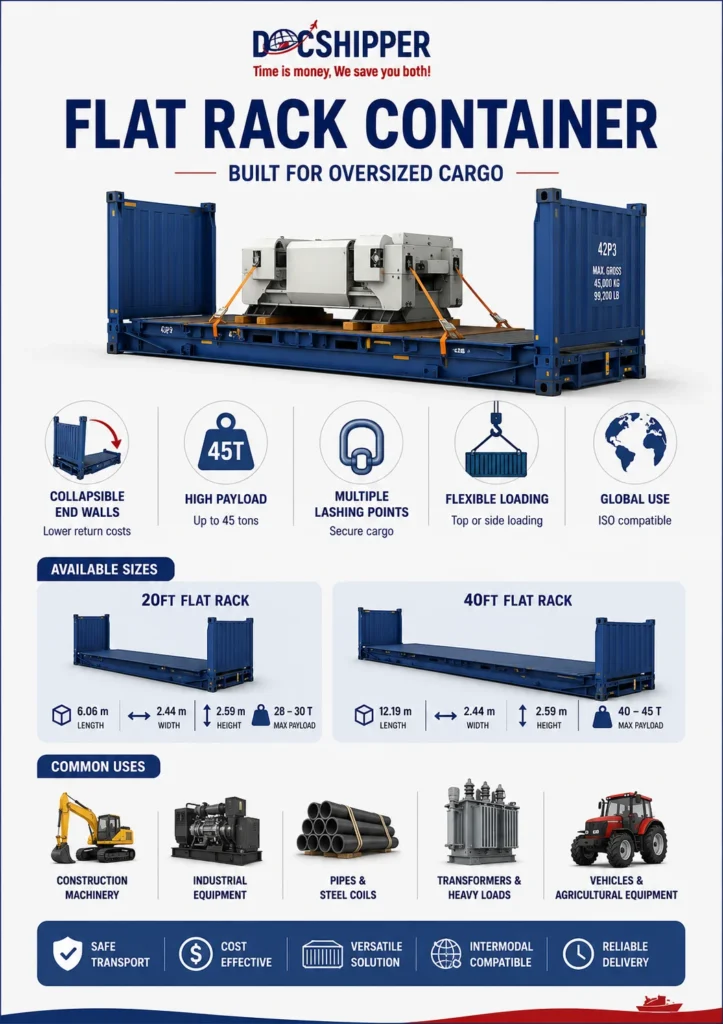
- Collapsible end walls: Foldable sides reduce return shipping costs when empty
- Reinforced flooring: Supports concentrated weight loads up to 45 tons
- Multiple lashing points: D-rings and corner posts for secure cargo fastening
- Stackable design: Corner castings enable vessel stacking despite open structure
- Ventilation advantage: Natural airflow prevents condensation damage for sensitive equipment
Technical Specifications & Operational Characteristics
Flat Rack Containers follow ISO 668 standardization while offering dimensional flexibility unavailable in conventional units. Two primary configurations dominate global shipping: the 20ft Flat Rack and 40ft Flat Rack, each with distinct load capacities and structural features.
The 20ft Flat Rack Container measures 6.06m (length) × 2.44m (width) × 2.59m (height), supporting maximum payloads of 28-30 metric tons. Its shorter footprint suits port-to-port routes with weight restrictions. The 40ft Flat Rack extends to 12.19m length with identical width, accommodating loads up to 40-45 metric tons—ideal for pipelines, turbines, or bridge components.
Critical operational parameters include:
- Collapsible vs. Fixed End Walls: Collapsible models reduce repositioning costs by 60% through compact stacking when unloaded
- Loading Methods: Top-loading via crane, side-loading for wheeled cargo, or roll-on configurations
- Lashing Requirements: International Maritime Dangerous Goods (IMDG) Code mandates minimum 4-point securing for out-of-gauge cargo
- Weight Distribution: Floor load capacity concentrates at 6-8 tons per meter for uneven cargo shapes
- Customs Classification: HS Code variations depending on whether cargo requires tarpaulin coverage or open-air transport
According to ISO International Standards, all Flat Racks must withstand CSC (Container Safety Convention) plate certifications, ensuring structural integrity under stacking pressures exceeding 192,000 kg at corner posts.
At DocShipper, we conduct pre-shipment surveys verifying lashing point compatibility and weight distribution calculations. This prevents vessel loading rejections that cause average delays of 7-10 days at origin ports. Our technical teams coordinate with surveyors to approve non-standard cargo configurations before booking confirmation.
Practical Applications & Comparative Data
Flat Rack Containers dominate project cargo logistics, particularly in energy, construction, and manufacturing sectors. Their versatility addresses challenges standard equipment cannot solve, from agricultural machinery to aerospace components.
Industry-Specific Use Cases:
| Cargo Type | Typical Dimensions | Container Choice | Cost vs. Standard (Est.) |
|---|---|---|---|
| Industrial Boilers | 8m L × 3.2m W × 3.5m H | 40ft Flat Rack | +85-120% |
| Excavator (25-ton) | 9m L × 2.8m W × 3.1m H | 40ft Flat Rack (Collapsible) | +70-95% |
| Steel Coils (Bundle) | 5.8m L × 2.1m W × 2.4m H | 20ft Flat Rack (Fixed) | +50-70% |
| Transformers (High Voltage) | 7.5m L × 2.9m W × 4.2m H | 40ft Flat Rack + Open Top | +130-160% |
| Yacht (Deck Loading) | 10.5m L × 3.4m W × 2.8m H | 40ft Flat Rack (Multiple Units) | +200-250% |
Real-World Case Study: A European manufacturer needed to ship 12 CNC milling machines (each 6.2m × 2.9m × 3.1m, 18 tons) from Hamburg to Shanghai. Standard 40ft High Cube containers were incompatible due to width constraints.
Solution implemented:
- 6× 40ft Flat Rack Containers (collapsible end walls)
- Custom steel cradles with vibration dampening (15mm rubber pads)
- Tarpaulin weatherproofing (UV-resistant, 680g/m² PVC)
- Total transit cost: €42,300 vs. alternative breakbulk shipping at €68,000 (38% savings)
- Door-to-door timeline: 34 days (standard route: 28 days + 6-day custom clearance)
Key lesson: Collapsible Flat Racks enabled return shipping at minimal cost, as empty units folded to 20% original height, reducing repositioning fees by €8,400 compared to one-way fixed models.
Conclusion
The Flat Rack Container remains indispensable for oversized cargo requiring ISO-compliant intermodal transport. Its structural versatility and load capacity bridge the gap between standard containers and costly breakbulk alternatives, particularly for project logistics and industrial equipment.
Need expert guidance on flat rack logistics or custom lashing solutions? Contact DocShipper today for tailored freight solutions.
📚 Quiz
Test Your Knowledge: Flat Rack Container
What is the primary defining characteristic of a Flat Rack Container?
A shipper claims Flat Rack Containers cost the same as standard 40ft containers. Is this interpretation correct?
Your client needs to ship a 25-ton excavator (9m L × 2.8m W × 3.1m H) from Hamburg to Shanghai. Which solution is most appropriate?
🎯 Your Result
📞 Free Quote in 24hFAQ | Flat Rack Container: Definition, Specifications & Practical Use Cases
A 40ft Flat Rack supports payloads between 40-45 metric tons, depending on the manufacturer and end wall configuration. Fixed-end models typically handle higher loads than collapsible versions due to reinforced corner posts. Always verify container specifications with the shipping line before loading concentrated weights exceeding 8 tons per linear meter.
Yes, Flat Racks feature standard ISO corner castings enabling vessel stacking. However, stacking positions depend on cargo protrusion and weight distribution. Shipping lines limit stacking to 2-3 tiers for loaded Flat Racks versus 6-9 tiers for standard containers. Empty collapsible units stack higher due to reduced height profile.
Flat Rack freight rates typically range 50-200% above standard 40ft container costs, depending on cargo dimensions and route. Factors include: out-of-gauge surcharges (15-40%), special equipment fees (€300-800 per unit), and lashing material costs (€150-500). Return positioning for collapsible models reduces total costs by 35-50% versus one-way fixed Flat Racks.
International standards mandate: minimum 4 lashing points per cargo unit, wire rope (minimum 26mm diameter) or synthetic webbing straps (breaking strength ≥10 tons), turnbuckles for tension adjustment, and corner protectors to prevent cargo damage. The IMDG Code requires lashing plans approved by marine surveyors for over-dimensional loads exceeding container boundaries.
Standard Flat Racks lack climate control and offer minimal weather protection. For temperature-sensitive equipment, solutions include: thermal insulation blankets (R-value 3.5-5.0), ventilated tarpaulins preventing condensation, or hybrid Flat Rack/Reefer configurations with refrigeration units. Oil & gas equipment often requires VCI (volatile corrosion inhibitor) packaging when shipped via Flat Rack through tropical routes.
Required documents include: Bill of Lading with accurate cargo dimensions (length × width × height), packing declaration certifying lashing compliance, cargo insurance certificate (typically 110% CIF value), and out-of-gauge approval from the carrier. Many countries require additional certificates: dangerous goods declaration (if applicable), fumigation certificates for wooden packaging, and surveyor reports for high-value machinery.
Yes, Flat Racks excel at vehicle transport, particularly oversized construction equipment, agricultural machinery, and military vehicles. Roll-on loading via reinforced ramps eliminates crane requirements. Wheel chocks, ratchet straps (4-6 per vehicle), and brake engagement ensure secure transit. Shipping lines may require additional "RoRo surcharges" (15-25% of base rate) for wheeled cargo due to specialized handling protocols.
Collapsible Flat Racks feature hinged end walls folding to approximately 20% original height when empty, reducing repositioning costs by 60-70%. Fixed-end models offer 10-15% higher load capacity (up to 48 tons on some 40ft units) due to welded corner structures. Choose collapsible for round-trip shipments or equipment rental logistics; select fixed-end for maximum payload or permanent installation cargo.
Major trade routes (Asia-Europe, Transpacific) require 7-14 days advance booking due to limited equipment availability. Secondary routes or specialized 45ft High Cube Flat Racks may need 3-4 weeks notice. Peak seasons (Q3-Q4 for retail, Q1 for project cargo) see availability drops of 30-40%, often requiring premium positioning fees (€500-1,200 per unit) to secure equipment from alternative depots.
While designed for open-air transport, Flat Racks accommodate air-sensitive cargo with proper protection. Solutions include: custom-fit tarpaulins (600-900g/m² PVC-coated polyester), shrink-wrap for moisture barriers, or rigid crating systems secured to the deck. However, fully enclosed containers (standard dry boxes or hardtops) provide superior protection for electronics, optics, or corrosion-prone materials.
Customs authorities scrutinize oversized cargo more closely due to valuation complexities and potential duty implications. Prepare: detailed commercial invoices breaking down equipment components, technical specifications proving HS code classification accuracy, and certificates of origin for preferential tariff claims. Out-of-gauge cargo may trigger physical inspections (60% likelihood vs. 20% for standard containers), adding 2-5 days to clearance timelines.
Cargo exceeding Flat Rack boundaries requires "out-of-gauge" (OOG) approvals. Most carriers accept: 30cm overhang on length, 60cm on width (non-stacking zones), and unlimited height for vessel deck cargo. Extreme dimensions (12m+ width, 30m+ length) necessitate breakbulk vessels or heavy-lift ships. Port infrastructure limits apply—verify crane capacities (typically 40-100 tons at standard terminals) before finalizing shipping plans.
Need Help with
Logistics or Sourcing ?
First, we secure the right products from the right suppliers at the right price by managing the sourcing process from start to finish. Then, we simplify your shipping experience - from pickup to final delivery - ensuring any product, anywhere, is delivered at highly competitive prices.


Fill the Form
Prefer email? Send us your inquiry, and we’ll get back to you as soon as possible.
Contact us




