


In short ⚡
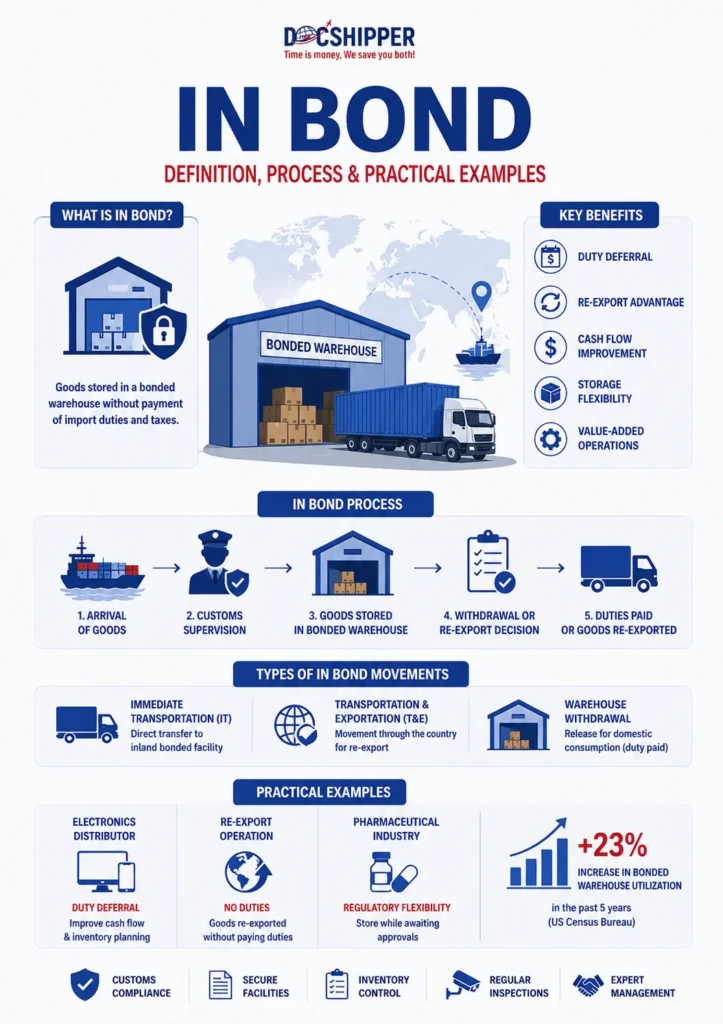
In Bond refers to goods stored in a bonded warehouse or customs-controlled facility without payment of import duties and taxes. This temporary storage allows importers to defer customs clearance until the merchandise is ready for distribution, re-export, or final consumption, providing significant cash flow advantages and operational flexibility in international trade.
Introduction
Many importers face the challenge of managing cash flow while awaiting final destination decisions for their goods. Paying duties immediately upon arrival can strain working capital, especially for high-value shipments or uncertain market conditions.
The In Bond system addresses this issue by allowing merchandise to enter a country without immediate duty payment. This mechanism plays a critical role in supply chain optimization, particularly for companies involved in distribution, manufacturing, or re-export activities.
- Duty deferral: Postpones tax obligations until goods leave the bonded facility
- Regulatory compliance: Operates under strict customs supervision and documentation
- Storage flexibility: Allows goods to remain warehoused for extended periods (typically 1-5 years depending on jurisdiction)
- Re-export advantage: Eliminates duties entirely if goods are shipped to another country
- Value-added operations: Permits certain processing activities while maintaining bonded status
In-Depth Analysis & Regulatory Framework
The In Bond procedure is governed by international customs conventions and national regulations. In the United States, bonded warehouses operate under CBP Title 19 CFR Part 144, while the European Union follows the Union Customs Code provisions for temporary storage facilities.
When goods arrive at a port of entry, they can be transferred to a bonded warehouse under customs supervision. The facility must be licensed by customs authorities and maintain strict inventory controls. All movements are tracked through specialized documentation, including bond entries and withdrawal permits.
Three primary types of In Bond movements exist:
- Immediate Transportation (IT): Direct transfer from arrival port to inland bonded facility
- Transportation and Exportation (T&E): Movement through the country for re-export at another port
- Warehouse Withdrawal: Release from bonded storage for domestic consumption with duty payment
The financial advantage becomes significant with high-duty products. For example, luxury goods subject to 25% tariffs worth $500,000 would require $125,000 in immediate duty payments without bonded storage. Using In Bond facilities, companies can defer this obligation for months or years.
At DocShipper, we systematically verify bonded warehouse certifications and manage all required documentation to ensure seamless customs compliance and optimal duty deferral strategies for our clients.
Security requirements for bonded facilities include continuous customs bond coverage, typically ranging from $50,000 to millions depending on inventory value. Operators must submit detailed reports and allow unannounced inspections by customs officers.
Permitted activities within bonded warehouses include repacking, relabeling, sorting, and minor assembly operations. However, substantial manufacturing that changes tariff classification generally disqualifies merchandise from bonded status. Each jurisdiction defines these limitations differently, requiring careful regulatory review.
Practical Examples & Data
Understanding In Bond through real-world scenarios demonstrates its practical value across different industries and trade situations.
Use Case 1: Electronics Distributor
A U.S. electronics distributor imports $2 million worth of smartphones from Asia quarterly. Rather than paying $140,000 in duties immediately (7% tariff), they utilize a bonded warehouse near their distribution center.
Over six months, they gradually withdraw inventory as orders materialize, paying duties only on released quantities. This approach provides $70,000 in improved cash flow at any given time, which they reinvest in marketing and operations.
Use Case 2: Re-Export Operation
A Canadian company imports machinery from Germany destined for Mexico. By using Transportation and Exportation (T&E) In Bond procedures, the goods transit through U.S. territory without triggering American import duties.
The shipment travels from New York to Laredo, Texas under bond, then crosses into Mexico. Total duty savings: $85,000 on equipment valued at $950,000 (9% U.S. tariff rate avoided entirely).
Comparative Analysis: In Bond vs. Immediate Clearance
| Factor | In Bond Storage | Immediate Clearance |
|---|---|---|
| Duty Payment Timing | Deferred until withdrawal | Due within 10 business days |
| Cash Flow Impact | Positive (delayed outflow) | Negative (immediate payment) |
| Storage Duration | Up to 5 years (U.S.) | N/A |
| Re-Export Option | No duties if re-exported | Requires duty drawback claim |
| Administrative Burden | Higher (bond management, tracking) | Lower (single transaction) |
Industry-Specific Applications
Automotive sector: Spare parts stored In Bond near assembly plants reduce inventory carrying costs. Manufacturers withdraw components based on production schedules, optimizing just-in-time supply chains.
Fashion and apparel: Seasonal collections remain bonded until market demand confirms. If trends shift, merchandise can be re-exported to alternative markets without incurring domestic duties.
Pharmaceutical industry: Temperature-controlled bonded warehouses allow drugs awaiting regulatory approval to remain duty-free. If approval fails, products return to origin without financial loss from paid duties.
According to U.S. Census Bureau data, bonded warehouse utilization has increased by 23% over the past five years, reflecting growing awareness of cash flow optimization strategies in volatile trade environments.
Conclusion
The In Bond system represents a strategic financial tool for importers seeking to optimize cash flow, maintain supply chain flexibility, and minimize duty exposure on uncertain or re-exported merchandise. Understanding its regulatory framework and operational requirements enables companies to leverage significant competitive advantages.
Need expert guidance on implementing In Bond strategies for your shipments? Contact DocShipper for personalized consultation and end-to-end logistics support.
📚 Quiz
Test Your Knowledge: In Bond Procedures
1. What is the primary purpose of In Bond storage?
2. When goods are withdrawn from In Bond storage for domestic consumption in the U.S., which tariff rates apply?
3. A Canadian company imports machinery from Germany to Mexico via the U.S. using Transportation and Exportation (T&E) In Bond procedures. What is the primary advantage?
🎯 Your Result
📞 Free Quote in 24hFAQ | In Bond: Definition, Process & Practical Examples
U.S. regulations permit merchandise to remain in bonded warehouses for up to five years from the date of importation under 19 CFR 144.37. Extensions beyond this period require special permission from Customs and Border Protection and are rarely granted except for specific circumstances like litigation or regulatory delays.
Most countries with established customs systems offer some form of bonded storage, though terminology and specific regulations vary. The concept exists globally under frameworks like the WCO Revised Kyoto Convention. However, operational efficiency, storage duration limits, and permitted activities differ significantly between jurisdictions. Emerging markets may have limited bonded infrastructure compared to major trading nations.
Yes, ownership of bonded merchandise can transfer between parties through proper documentation and customs notification. The new owner assumes responsibility for duties and compliance obligations. This frequently occurs in commodity trading, where goods change hands multiple times before final customs clearance. Both parties must be registered with customs authorities and maintain appropriate bond coverage.
Customs authorities require immediate notification of any loss, theft, or damage to bonded merchandise. If destruction occurs due to unforeseen circumstances (fire, flood, etc.) and is properly documented, duties may be relieved. However, the warehouse operator's insurance typically covers the commercial value, and customs may still assess duties unless formal relief is granted through claims procedures outlined in regulations like 19 CFR 158.
Certain categories face restrictions or prohibitions. Perishable goods require special authorization and temperature-controlled facilities. Explosives, hazardous materials, and items subject to sanitary or phytosanitary controls need additional permits. Prohibited goods (contraband, items violating intellectual property) cannot enter bonded storage. Alcohol and tobacco products face specific regulatory requirements and often require separate specialized bonded facilities.
Both defer duties, but Foreign Trade Zones offer broader manufacturing and processing capabilities. FTZs permit substantial transformation, assembly, and production activities that would disqualify goods from standard bonded warehouses. In Bond facilities focus primarily on storage and minor manipulations. FTZ status requires more extensive application processes and ongoing compliance obligations, making them suitable for larger operations with significant value-added activities.
Essential documents include the In Bond Entry (CBP Form 7512 in the U.S.), commercial invoice, bill of lading, and detailed manifest. For Transportation and Exportation movements, carriers must provide proof of export within specified timeframes. Electronic filing through systems like ACE (Automated Commercial Environment) has replaced paper processes in many jurisdictions. Proper documentation prevents penalties and ensures customs can track merchandise throughout its bonded journey.
Absolutely. This represents one of the key advantages of In Bond storage. Companies can withdraw inventory incrementally as needed, paying duties only on released quantities. Each withdrawal requires a separate customs entry and duty calculation based on current tariff rates and exchange rates at the time of release. This flexibility supports demand-responsive distribution strategies and seasonal business models.
Expect warehouse storage fees (usually per pallet per month), customs bond premiums (0.5-2% of potential duty liability annually), handling charges for receipts and withdrawals, and potential examination fees if customs inspects the merchandise. Some facilities charge administrative fees for documentation preparation. Despite these costs, the cash flow benefits and duty elimination potential on re-exported goods often provide substantial net savings for appropriate use cases.
Withdrawal timeframes depend on several factors. If pre-clearance arrangements exist and duties are paid electronically, release can occur within hours. Standard procedures typically require 1-3 business days to process customs entries, verify documentation, and arrange physical transfer. Emergency situations may qualify for expedited processing, though this often incurs additional fees. Advance planning and established relationships with customs brokers significantly accelerate withdrawal processes.
Generally, no. When goods are withdrawn from bonded storage for domestic consumption, they are subject to the tariff rates in effect at the time of withdrawal, not the rates when originally imported. This creates potential risk if duties increase during storage. However, if rates decrease, importers benefit from the lower assessment. Strategic timing of withdrawals during favorable tariff periods can optimize costs, particularly in volatile trade policy environments.
Cross-border In Bond procedures require coordination between multiple customs jurisdictions. Transit countries may require TIR Carnets (international customs transit documents) or equivalent guarantees. Each country's customs authority must be notified of the shipment's passage, and documentation must prove the goods never entered local commerce. Violation of transit terms in any jurisdiction can result in duty assessment, penalties, and seizure, making experienced logistics providers essential for multi-country In Bond movements.
Need Help with
Logistics or Sourcing ?
First, we secure the right products from the right suppliers at the right price by managing the sourcing process from start to finish. Then, we simplify your shipping experience - from pickup to final delivery - ensuring any product, anywhere, is delivered at highly competitive prices.


Fill the Form
Prefer email? Send us your inquiry, and we’ll get back to you as soon as possible.
Contact us




