



In short ⚡
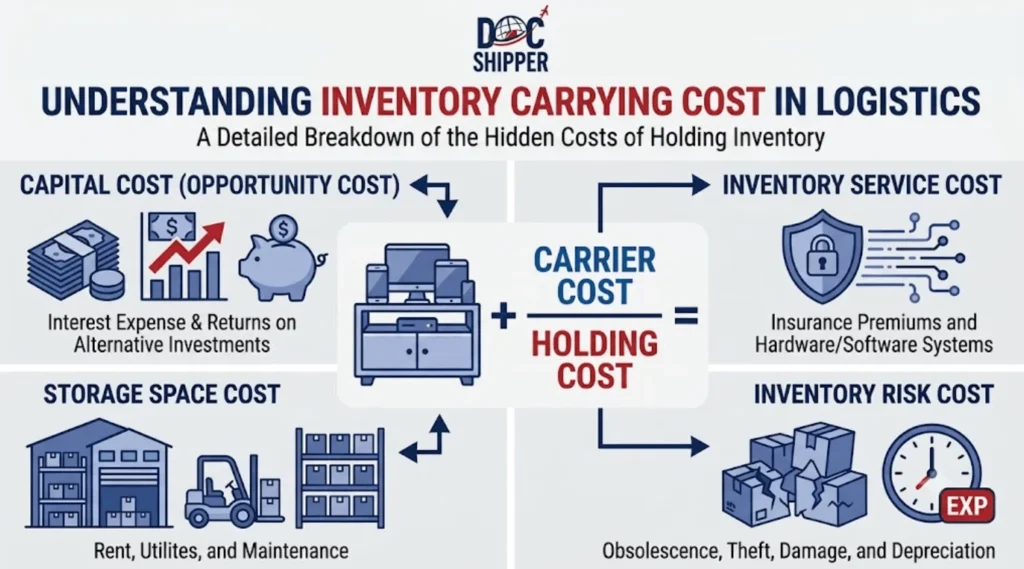
Inventory Carrying Cost represents the total expenses associated with storing and maintaining unsold goods over a specific period. This critical metric includes warehousing fees, insurance, depreciation, opportunity costs, and handling expenses, typically ranging from 20% to 30% of inventory value annually in international trade operations.
Introduction
Many businesses underestimate the hidden costs of holding inventory. They focus solely on purchase prices while overlooking the substantial financial burden of storage and maintenance expenses.
In international logistics, understanding inventory carrying costs determines profitability margins, cash flow management, and competitive positioning. Companies importing goods face additional challenges with extended lead times and customs clearance delays.
Key characteristics of inventory carrying costs include:
- Capital costs: Money tied up in unsold inventory that could generate returns elsewhere
- Storage expenses: Warehouse rent, utilities, equipment maintenance, and facility management
- Service costs: Insurance premiums, taxes, and administrative handling fees
- Risk costs: Obsolescence, damage, theft, and market depreciation of stored goods
- Opportunity costs: Lost investments or business development opportunities due to frozen capital
In-Depth Analysis & Expertise
Inventory carrying costs follow a compound formula where multiple expense categories accumulate simultaneously. The standard calculation method divides total annual carrying costs by average inventory value, expressed as a percentage.
The four primary cost components require distinct calculation approaches. Capital costs typically represent 10-15% annually, calculated by multiplying inventory value by the company’s weighted average cost of capital (WACC). This reflects the financial opportunity lost by allocating funds to inventory rather than revenue-generating investments.
Storage and handling costs encompass physical warehousing expenses. These include square footage rent, climate control systems, material handling equipment, labor for inventory management, and security systems. In international operations, these costs vary significantly by region—European warehouses average €8-12 per square meter monthly, while Asian facilities range from $3-6.
Risk and insurance costs protect against inventory loss through theft, damage, or obsolescence. Insurance premiums typically cost 1-3% of inventory value annually. Technology products face higher obsolescence risks (15-25% annual depreciation), while commodity goods maintain more stable values. According to U.S. Department of Commerce trade data, companies lose an average of 8% of inventory value annually to shrinkage and damage.
The service cost component includes property taxes on stored goods, administrative overhead for inventory tracking systems, and regulatory compliance expenses. Import businesses must factor customs storage fees, demurrage charges, and documentation management costs into this category.
At DocShipper, we systematically analyze clients’ inventory carrying costs to optimize warehousing strategies and reduce unnecessary holding expenses through our integrated logistics solutions. Our approach identifies cost reduction opportunities across the entire supply chain, from origin to final delivery.
Concrete Examples & Data
Consider a European electronics importer holding $500,000 average inventory value throughout the year. Their annual carrying cost breakdown demonstrates typical expense distribution:
| Cost Component | Annual % | Dollar Amount |
|---|---|---|
| Capital Cost (12% WACC) | 12% | $60,000 |
| Warehouse Storage | 6% | $30,000 |
| Insurance & Risk | 4% | $20,000 |
| Obsolescence | 5% | $25,000 |
| Administrative & Services | 3% | $15,000 |
| TOTAL CARRYING COST | 30% | $150,000 |
This 30% annual carrying cost means every dollar in inventory effectively costs $1.30 over twelve months. Reducing average inventory by 20% would save $30,000 annually while maintaining service levels.
Use Case: A furniture importer ships containers from Vietnam to the United States. Each container holds $80,000 worth of products with a 45-day ocean transit plus 15 days customs clearance and inland delivery. The company maintains 90-day safety stock for demand variability.
Total inventory cycle: 150 days (transit + clearance + safety stock). With 25% annual carrying costs, the holding expense equals: ($80,000 × 0.25 × 150/365) = $8,219 per container. Optimizing safety stock from 90 to 60 days reduces this cost to $6,575, saving $1,644 per shipment—a 20% reduction.
Key optimization strategies for reducing inventory carrying costs:
- Just-in-time ordering: Synchronize procurement with demand forecasts to minimize holding periods
- Warehouse consolidation: Centralize storage facilities to reduce duplicate overhead expenses
- Improved forecasting: Implement demand planning software to reduce safety stock requirements
- Faster inventory turnover: Negotiate shorter lead times with suppliers and optimize sales channels
- Cross-docking strategies: Transfer goods directly from inbound to outbound logistics without warehousing
Conclusion
Inventory carrying costs directly impact profitability and cash flow in international trade. Understanding and actively managing these expenses separates successful importers from those struggling with hidden operational drains.
Need expert guidance on optimizing your inventory management strategy? Contact DocShipper for comprehensive logistics solutions tailored to your business needs.
📚 Quiz
Test Your Knowledge: Inventory Carrying Cost
1. What does inventory carrying cost represent in international logistics?
2. A company has $500,000 average inventory value with 30% annual carrying costs. If they reduce inventory by 20%, what is the annual savings?
3. Which statement about customs duties and inventory carrying costs is correct?
🎯 Your Result
📞 Free Personalized QuoteFAQ | Inventory Carrying Cost: Definition, Calculation & Concrete Examples
Industry standards place inventory carrying costs between 20-30% of total inventory value annually. Technology and fashion products trend toward the higher end (25-35%) due to obsolescence risks, while commodities and non-perishable goods average 18-25%. Companies with efficient logistics operations and rapid inventory turnover can achieve costs below 20%.
Opportunity cost equals your inventory value multiplied by your company's weighted average cost of capital (WACC) or expected return rate on alternative investments. If your WACC is 12% and average inventory is $200,000, the annual opportunity cost is $24,000. This represents potential earnings lost by tying capital in unsold goods rather than revenue-generating activities.
These terms are interchangeable in logistics contexts. Both refer to the total expenses associated with storing unsold inventory over time. Some organizations use "holding cost" for warehouse-specific expenses and "carrying cost" for the comprehensive calculation including capital, risk, and service costs. The distinction matters less than ensuring all expense categories are captured.
Perform comprehensive recalculations quarterly to capture seasonal variations and changing business conditions. Monitor monthly for businesses with volatile inventory levels or rapid market changes. Annual reviews suffice for stable operations with consistent inventory patterns. Recalculate immediately after major changes like warehouse relocations, new product categories, or significant interest rate fluctuations.
Customs duties paid at import entry become part of the inventory acquisition cost (landed cost), not carrying costs. However, storage fees at customs warehouses, demurrage charges, and interest on duty payments do count as carrying costs. If goods remain in bonded warehouses awaiting clearance, those storage expenses directly increase your inventory carrying burden.
Higher inventory turnover directly reduces carrying costs by shortening storage duration. A company with 12x annual turnover (30-day average holding period) pays one-quarter the carrying costs of a competitor with 3x turnover (120-day holding). Faster turnover minimizes exposure to obsolescence, reduces warehouse space requirements, and frees capital for other business investments.
Geographic location significantly impacts storage expenses and operational efficiency. Urban warehouses near ports offer faster processing but charge premium rent. Rural facilities provide lower square-footage costs but increase inland transportation expenses. Climate considerations affect utility costs—temperature-controlled storage in tropical regions costs 30-50% more than ambient storage. Strategic location selection balances accessibility against facility expenses.
Most inventory carrying cost components qualify as deductible business expenses, including warehouse rent, insurance premiums, utilities, and administrative costs. However, the opportunity cost component represents foregone earnings rather than actual expenditures and generally isn't tax-deductible. Consult with tax professionals regarding specific deductibility in your jurisdiction, as regulations vary internationally.
Seasonal businesses experience carrying cost spikes during inventory buildup periods. Smart strategies include negotiating flexible warehouse agreements with seasonal rate structures, leveraging just-in-time manufacturing for predictable demand portions, and implementing pre-ordering programs that shift inventory to customers earlier. Calculate carrying costs using weighted average inventory across the full year rather than peak periods alone.
Shrinkage from theft, damage, or administrative errors typically adds 1-3% to annual carrying costs for well-managed operations. Retail environments average 1.4% shrinkage, while poorly controlled warehouses exceed 5%. Beyond direct loss value, shrinkage increases insurance premiums, requires additional inventory investment to maintain service levels, and necessitates enhanced security systems—all compounding the total carrying cost burden.
Include only warehouse staff directly involved in inventory management and handling—receiving clerks, stockkeepers, and material handlers. Exclude purchasing department salaries, sales personnel, and general management as these represent operational overhead rather than inventory-specific carrying costs. The allocation ensures accurate cost-per-unit calculations and proper inventory valuation for financial reporting.
Exchange rate volatility introduces additional risk costs for imported inventory. If your home currency weakens against the supplier's currency, inventory value increases without generating additional revenue, raising carrying costs proportionally. Sophisticated importers use currency hedging instruments to stabilize inventory valuations, though hedging fees themselves become part of the carrying cost calculation. Factor 1-2% additional risk premium for unhedged international inventory exposure.
Need Help with
Logistics or Sourcing ?
First, we secure the right products from the right suppliers at the right price by managing the sourcing process from start to finish. Then, we simplify your shipping experience - from pickup to final delivery - ensuring any product, anywhere, is delivered at highly competitive prices.


Fill the Form
Prefer email? Send us your inquiry, and we’ll get back to you as soon as possible.
Contact us




