
In short ⚡
Logistics management matters because it directly shapes service quality, total landed cost, and business resilience by planning, executing, and controlling the flow of goods, documents, and information from consignor to consignee.
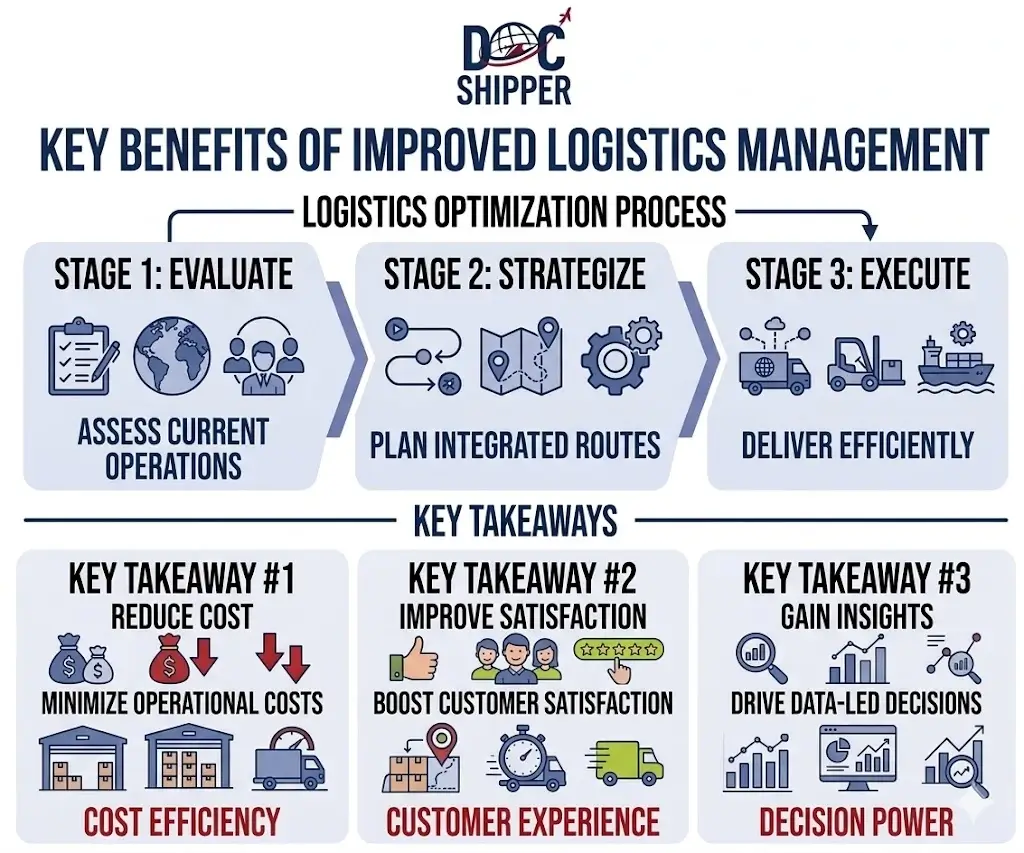
Done well, it reduces lead times, demurrage, detention charges, inventory swings, and compliance risks while improving cash flow and customer satisfaction.
We hope you’ll find this article genuinely useful, but remember, if you ever feel lost at any step, whether it’s finding a supplier, validating quality, managing international shipping or customs, DocShipper can handle it all for you!
What is logistics management and why does it matter to your business?
If you’re trying to grasp the importance of logistics management, start with this, it’s the difference between a shipment that lands smoothly and one that turns into demurrage, detention charges, and angry customer emails.
You’ll notice fast that “logistics” isn’t just moving cargo, it’s controlling lead time, costs, and service quality from consignor to consignee.
In practical terms, logistics management is how you plan, execute, and control the flow of goods and information across transportation, warehousing, and delivery, including freight forwarding, customs clearance, and tracking and tracing.
And yes, it touches the paperwork too, bill of lading, airway bill, export declaration, freight invoice, delivery order, and the customs brokerage steps that decide whether your container gets released today or “maybe next week.”
Micro-story from experience: you’ve probably lived this one, the supplier ships “FOB” but books a carrier you didn’t approve, the freight rate looks fine until the destination terminal hits you with surprise fees, and suddenly your margins evaporate.
That’s the moment you realize logistics management isn’t an ops detail, it’s a profit lever.
Checklist, quick signs your logistics management needs tightening:
- You can’t reliably predict lead time by lane, carrier, or incoterms.
- Your team argues over who pays what because the incoterms and freight contract don’t match the reality.
- Customs clearance delays repeat because HS code and tariff classification vary by broker or by exporter.
- Inventory management swings between stockouts and overstock, even when demand stays stable.
- Cost surprises show up after arrival, demurrage, detention charges, re-handling, or last-mile delivery add-ons.
Workflow, how we help you make logistics “manageable” instead of chaotic:
Step 1, confirm incoterms, roles (consignor, consignee), and service scope.
Step 2, lock transport mode, containerization, palletization, multimodal transport, and consolidation plan.
Step 3, align documents, bill of lading or airway bill, export declaration, cargo insurance.
Step 4, run customs brokerage with validated HS code, import duty expectations, and clearance timeline.
Step 5, execute delivery, cross-docking or warehousing, then last-mile delivery with tracking and tracing.
DocShipper Alert
Secure your incoterms, carriers, and customs flow before shipment, we align contracts and execution to protect your landed cost and delivery deadlines.
Defining logistics management and the 7 “rights” of product flow
The importance of logistics management becomes obvious when you view it as a discipline for getting the “7 rights” right, not just booking a shipment.
Here’s the thing, every “right” is a cost or risk control point.
In the language many teams use (and that the CSCMP aligns with in its supply chain definitions), logistics management focuses on moving and storing goods effectively, with the right information at the right time.
That includes everything from freight forwarding and carrier coordination to bonded warehouse storage and release documentation.
The 7 rights you’re actually managing:
- Right product, matched to PO, packing list, and labeling, no mismatch at receiving.
- Right quantity, aligned with palletization, containerization, and freight consolidation rules.
- Right condition, protected via cargo insurance, packaging specs, and handling controls.
- Right place, correct consignee, correct delivery order, correct last-mile delivery address and access.
- Right time, controlled lead time, cut-offs, and just-in-time delivery windows.
- Right customer, no confusion between consignee entities, especially in multi-site receiving.
- Right cost, verified freight rate, validated surcharges, and clean freight invoice reconciliation.
Micro-story: we once saw a buyer “save” on freight by skipping palletization, cartons shifted in transit, the carrier noted damage, and the consignee rejected the delivery.
The freight rate looked cheaper, but the total landed cost wasn’t, that’s exactly why logistics management matters.
Workflow, a simple 7-rights control loop you can copy:
Step 1, validate product, quantity, and packaging against PO and incoterms.
Step 2, choose mode and carrier, then lock freight contract terms and liability.
Step 3, confirm documents, bill of lading or airway bill, and consignee details.
Step 4, monitor tracking and tracing to protect time and condition.
Step 5, reconcile freight invoice and exceptions to protect cost.
DocShipper Advice
Apply a 7-rights control check before every shipment to protect condition, timing, and invoice accuracy end to end.
How logistics fits within supply chain management (and how it differs)
You can’t talk about the importance of logistics management without clearing up the classic confusion, logistics is not the whole supply chain, but it can absolutely break it.
Supply chain management covers end-to-end decisions, sourcing, supplier negotiation, production planning, and customer fulfillment, while logistics management is the execution engine for moving and storing goods.
Put differently, your supply chain strategy might decide where you source and how you buffer risk, while logistics decides how the cargo actually moves, by air with an airway bill, by ocean with a bill of lading, or via multimodal transport with tight handoffs.
And when customs clearance enters the picture, logistics management is where theory meets the port gate.
Micro-story: you negotiate a great unit price, then your supplier ships under the wrong incoterms, lists the wrong HS code, and your import duty spikes.
The sourcing win turns into a landed-cost loss, purely because logistics management and supply chain decisions weren’t aligned.
| Area | Supply chain management (SCM) | Logistics management |
| Scope | End-to-end planning from suppliers to customers | Operational execution of transport, warehousing, and delivery |
| Typical decisions | Sourcing strategy, supplier base, inventory policy, network design | Carrier selection, freight rate negotiation, consolidation, route and mode choice |
| Documents and compliance | Governance and policies | Export declaration, customs brokerage, tariff classification, HS code, delivery order |
| KPIs you feel daily | Total cost-to-serve, resilience, service levels | Lead time, throughput, demurrage, detention charges, damage rate, on-time delivery |
Checklist, make SCM and logistics line up:
- Make incoterms non-negotiable in your PO and supplier SOPs.
- Define who controls booking, you, your freight forwarder, or the supplier.
- Standardize HS code ownership and validation before shipping.
- Map landed cost, freight, duty, brokerage, storage, last mile, not just unit price.
DocShipper Info
Align sourcing, incoterms, and customs ownership with one accountable logistics lead to avoid duty spikes and clearance surprises.
Core components of effective logistics management you must get right
The importance of logistics management shows up in four places, transportation, warehousing, inventory, and information flow.
Miss one, and the others start bleeding money.
At DocShipper, we see it every week, a client optimizes a freight rate but forgets about cross-docking capacity, or they speed up a shipment only to hit a customs clearance wall because the export declaration doesn’t match the cargo.
So let’s break the core components down in a way you can act on immediately.
Checklist, the “must-get-right” basics before you scale volume:
- Document control, bill of lading or airway bill accuracy, consignee and consignee tax IDs, and delivery order process.
- Cost control, clean freight contract terms and auditable freight invoice checks.
- Time control, realistic lead time by lane, including port dwell and clearance buffers.
- Risk control, cargo insurance fit-for-purpose and clear claims procedure.
- Compliance control, HS code, tariff classification, and import duty visibility before departure.
Workflow, a practical logistics management operating rhythm:
Step 1, plan, lanes, modes, consolidation rules, and service levels.
Step 2, execute, book with carrier or freight forwarder, then dispatch.
Step 3, control, tracking and tracing, exception management, and milestone alerts.
Step 4, clear, customs brokerage and release, including bonded warehouse if needed.
Step 5, close, proof of delivery, freight invoice audit, KPI review.
DocShipper Advice
Audit your documents, contracts, and HS codes before departure to avoid clearance delays and costly post-arrival corrections.
Key activities: transportation, warehousing, inventory, and information flow
The importance of logistics management becomes painfully clear when you manage these activities daily, transportation, warehousing, inventory management, and the information that connects them.
Any disconnect turns into cost, delay, or both.
Transportation: you manage carrier performance, freight rates, schedules, and multimodal transport handoffs.
This is where containerization choices, consolidation, and booking discipline prevent “cheap freight” from becoming expensive demurrage.
Warehousing: you decide between bonded warehouse storage, cross-docking, or standard warehousing to protect throughput.
Good warehousing keeps inventory visible and prevents last-minute premium shipping.
Inventory: you balance just-in-time with safety stock, based on actual lead time variability.
When inventory management ignores transit risk, you end up firefighting with air freight.
Information flow: you keep data consistent across documents and systems, PO, packing list, bill of lading, airway bill, and customs entry.
This is where tracking and tracing plus exception alerts save you hours, and sometimes save the shipment.
Micro-story: a consignee once waited two extra days because the delivery order required an original bill of lading, but nobody flagged it before arrival.
Transport was “on time,” yet the cargo sat idle, logistics management is also document timing.
| Activity | What you control | What breaks when it’s weak |
| Transportation | Freight rate, carrier, routes, consolidation, mode choice | Late delivery, high surcharges, demurrage and detention charges |
| Warehousing | Storage, cross-docking, throughput, picking accuracy | Congestion, mispicks, delayed last-mile delivery |
| Inventory | Reorder points, JIT policy, buffers by SKU | Stockouts, overstock, emergency shipments |
| Information | Milestones, documents, customs data, visibility | Clearance delays, disputes, invoice errors |
DocShipper Alert
Synchronize transport, warehouse, and customs data to prevent idle cargo, demurrage, and missed appointments.
Types of logistics: inbound, outbound, production, reverse, and 3PL
The importance of logistics management also depends on which logistics “type” you’re dealing with, because each one has different failure points and KPIs.
And yes, the fastest way to spot maturity is to see whether you treat reverse logistics as an afterthought.
Inbound logistics: you pull goods from suppliers, manage pickup, export declaration, and origin handling.
This is where you prevent supplier-driven chaos, wrong incoterms, missing documents, or sloppy palletization.
Outbound logistics: you deliver to customers, manage last-mile delivery promises, and ensure the consignee receives clean, on-time cargo.
Outbound is where service quality becomes brand reputation.
Production logistics: you feed manufacturing lines with just-in-time reliability, not hope.
If inbound lead time varies, production stops, and that cost dwarfs any freight savings.
Reverse logistics: you handle returns, repairs, and disposal flows, often with customs nuances.
One small paperwork error can make a return shipment look like a new import, and then you’re staring at unexpected import duty.
3PL logistics: you outsource execution to a 3PL, or coordinate broader orchestration with a 4PL.
With a good freight forwarder and 3PL setup, you gain scale, better freight rates, and tighter processes, without building everything in-house.
Micro-story: a retailer launched in two countries and used one 3PL for warehousing and another broker for customs clearance, but nobody owned the handoff.
The cargo cleared customs, then sat because the warehouse appointment system didn’t match the arrival notice, a small coordination gap with a big throughput hit.
Checklist, choose the right operating model for each type:
- Inbound: define booking authority and incoterms, then lock document deadlines.
- Outbound: set delivery SLAs and track exceptions by lane and carrier.
- Production: measure line-stoppage risk, not just freight cost.
- Reverse: pre-plan customs treatment and documentation to avoid double duty.
- 3PL: clarify KPIs, data visibility, and who owns claims, invoices, and disputes.
At DocShipper, we support you across freight forwarding, customs brokerage, and end-to-end logistics coordination, so each logistics type runs as one system, not five disconnected workflows.
That’s where the operational payoff of the importance of logistics management becomes very real.
DocShipper Info
Centralize 3PL, brokerage, and warehousing coordination under one operational framework to protect throughput and accountability.
The importance of logistics management for performance, costs, and risk
The importance of logistics management becomes obvious when you measure how directly it impacts your service level, working capital, and operational stability. You feel it immediately in your margins, your delivery times, and your customer retention rate.
If your logistics is poorly controlled, you pay more for freight, you carry excess stock, and you expose your business to disruptions. If it is optimized, you unlock speed, visibility, and predictable growth.
- Performance: Faster order processing, higher OTIF rates, shorter lead times.
- Cost control: Optimized transport modes, reduced storage fees, lower inventory holding costs.
- Cash flow: Better inventory turnover and fewer blocked funds in slow-moving stock.
- Risk reduction: Diversified carriers, backup routes, compliance management.
- Customer satisfaction: Accurate deliveries, transparent tracking, fewer returns.
You cannot separate logistics performance from financial performance. Transport optimization alone can reduce total landed cost by 5 to 15 percent when properly engineered.
| Area | Poor Logistics Management | Optimized Logistics Management |
| Transportation | Emergency shipments, high spot rates | Planned capacity, negotiated contracts |
| Inventory | Overstock or stockouts | Balanced safety stock, accurate forecasting |
| Risk | Single supplier or carrier dependency | Multi-sourcing and contingency planning |
| Customer experience | Late or damaged deliveries | Reliable, trackable shipments |
Risk management is now central to logistics strategy, especially in global sourcing from China and other manufacturing hubs. You must anticipate port congestion, customs delays, regulatory changes, and geopolitical instability.
At DocShipper, we design logistics flows that integrate sourcing, quality control, and international freight in one coordinated system. You reduce uncertainty because we manage suppliers, inspections, freight, and customs as a single operational chain.
DocShipper Advice
Engineer your lanes, carriers, and buffers to cut landed costs and stabilize cash flow without sacrificing service level.
How technology and data elevate modern logistics management
You cannot talk about the importance of logistics management today without talking about data. Technology transforms logistics from reactive firefighting into proactive decision-making.
Real-time visibility allows you to monitor shipments, inventory levels, and supplier performance in one dashboard. You move from assumptions to measurable KPIs.
- Transportation Management Systems optimize routes and carrier selection.
- Warehouse Management Systems improve picking accuracy and storage efficiency.
- ERP integration synchronizes procurement, inventory, and finance.
- Tracking platforms provide live shipment updates.
- Data analytics tools forecast demand and identify bottlenecks.
When you centralize data, you reduce manual errors and duplicated processes. You also gain negotiation power because you know your volumes, costs, and performance metrics precisely.
| Technology Lever | Operational Impact | Strategic Benefit |
| Automation | Fewer human errors | Lower operational cost |
| Predictive analytics | Better demand planning | Reduced stockouts |
| Digital documentation | Faster customs clearance | Lower compliance risk |
| Integrated platforms | End-to-end visibility | Stronger decision-making |
Data-driven logistics gives you control over complexity, especially when importing from multiple suppliers across Asia. We help you consolidate supplier coordination, freight booking, and compliance documentation into a unified digital workflow.
The result is not just operational efficiency. It is strategic agility.
DocShipper Info
Integrate TMS, WMS, and digital documentation to reduce errors, accelerate clearance, and negotiate from real performance data.
Conclusion
The importance of logistics management goes far beyond moving goods from point A to point B. It defines your cost structure, your resilience, and your competitive advantage.
- You improve operational performance through structured transport and inventory control.
- You reduce costs by optimizing freight, warehousing, and stock levels.
- You protect your business by managing logistics risks proactively.
- You enhance customer satisfaction with reliable and transparent deliveries.
- You leverage technology and data to transform logistics into a strategic asset.
- You gain full control when sourcing internationally by integrating suppliers, inspections, and freight.
When you treat logistics as a core management discipline, not a back-office function, you unlock sustainable growth. At DocShipper, we help you design, control, and optimize that entire logistics architecture from sourcing to final delivery.
Looking for a Reliable Shipping & Sourcing Partner?
FAQ | The importance of logistics management for efficiency, cost control, and customer satisfaction
- Supply chain management (SCM) is the end-to-end strategy, from sourcing and supplier selection to production planning and customer fulfillment.
- Logistics management is the execution engine, it handles transport, warehousing, customs, and delivery on a day-to-day basis.
- SCM decisions: where to produce, how much inventory to hold, which suppliers to use, how to design your network.
- Logistics decisions: which carrier and mode to book, how to consolidate cargo, how to manage customs clearance and delivery time.
- In short: SCM decides the “what and where,” logistics manages the “how and when” so goods actually move on time and at the right cost.
- Inbound logistics: managing flows from your suppliers to you (pickup, export docs, origin handling).
- Outbound logistics: moving goods from you to your customers (order processing, last-mile, delivery promises).
- Production logistics: feeding your manufacturing/assembly lines with the right materials at the right time.
- Reverse logistics: handling returns, repairs, and disposal, including customs treatment for international flows.
- 3PL logistics: outsourcing part or all of your logistics (warehousing, transport, customs) to a third-party provider.
- The key is to define KPIs and responsibilities separately for each type, then connect them into one coherent process.
- Transportation
- Choose the right modes and carriers by lane, negotiate contracts instead of relying on spot rates.
- Use consolidation and containerization to reduce cost per unit and avoid partial loads.
- Warehousing
- Decide when to use cross-docking vs. storage; design clear inbound/outbound workflows.
- Track accuracy (receiving, picking, loading) and throughput as core KPIs.
- Inventory
- Set reorder points and safety stock based on real lead time and variability, not guesses.
- Link purchasing plans to logistics capacity so you don’t create peak bottlenecks.
- Information flow
- Keep PO, packing list, bill of lading/airway bill, and customs data fully aligned.
- Implement tracking and exception alerts so issues are visible before they become delays.
- Transport
- Planned shipments and contracts reduce emergency airfreight and high spot rates.
- Route and mode optimization lower fuel, surcharges, and demurrage/detention.
- Inventory
- More predictable lead times let you cut excess safety stock and free working capital.
- Fewer stockouts mean less last-minute premium shipping to “save” customers.
- Warehousing
- Better layout and processes cut handling time, overtime, and picking errors.
- Smarter use of bonded or regional warehouses reduces storage and tax exposure.
- Administration
- Clean documentation and accurate HS codes prevent fines, storage at customs, and rework.
- Standardized processes make invoice auditing easier, catching billing errors quickly.
- From the customer’s view, returns are part of the buying experience; slow or messy returns damage trust.
- A clear reverse logistics process:
- Defines return conditions and documentation upfront (labels, RMA, customs info).
- Minimizes customer effort (pickup options, simple instructions, fast refunds/replacements).
- From the margin side, structured reverse flows:
- Allow you to inspect and restock salable items quickly.
- Separate repair, refurbish, recycle, and scrap streams to recover value where possible.
- Avoid double payment of duties or taxes on international returns through correct customs treatment.
- When volumes or trade lanes become too complex for a small in-house team to manage efficiently.
- When you need capabilities you don’t have internally, such as:
- Multi-country customs expertise and HS classification support.
- International freight contracts, consolidation, and multimodal transport options.
- Warehousing in key markets (bonded or standard) with established systems.
- When your priority is focusing on core activities (product, sales, marketing) while a specialist:
- Designs and runs the logistics flows.
- Provides tracking, data, and KPIs in one platform.
- Manages exceptions, claims, and disputes on your behalf.
- Visibility tools
- Use tracking platforms or integrated portals for real-time shipment and inventory status.
- Set automated alerts for delays, customs holds, or missed milestones.
- Operational systems
- TMS (Transportation Management System) for route planning, carrier selection, and freight optimization.
- WMS (Warehouse Management System) for accurate receiving, storage, and picking.
- ERP integration to sync purchasing, inventory, and finance with logistics events.
- Analytics
- Monitor KPIs like OTIF, damage rate, demurrage/detention, and cost per shipment.
- Identify recurring bottlenecks by lane, supplier, or carrier and target them for improvement.
- Over time, this data lets you move from firefighting to scenario planning, negotiating better rates, and designing more resilient logistics networks.
Need Help with
Logistics or Sourcing ?
First, we secure the right products from the right suppliers at the right price by managing the sourcing process from start to finish. Then, we simplify your shipping experience - from pickup to final delivery - ensuring any product, anywhere, is delivered at highly competitive prices.
Fill the Form
Prefer email? Send us your inquiry, and we’ll get back to you as soon as possible.
Contact us