


In short ⚡
Integrated Logistics is a holistic approach that unifies all supply chain activities—procurement, transportation, warehousing, and distribution—into a synchronized system. By eliminating silos and fostering collaboration across functions, it optimizes costs, reduces lead times, and enhances customer satisfaction through seamless coordination.Introduction
Many companies struggle with fragmented logistics operations where departments work in isolation. Purchasing, warehousing, and transport teams often pursue conflicting objectives, creating bottlenecks, excess inventory, and missed delivery deadlines. This dysfunction directly impacts profitability and customer loyalty.
Integrated Logistics emerged as the solution to this chaos. By treating the supply chain as a unified ecosystem rather than disconnected departments, businesses achieve operational excellence that competitors cannot replicate. This approach is particularly critical in international trade, where coordination between customs brokers, freight forwarders, and distributors determines success or failure.
Key characteristics of Integrated Logistics include:
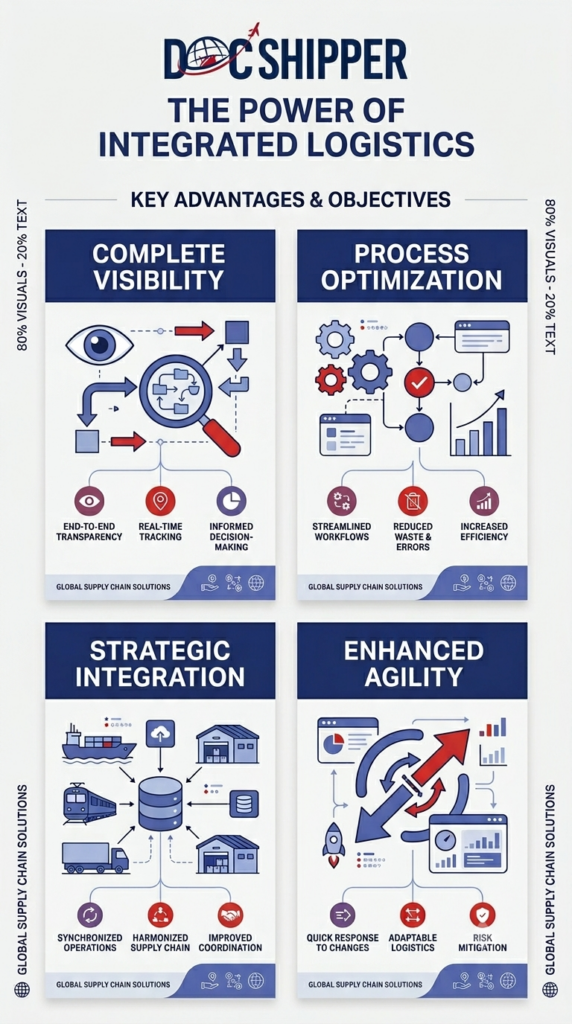
- End-to-end visibility: Real-time tracking from supplier to final customer
- Cross-functional collaboration: Shared KPIs and unified decision-making
- Technology integration: ERP, WMS, and TMS systems communicating seamlessly
- Demand-driven planning: Synchronizing supply with actual market needs
- Continuous optimization: Using data analytics to eliminate waste systematically
Mechanisms & Strategic Expertise
Integrated Logistics operates on five foundational principles that transform disconnected activities into competitive advantage. Understanding these mechanisms enables companies to implement strategies that deliver measurable results.
Information Flow Synchronization forms the nervous system of integrated operations. Advanced systems like SAP or Oracle provide a single source of truth where inventory levels, shipment status, and demand forecasts update in real time. This eliminates the classic problem of sales teams promising deliveries that warehouses cannot fulfill. At DocShipper, we implement API connections between client systems and carrier platforms to ensure seamless data exchange across all touchpoints.
Process Standardization creates predictability in complex operations. When a company standardizes procedures for receiving goods, quality control, and dispatch, errors decrease dramatically. The ISO 9001 framework provides excellent guidelines for documenting these workflows. Standardized processes also facilitate training and reduce dependency on individual employees’ knowledge.
Strategic Partnerships extend integration beyond company walls. Leading firms treat key suppliers and logistics providers as extensions of their own operations. This involves shared forecasting, collaborative planning, and even joint investment in technology. Contracts move from transactional spot-buying to long-term strategic agreements with performance incentives aligned to mutual success.
Risk Management Integration addresses vulnerabilities proactively rather than reactively. Companies map their entire supply network to identify single points of failure—whether a critical supplier, a congested port, or geopolitical instability. They then develop contingency plans, maintain safety stock strategically, and diversify sourcing. This approach proved essential during COVID-19 disruptions when integrated companies recovered faster than competitors.
Performance Measurement Systems provide the feedback loops that drive continuous improvement. Beyond traditional metrics like on-time delivery, integrated logistics tracks total landed cost, inventory turnover, perfect order percentage, and cash-to-cash cycle time. These holistic KPIs reveal trade-offs—for example, air freight increases transport costs but may reduce total costs by avoiding stockouts. DocShipper helps clients establish these measurement frameworks to make data-driven decisions.
Concrete Examples & Performance Data
Quantifiable results demonstrate the superiority of integrated approaches over traditional fragmented logistics. The following cases illustrate tangible benefits across different industries.
Automotive Manufacturing Case: A European car manufacturer reduced its supplier base from 840 to 320 vendors while improving parts availability from 94% to 99.2%. By integrating just-in-sequence delivery with production schedules, they cut warehouse space by 35% and reduced working capital tied in inventory by €47 million. The key was a shared digital platform where suppliers received 4-week rolling forecasts with daily updates, enabling precise production planning.
Retail Distribution Comparison: The table below contrasts traditional versus integrated logistics performance in the retail sector:
| Metric | Traditional Approach | Integrated Logistics | Improvement |
|---|---|---|---|
| Order Fulfillment Time | 7.2 days | 3.1 days | 57% faster |
| Inventory Accuracy | 89% | 98.5% | +9.5 points |
| Logistics Cost (% revenue) | 11.8% | 8.3% | 30% reduction |
| Customer Satisfaction Score | 7.4/10 | 8.9/10 | +20% improvement |
Pharmaceutical Cold Chain Success: A biotech company transporting temperature-sensitive vaccines implemented integrated logistics across 23 countries. By connecting refrigerated warehouses, specialized carriers, and customs brokers through a unified control tower, they achieved 99.97% temperature compliance versus the industry average of 94%. The system automatically rerouted shipments when delays threatened cold chain integrity, preventing $12 million in potential product losses annually.
E-commerce Scalability: An online marketplace grew from 50,000 to 2 million daily orders without proportional cost increases. Their integrated system dynamically allocated inventory across 18 fulfillment centers based on demand patterns, used predictive analytics for pre-positioning stock, and optimized carrier selection per shipment. This resulted in maintaining same-day delivery for 67% of orders while keeping logistics costs at 6.2% of revenue.
Import/Export Efficiency: For international shipments, integration dramatically reduces clearance times. Companies using integrated customs compliance systems experience 48-hour average clearance versus 5-7 days for those managing documentation manually. DocShipper’s integrated approach combines trade compliance software, licensed customs brokers, and proactive issue resolution, ensuring goods move smoothly across borders without costly delays.
Conclusion
Integrated Logistics transforms supply chains from cost centers into strategic competitive weapons. Companies that successfully implement this approach consistently outperform competitors in cost efficiency, delivery speed, and customer satisfaction. The investment in technology and process redesign delivers returns within 18-24 months for most organizations.
Need support implementing integrated logistics solutions for your international operations? Contact DocShipper for customized consulting and execution services.
📚 Quiz
Test Your Knowledge: Integrated Logistics
What is the primary defining characteristic of Integrated Logistics?
A common misconception about Integrated Logistics is that:
In which scenario would Integrated Logistics provide the MOST strategic value?
🎯 Your Result
📞 Get Your Free Personalized QuoteFAQ | Integrated Logistics: Definition, Implementation & Concrete Examples
Integrated logistics emphasizes horizontal coordination across functions with unified KPIs and shared technology platforms. Traditional SCM often operates vertically with departments optimizing their own metrics independently. Integration creates a single, orchestrated flow rather than a series of handoffs, eliminating the inefficiencies that arise from departmental silos and conflicting objectives.
Implementation costs vary from $500,000 for mid-sized companies to $50 million for global enterprises. Major expenses include software platforms (ERP/WMS/TMS), process consulting, training, and change management. However, companies typically achieve ROI within 18-24 months through reduced inventory, lower transportation costs, and improved asset utilization. Cloud-based solutions have reduced upfront capital requirements significantly.
Absolutely. Small businesses can implement integration principles using affordable cloud platforms like ShipStation, Odoo, or Cin7. The key is starting with core integrations—connecting your e-commerce platform to inventory management and shipping systems. Even basic automation eliminates manual errors and provides visibility that improves decision-making. Scale the sophistication as your business grows rather than waiting until you're large enough for enterprise systems.
Organizational resistance tops the list, as integration often disrupts established workflows and power structures. Technical challenges include connecting legacy systems with modern platforms. Data quality issues emerge when consolidating information from multiple sources. Companies also struggle with defining appropriate KPIs that balance competing priorities. Successful transitions require executive sponsorship, phased implementation, comprehensive training, and realistic timelines of 12-18 months.
Integration enables precise demand forecasting that reduces overproduction and waste. Optimized routing decreases fuel consumption and emissions. Better inventory management cuts obsolescence. Visibility into supplier practices allows enforcement of environmental standards. Companies with integrated logistics report 15-30% reductions in carbon footprints through network optimization, mode shifting, and elimination of expedited shipments caused by poor coordination.
Core technologies include ERP systems for enterprise-wide data management, WMS for warehouse operations, TMS for transportation planning, and IoT sensors for real-time tracking. Cloud platforms enable collaboration with external partners. AI and machine learning optimize routing and forecasting. API management tools connect disparate systems. Blockchain increasingly handles documentation and compliance. Mobile applications empower field personnel with instant access to information.
Success metrics include perfect order percentage, total landed cost reduction, inventory turnover improvement, cash-to-cash cycle time, and on-time-in-full delivery rates. Financial measures track working capital reduction and logistics cost as a percentage of revenue. Customer-focused KPIs include NPS scores and order-to-delivery time. Leading companies also measure system adoption rates and data accuracy to ensure the integration is actually being used effectively.
No, integration is an operational philosophy applicable to both in-house and outsourced logistics. However, 3PLs with advanced capabilities can accelerate integration by providing established technology platforms and expertise. Many companies adopt hybrid models, keeping strategic functions in-house while outsourcing execution. The key is ensuring any external partners integrate seamlessly into your systems and share real-time data rather than operating as black boxes.
Integrated systems provide early warning through real-time monitoring and predictive analytics. When disruptions occur, control towers assess impact across the network and execute pre-planned contingencies automatically. Alternative routing, supplier switching, and inventory reallocation happen within hours rather than days. Companies with integrated logistics recovered 40% faster from COVID-19 disruptions compared to those with fragmented operations, according to supply chain resilience studies.
Customs integration is critical for cross-border efficiency. Advanced systems automatically classify products, calculate duties, generate required documentation, and track regulatory changes across jurisdictions. This prevents costly delays, penalties, and seizures. Integration with customs brokers and government portals enables pre-clearance and accelerated release. Companies using integrated customs compliance experience 60-70% faster clearance times and significantly lower error rates.
Scalability is a core advantage of integrated systems. Cloud-based platforms expand capacity automatically during peak periods. Integrated networks redistribute inventory and capacity across locations to balance loads. Predictive analytics enable proactive scaling of resources before demand spikes. Companies with integrated logistics handle 2-3x volume fluctuations without service degradation, while traditional operations struggle with 30-50% increases.
Conduct comprehensive strategy reviews annually, with quarterly performance assessments. Market conditions, technology advancements, and business growth necessitate continuous evolution. However, avoid constant system changes that prevent standardization benefits. Focus quarterly reviews on optimizing existing processes and addressing performance gaps. Annual reviews should evaluate strategic shifts like network redesign, new technology adoption, or partnership restructuring based on business direction changes.
Need Help with
Logistics or Sourcing ?
First, we secure the right products from the right suppliers at the right price by managing the sourcing process from start to finish. Then, we simplify your shipping experience - from pickup to final delivery - ensuring any product, anywhere, is delivered at highly competitive prices.


Fill the Form
Prefer email? Send us your inquiry, and we’ll get back to you as soon as possible.
Contact us




