


In short ⚡
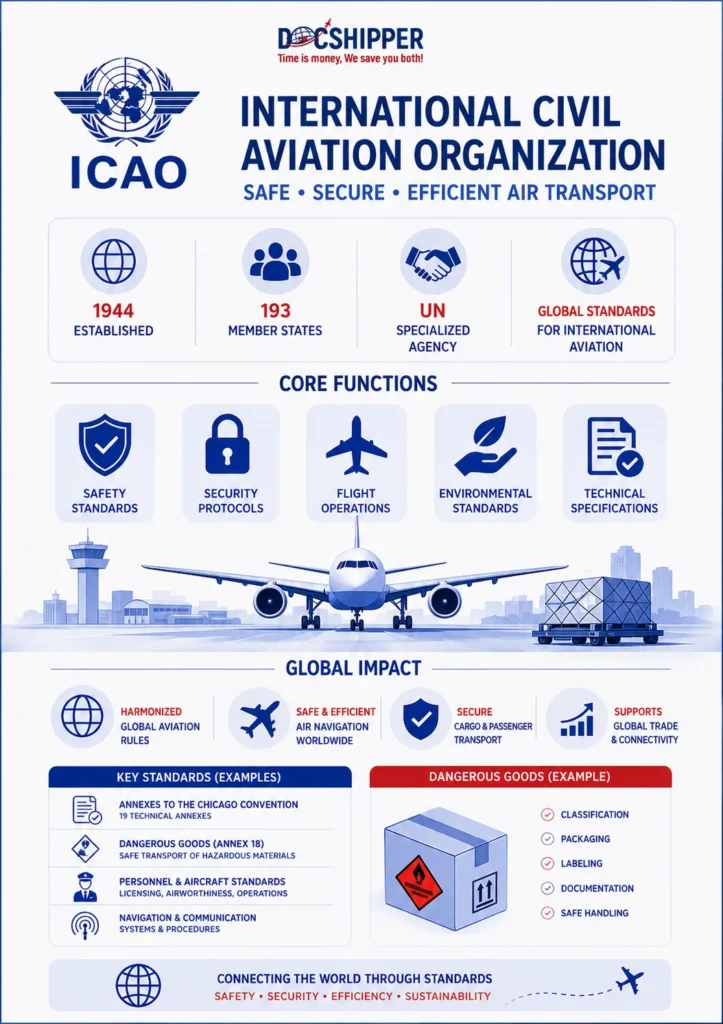
The International Civil Aviation Organization (ICAO) is a United Nations specialized agency established in 1944 to govern international air transport protocols. It develops standards and regulations that enable safe, secure, and efficient air navigation across 193 member states, harmonizing aviation practices worldwide.Introduction
Air cargo represents 35% of global trade value despite accounting for less than 1% of volume. This efficiency depends entirely on standardized procedures that prevent regulatory chaos across borders. Without unified aviation protocols, international shipping would face incompatible safety standards, conflicting airspace regulations, and operational gridlock.
The ICAO emerged from the Chicago Convention of 1944 to solve this exact problem. As global commerce accelerated post-World War II, nations recognized that fragmented aviation rules threatened international connectivity. The organization now coordinates everything from aircraft registration codes to cargo security screening protocols.
For logistics operators, ICAO compliance isn’t optional—it’s foundational. Key organizational contributions include:
- Standardized flight procedures enabling seamless cross-border operations
- Safety regulations governing aircraft maintenance and crew qualifications
- Security protocols for dangerous goods and cargo screening
- Environmental standards addressing emissions and noise pollution
- Technical specifications for navigation systems and communication frequencies
ICAO Framework & Regulatory Authority
The organization operates through 19 technical annexes to the Chicago Convention. These documents form legally binding standards (SARPs—Standards and Recommended Practices) that member states implement through national aviation authorities. Each annex addresses specific operational domains, from personnel licensing to aircraft airworthiness.
ICAO’s governance structure includes the Assembly (all member states meeting triennially), the Council (36 elected states providing strategic direction), and the Secretariat (implementing daily operations). This hierarchy ensures democratic representation while maintaining technical expertise. Headquarters in Montreal, Canada, coordinate with seven regional offices spanning every continent.
The organization distinguishes between standards (mandatory compliance) and recommended practices (encouraged but not required). When nations cannot meet a standard, they must file formal differences with ICAO—a transparency mechanism that prevents safety gaps. For instance, if a country’s terrain prevents certain navigation equipment installations, they document alternative procedures meeting equivalent safety levels.
For air cargo operations, Annex 18 (Dangerous Goods) proves critical. It defines nine hazard classes ranging from explosives to radioactive materials, establishing packaging, labeling, and documentation requirements. Companies shipping lithium batteries, chemicals, or medical specimens must comply with these specifications. At DocShipper, we verify all hazardous cargo documentation against current ICAO standards to prevent shipment rejections and regulatory penalties.
The Universal Safety Oversight Audit Programme (USOAP) conducts regular compliance assessments across member states. These audits evaluate whether national civil aviation authorities effectively implement ICAO standards. Results feed into the ICAO Coordinated Validation Mission process, which helps countries address deficiencies. This continuous improvement cycle maintains global aviation safety standards even as technology and threats evolve.
Recent priorities include unmanned aircraft systems (UAS) integration and cybersecurity frameworks. As drones increasingly handle cargo deliveries and digital systems control critical infrastructure, ICAO develops standards balancing innovation with safety. Their work directly impacts logistics providers exploring autonomous delivery solutions or implementing digital air waybills. Reference documentation is available through the ICAO Safety Portal.
Operational Impact & Industry Standards
ICAO standards directly shape daily logistics operations. The organization assigns four-letter airport codes (ICAO codes) used in flight planning and cargo routing—distinct from the three-letter IATA codes passengers recognize. For example, Paris Charles de Gaulle appears as LFPG in ICAO systems but CDG in consumer bookings. Freight forwarders use ICAO codes when coordinating with air traffic control and customs authorities.
The Technical Instructions for the Safe Transport of Dangerous Goods by Air (Doc 9284) represents aviation’s most comprehensive hazmat reference. Updated biennially, this 1,200+ page manual details packing instructions, compatibility charts, and emergency response procedures. A single lithium battery shipment must comply with specific limits: passenger aircraft cannot carry batteries exceeding 100Wh individual capacity, while cargo-only aircraft accept up to 300Wh with proper documentation.
| Cargo Type | ICAO Class | Key Restriction | Documentation Required |
|---|---|---|---|
| Lithium Batteries | Class 9 | 100Wh limit (passenger aircraft) | Shipper’s Declaration, handling labels |
| Dry Ice (Coolant) | Class 9 | 200kg per package | Ventilation warnings, net weight |
| Perfumes/Cosmetics | Class 3 (Flammable Liquids) | 5L individual containers | Limited quantity markings |
| Medical Specimens | Class 6.2 (Infectious Substances) | Triple packaging system | Biohazard labels, shipper training cert |
Environmental initiatives increasingly influence cargo operations. The Carbon Offsetting and Reduction Scheme for International Aviation (CORSIA) mandates emissions monitoring for flights between participating countries. Airlines must purchase carbon credits if emissions exceed 2019-2020 baseline levels. This affects freight rates as carriers incorporate environmental costs—large shipments on long-haul routes see the most significant pricing adjustments.
Flight planning relies on ICAO’s Standard Instrument Departure (SID) and Standard Terminal Arrival Route (STAR) procedures. These published routes optimize airspace usage while maintaining safety separation. When weather forces diversions or delays, cargo arrives late because alternative routes add distance—understanding these protocols helps logistics managers set realistic delivery expectations and communicate delays to clients.
Use Case: A pharmaceutical company ships temperature-sensitive vaccines from Belgium to Kenya. The shipment contains dry ice (Class 9 hazmat) and requires uninterrupted cold chain. ICAO regulations mandate ventilated containers preventing CO2 buildup, maximum 200kg dry ice per package, and specific handling labels. The airline files a flight plan using ICAO-approved airways through European and African airspace. En route, Khartoum control directs a weather-related reroute following ICAO protocols, adding 45 minutes but maintaining safety standards. Customs at Nairobi references ICAO documentation standards when clearing the shipment. Total compliance cost: packaging materials ($340), additional dry ice for extended transit ($180), IATA training for shipper staff ($450). Non-compliance penalty: shipment rejection, $25,000+ vaccine loss, regulatory investigation.
The organization’s Facilitation Programme (Annex 9) promotes efficient border procedures without compromising security. It advocates for electronic cargo documentation, coordinated border inspections, and risk-based screening. Countries implementing these recommendations reduce clearance times—Singapore’s TradeNet system, aligned with ICAO principles, clears 99% of air cargo declarations within 10 minutes.
Conclusion
The International Civil Aviation Organization provides the regulatory backbone enabling $6.8 trillion annual air cargo value. Its standards transform disparate national systems into a cohesive global network. For logistics professionals, ICAO compliance isn’t bureaucratic overhead—it’s operational necessity protecting shipments, ensuring on-time delivery, and preventing costly regulatory violations.
Need expert guidance navigating ICAO regulations for your international shipments? Contact DocShipper for comprehensive air freight compliance support.
📚 Quiz
Test Your Knowledge: International Civil Aviation Organization (ICAO)
What is the primary function of ICAO in international aviation?
A logistics company believes ICAO standards are optional guidelines that can be ignored if they conflict with faster shipping methods. Is this interpretation correct?
An e-commerce seller ships smartphone power banks internationally. Which ICAO document must they consult for proper classification and packaging?
🎯 Your Result
📞 Free Personalized QuoteFAQ | International Civil Aviation Organization (ICAO): Definition, Functions & Global Impact
ICAO is a United Nations governmental organization setting legally binding international aviation standards. IATA is a trade association representing airlines, developing commercial practices and passenger codes. ICAO creates regulations; IATA facilitates industry implementation. Both organizations collaborate but serve distinct functions—regulatory authority versus industry representation.
Compliance drives costs through specialized packaging requirements, hazmat training, documentation preparation, and carbon offset fees under CORSIA. Dangerous goods shipments typically cost 15-30% more than general cargo due to handling restrictions and insurance premiums. Route restrictions for certain hazmat classes may force longer routing, increasing fuel surcharges and transit times.
Airlines refuse non-compliant cargo before loading. If discovered in-flight, crew must follow emergency protocols potentially requiring unscheduled landings. Shippers face civil penalties ranging from $5,000 to $50,000+ depending on violation severity, potential criminal charges for egregious cases, and permanent shipping privilege revocation. Cargo may be destroyed without compensation if deemed unsafe.
Annex 17 (Security) establishes cargo screening requirements, chain-of-custody protocols, and known shipper programs. It mandates security controls preventing unauthorized access, tampering, or terrorist threats. Recent amendments address cyber threats to cargo tracking systems and require enhanced screening for high-risk shipments based on intelligence assessments.
The Technical Instructions update biennially through the Dangerous Goods Panel review process. Minor amendments issue annually via State Letters addressing urgent safety concerns. Lithium battery rules have undergone four major revisions since 2015 reflecting incident data. Logistics providers must track these changes—using outdated procedures violates current standards even if shipments previously complied.
No. Member states agree to implement ICAO standards through the Chicago Convention treaty. However, nations may file differences when compliance proves impossible due to geography, infrastructure, or technology limitations. These differences must not compromise safety and require alternative measures achieving equivalent protection levels. Other countries receive notification enabling risk assessment.
This standardized form certifies hazmat cargo meets all packaging, labeling, and classification requirements. It includes shipper/consignee details, proper shipping names, UN numbers, hazard classes, packing group, quantity, and emergency contact information. Signatories legally attest to compliance—false declarations carry criminal liability. Airlines refuse shipments lacking proper declarations or containing errors.
The Remotely Piloted Aircraft Systems (RPAS) Panel develops standards for unmanned cargo operations. Current focus areas include detect-and-avoid systems, pilot certification for beyond-visual-line-of-sight flights, and urban airspace integration. Standards remain evolving as technology advances—commercial drone freight currently operates under experimental certificates requiring case-by-case approval from national authorities.
Annex 13 establishes investigation protocols ensuring objective safety analysis. It mandates independent accident investigation authorities, cockpit voice recorder preservation, and international cooperation. While ICAO doesn't conduct investigations directly, it coordinates when incidents involve multiple countries and maintains the Accident/Incident Data Reporting system identifying global safety trends. Findings drive regulatory updates preventing recurrence.
Absolutely. Consumer goods like perfumes, aerosols, power banks, and cosmetics often contain hazardous materials requiring ICAO compliance. The rise of cross-border e-commerce led to increased violations from uninformed online sellers. Platforms now implement automated screening flagging restricted items, but shippers remain legally responsible for accurate classification and documentation regardless of sales channel.
Partner with IATA-certified freight forwarders possessing dangerous goods expertise. Invest in staff training through accredited programs—initial courses cost $300-600 but prevent violations. Use ICAO-compliant packaging suppliers providing certified materials and documentation. Implement classification checklists identifying hazmat before shipment. Many violations stem from sellers not recognizing common products (nail polish, hand sanitizer, smartphones) as regulated dangerous goods.
This initiative promotes machine-readable travel documents and biometric identification improving border security and facilitation. While focused on passengers, it affects cargo through enhanced security screening requirements. The programme's digital identity standards now extend to supply chain personnel—crew members, cargo handlers, and customs brokers increasingly use biometric credentials expediting secure facility access while maintaining accountability.
Need Help with
Logistics or Sourcing ?
First, we secure the right products from the right suppliers at the right price by managing the sourcing process from start to finish. Then, we simplify your shipping experience - from pickup to final delivery - ensuring any product, anywhere, is delivered at highly competitive prices.


Fill the Form
Prefer email? Send us your inquiry, and we’ll get back to you as soon as possible.
Contact us




