


In short ⚡
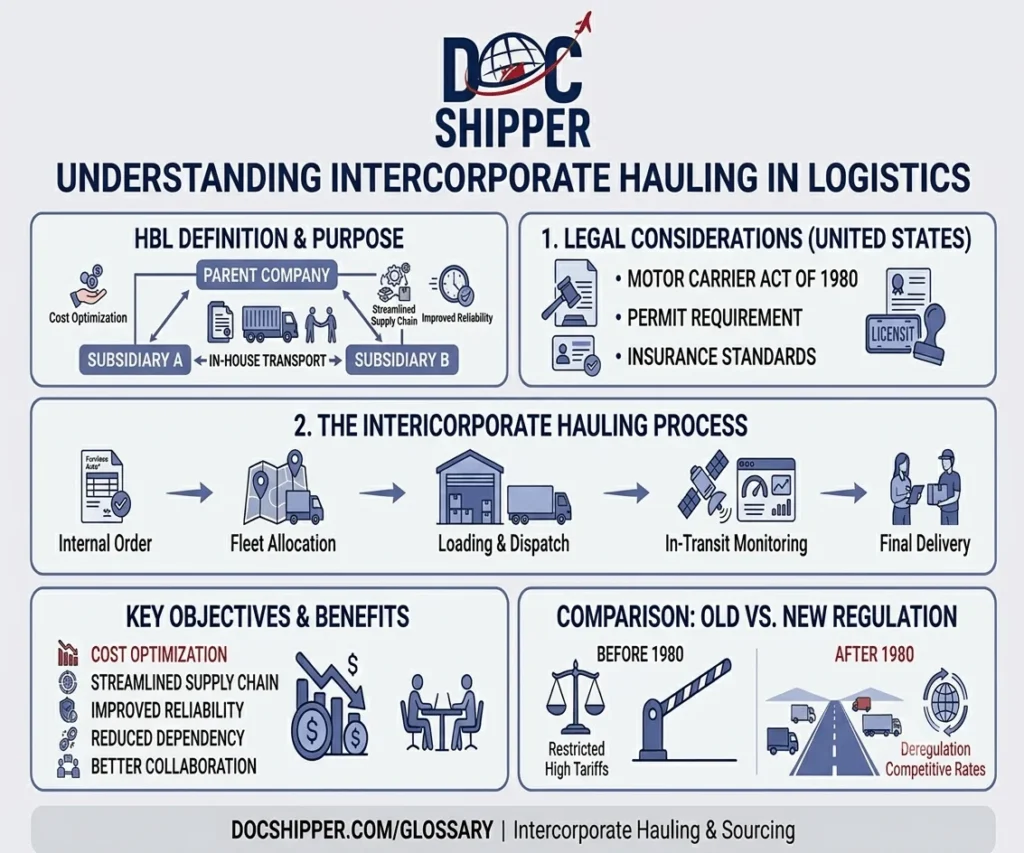
Intercorporate hauling refers to the transportation of goods between facilities or subsidiaries of the same parent company, using its own fleet and resources. This logistics practice enables businesses to maintain direct control over internal supply chains while optimizing costs and reducing dependency on third-party carriers. It plays a strategic role in vertical integration and operational efficiency.
Introduction
Many multinational corporations struggle with supply chain transparency and logistics costs when relying entirely on external carriers. Intercorporate hauling emerges as a solution to these challenges by allowing companies to transport goods internally between their own facilities.
In international trade and domestic distribution, this practice provides companies with enhanced visibility, schedule control, and potential cost savings. However, it requires careful consideration of regulatory compliance, fleet management, and strategic alignment with business objectives.
Key characteristics of intercorporate hauling include:
- Transport operations conducted between facilities under common corporate ownership
- Use of company-owned or long-term leased vehicles and equipment
- Exclusive movement of goods belonging to the parent company (no third-party cargo)
- Compliance with for-hire carrier regulations in most jurisdictions
- Integration with internal ERP and inventory management systems
Regulatory Framework & Operational Expertise
Despite being internal to a corporate structure, intercorporate hauling typically falls under the same regulatory framework as commercial transportation. In the United States, the Federal Motor Carrier Safety Administration (FMCSA) requires companies engaged in intercorporate hauling to maintain operating authority and comply with safety standards.
The legal distinction between private carriage and for-hire transportation becomes critical here. Even when moving goods exclusively for internal purposes, companies must obtain appropriate licenses, maintain liability insurance, and adhere to hours-of-service regulations for drivers.
Within the European Union, similar requirements exist under Regulation (EC) No 1071/2009, which establishes common rules for transport operators. Companies must demonstrate professional competence, financial standing, and good repute regardless of whether operations are intercorporate or commercial.
From an operational perspective, successful intercorporate hauling depends on several factors. Fleet management systems enable real-time tracking and route optimization. Preventive maintenance programs reduce downtime and ensure regulatory compliance. Driver training and retention become competitive advantages when operating internal fleets.
At DocShipper, we assist companies in evaluating whether intercorporate hauling aligns with their logistics strategy or if outsourcing remains more efficient. Our team analyzes regulatory requirements across jurisdictions to ensure full compliance while optimizing transportation networks.
Cost Analysis & Concrete Examples
The financial viability of intercorporate hauling depends on transport volume, distance, and frequency. Companies must compare the total cost of ownership (fleet acquisition, maintenance, insurance, labor) against third-party carrier rates to make informed decisions.
| Cost Component | Intercorporate Hauling | Third-Party Carrier |
|---|---|---|
| Vehicle Acquisition | $120,000 – $180,000 per truck | N/A (included in rate) |
| Insurance & Licensing | $12,000 – $20,000/year per vehicle | N/A (carrier responsibility) |
| Driver Salary + Benefits | $55,000 – $75,000/year | N/A (carrier expense) |
| Fuel & Maintenance | $0.85 – $1.20 per mile | Included in rate ($2.50 – $3.50/mile) |
| Break-Even Volume | ~150,000 miles/year per truck |
Case Study: Automotive Parts Manufacturer
A North American automotive parts manufacturer operates 27 production facilities across three countries. By implementing intercorporate hauling for high-frequency routes (5+ shipments weekly), the company achieved:
- 23% reduction in transportation costs on dedicated lanes
- Improved inventory accuracy through integrated tracking systems
- Reduced lead times by 1.5 days on critical components
- Better control over handling procedures for sensitive products
However, the same company maintains third-party carrier relationships for low-volume routes and specialized equipment needs (refrigerated transport, oversized cargo). This hybrid approach optimizes cost-efficiency while maintaining operational flexibility.
Industry data shows that 42% of Fortune 500 manufacturers utilize some form of intercorporate hauling, primarily for raw material distribution and finished goods transfer between assembly plants and distribution centers.
Conclusion
Intercorporate hauling represents a strategic logistics option for companies with predictable, high-volume transportation needs between owned facilities. Success requires careful analysis of regulatory obligations, operational costs, and alignment with broader supply chain objectives.
Need guidance on implementing or optimizing intercorporate hauling within your supply chain? Contact DocShipper for expert consultation on logistics strategy and regulatory compliance.
📚 Quiz
Test Your Knowledge: Intercorporate Hauling
What defines intercorporate hauling?
A common misconception about intercorporate hauling is that:
Based on the article's cost analysis, intercorporate hauling becomes financially viable when:
🎯 Your Results
📞 Free Quote in 24hFAQ | Intercorporate Hauling: Definition, Regulations & Practical Examples
Intercorporate hauling transports goods exclusively between facilities under the same corporate ownership using company-operated vehicles. Contract carriage involves a contractual relationship between a shipper and an independent carrier. The key distinction lies in ownership: intercorporate operations remain internal to the corporate structure, while contract carriage involves separate legal entities.
Yes, in most jurisdictions, intercorporate hauling requires the same operating authority and permits as commercial carriers. In the US, companies must obtain USDOT numbers and potentially MC numbers from the FMCSA. Insurance requirements, safety ratings, and driver qualification standards apply equally to intercorporate operations.
Intercorporate hauling can cross international borders, but additional complexity arises. Companies must comply with customs regulations, obtain cross-border operating authority, and ensure drivers possess proper documentation. In North America, FAST program enrollment and customs bonding remain necessary. Between EU member states, cabotage regulations may apply even to internal corporate movements.
The break-even point typically occurs around 150,000 miles annually per vehicle on consistent routes. Companies shipping 5+ loads weekly on the same lane often find intercorporate hauling cost-effective. Fixed costs (vehicle acquisition, insurance, driver salary) must be spread across sufficient volume to compete with variable per-load costs from third-party carriers.
Intercorporate hauling generally improves supply chain visibility when integrated with enterprise systems. Companies gain real-time tracking, direct communication with drivers, and full control over routing decisions. However, this requires investment in telematics, GPS systems, and integration between transportation management and ERP platforms.
Standard requirements include primary liability insurance ($750,000 minimum for non-hazmat in the US, $1 million for most operations), cargo insurance covering the full value of transported goods, and physical damage coverage for vehicles. Workers' compensation and employer liability insurance also apply to company drivers.
No, intercorporate hauling is limited to transport between company-owned facilities. Once goods are sold and delivered to external customers, the operation becomes commercial transportation requiring for-hire carrier authority. The cargo ownership status at the time of transport determines whether intercorporate classification applies.
Company-employed drivers fall under standard employment law, including minimum wage, overtime, and benefits requirements. Hours-of-service regulations from transportation authorities still apply. Union considerations may arise if other company employees are represented. Some companies find driver recruitment and retention more challenging than when using carrier services.
Essential technologies include transportation management systems (TMS) for route optimization, electronic logging devices (ELDs) for hours-of-service compliance, GPS tracking for real-time visibility, and preventive maintenance software. Integration with warehouse management systems (WMS) and ERP platforms enables seamless coordination between production, inventory, and transportation functions.
Companies operating internal fleets face direct responsibility for emissions and fuel efficiency. This creates both challenges and opportunities: intercorporate operations can implement alternative fuel vehicles, optimize routes more aggressively, and consolidate loads to reduce empty miles. Corporate sustainability goals often drive investment in cleaner technologies within company-owned fleets before affecting external carrier selection.
Since the company maintains control throughout the transportation process, product liability remains continuous from production through delivery to the destination facility. Proper handling procedures, temperature controls, and securing methods directly affect product quality. Unlike third-party transportation, there is no transfer of custody that could complicate liability determination in case of damage or contamination.
Intercorporate hauling creates internal cost allocations between corporate entities or divisions. Transfer pricing considerations arise for multinational corporations moving goods across borders. Vehicle depreciation, fuel taxes, and operating expenses must be properly allocated. Some jurisdictions offer tax incentives for company-operated fleets, particularly when using alternative fuel vehicles or meeting emission standards.
Need Help with
Logistics or Sourcing ?
First, we secure the right products from the right suppliers at the right price by managing the sourcing process from start to finish. Then, we simplify your shipping experience - from pickup to final delivery - ensuring any product, anywhere, is delivered at highly competitive prices.


Fill the Form
Prefer email? Send us your inquiry, and we’ll get back to you as soon as possible.
Contact us




