


In short ⚡
The Interstate Commerce Commission (ICC) was the first independent federal regulatory agency in the United States, established in 1887 to regulate railroads and later expanded to oversee trucking, buses, and freight forwarders. Though abolished in 1995, its legacy fundamentally shaped modern transportation law, freight regulations, and carrier licensing systems still used today.
Introduction
Many logistics professionals encounter references to the ICC without understanding its historical significance or why its legacy remains embedded in current freight regulations. The Interstate Commerce Commission represented the federal government’s first major intervention in private industry, establishing principles that continue to govern carrier operations today.
Understanding the ICC’s evolution helps importers and exporters navigate modern carrier requirements, licensing standards, and freight billing practices. The agency’s transformation from railroad regulator to comprehensive transportation authority mirrors the evolution of American logistics infrastructure.
Key aspects of the ICC’s influence include:
- Carrier licensing requirements – Establishing the MC (Motor Carrier) number system still mandatory for trucking companies
- Rate regulation principles – Creating frameworks for tariff publication and freight classification
- Common carrier obligations – Defining legal responsibilities that protect shippers’ rights
- Anti-discrimination provisions – Ensuring equitable access to transportation services regardless of shipper size
- Safety standards foundation – Pioneering vehicle and operational safety requirements later assumed by FMCSA
Historical Regulatory Framework & Legacy
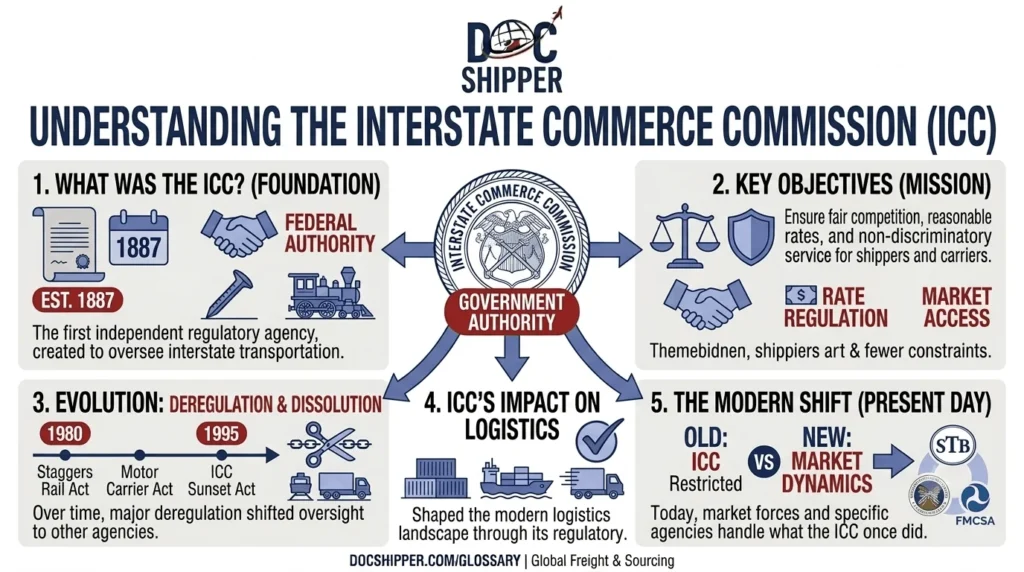
The Interstate Commerce Act of 1887 created the ICC in response to public outcry over railroad monopolies and discriminatory pricing practices. Farmers and small businesses faced exorbitant shipping rates while large corporations received preferential treatment through secret rebates.
The Commission’s original mandate focused exclusively on railroads, requiring them to publish rates publicly and charge “reasonable and just” fees. This represented a revolutionary shift from laissez-faire economic policy to active federal oversight of transportation markets.
Expansion occurred through successive legislation. The Motor Carrier Act of 1935 brought trucking companies under ICC jurisdiction, establishing the operating authority system. The Freight Forwarder Act of 1942 added intermediaries to the regulatory framework. By mid-century, the ICC controlled virtually all interstate surface transportation except pipelines.
The agency’s most significant contribution was developing the common carrier concept – legal obligations requiring licensed carriers to serve all shippers without discrimination, maintain published tariffs, and provide reasonable service. These principles protected small businesses from predatory practices while ensuring transportation accessibility.
Deregulation momentum began in the 1970s as economists questioned whether heavy regulation benefited consumers. The Motor Carrier Act of 1980 dramatically reduced entry barriers and rate controls. The ICC Termination Act of 1995 abolished the agency entirely, transferring remaining functions to the newly created Surface Transportation Board.
At DocShipper, we help clients navigate the modern regulatory landscape that evolved from ICC foundations, ensuring compliance with current FMCSA requirements and carrier selection criteria.
Practical Impact on Modern Logistics
Though dissolved nearly three decades ago, ICC-established systems remain deeply embedded in contemporary freight operations. Understanding this legacy helps shippers interpret carrier credentials and billing practices.
The MC number system originated under ICC regulation, requiring motor carriers to obtain operating authority before conducting interstate commerce. Today, the Federal Motor Carrier Safety Administration (FMCSA) administers this system, but the fundamental structure remains unchanged. Every trucking company operating across state lines must display its MC number on commercial vehicles.
Key modern remnants of ICC regulation include:
| ICC-Era Concept | Modern Equivalent | Current Authority |
|---|---|---|
| Operating Authority | MC/DOT Number | FMCSA |
| Common Carrier Obligations | 49 USC §13701 Requirements | FMCSA/STB |
| Freight Classification | NMFC Code System | NMFTA (Industry) |
| Published Tariffs | Contract/Quoted Rates | Private Agreement |
| Household Goods Licensing | HHG Authorization | FMCSA |
The National Motor Freight Classification (NMFC) system, developed during the ICC era, remains the industry standard for determining freight rates based on density, handling, stowability, and liability. Shippers must still assign proper NMFC codes to shipments to receive accurate quotes.
Historical ICC data reveals the scope of transformation. In 1980, approximately 18,000 trucking companies held ICC operating authority. Post-deregulation, this number exploded to over 500,000 registered carriers by 2020, demonstrating how regulatory barriers limited market entry.
For international shipments, the ICC’s legacy intersects with customs and border procedures. Carriers operating under ICC-derived authority must comply with additional requirements when handling imported goods, including bonded carrier status for in-bond movements and proper documentation protocols established under current CBP regulations.
DocShipper verifies carrier credentials descended from ICC standards, ensuring our clients work with properly authorized transportation providers for both domestic and international movements. Contact us at DocShipper Contact for compliance verification assistance.
Conclusion
The Interstate Commerce Commission’s 108-year history fundamentally shaped American transportation infrastructure and regulatory philosophy. While the agency itself no longer exists, its legacy persists through carrier licensing systems, freight classification standards, and legal frameworks governing common carriage.
Need assistance understanding carrier requirements or verifying transportation provider credentials? Contact DocShipper for expert guidance on modern logistics compliance.
📚 Quiz
Test Your Knowledge: Interstate Commerce Commission (ICC)
What was the Interstate Commerce Commission's primary original mandate when established in 1887?
Which legacy system from the ICC era remains mandatory for interstate trucking companies today?
A shipper discovers their carrier refuses to transport certain commodities despite holding proper authority. Under ICC-derived common carrier obligations, is this practice permitted?
🎯 Your Results
📞 Free Personalized QuoteFAQ | ICC (Interstate Commerce Commission): Definition, History & Impact on Logistics
The ICC was established on February 4, 1887, through the Interstate Commerce Act, making it the first independent federal regulatory agency in United States history. It initially regulated only railroads before expanding to other transportation modes.
Congress created the ICC to address widespread complaints about railroad monopolies, discriminatory pricing, and secret rebates favoring large shippers. The agency's mission was to ensure "reasonable and just" freight rates and prevent anti-competitive practices in interstate transportation.
The ICC was officially abolished on December 31, 1995, under the ICC Termination Act. Its remaining functions transferred to the newly created Surface Transportation Board (STB), while safety and licensing responsibilities moved to the Federal Motor Carrier Safety Administration (FMCSA).
The Motor Carrier (MC) number is a unique identifier assigned to interstate trucking companies, originally issued by the ICC starting in 1935. Today, FMCSA administers the MC number system, but the fundamental requirement for operating authority originated under ICC regulation.
The ICC primarily regulated domestic interstate commerce, not international ocean shipping. However, it did oversee inland transportation of imported goods, including trucking and rail movements within the United States. International ocean carriers fell under Federal Maritime Commission jurisdiction.
The Surface Transportation Board (STB) assumed the ICC's remaining rail and pipeline regulatory functions. The Federal Motor Carrier Safety Administration (FMCSA) took over trucking safety and licensing. The Federal Highway Administration inherited certain infrastructure responsibilities.
The Motor Carrier Act of 1980 eliminated most ICC rate controls, allowing market competition to determine pricing. Studies show freight rates declined approximately 20-35% in real terms during the decade following deregulation, while service quality generally improved through increased carrier competition.
The ICC required common carriers to serve all customers without discrimination, publish rates publicly, provide reasonable service, and maintain liability for cargo. These obligations prevented carriers from refusing shipments arbitrarily or charging different rates for similar services without justification.
While the ICC no longer exists, many regulations it developed remain codified in Title 49 of the United States Code. Carrier licensing requirements, household goods moving protections, and certain rail rate procedures continue under current law, administered by successor agencies.
The ICC encouraged development of standardized freight classification through the National Motor Freight Classification (NMFC), which categorizes commodities by transportation characteristics. This system, still used industry-wide, helps carriers determine appropriate rates based on density, handling requirements, and liability factors.
The ICC originally focused exclusively on railroads, setting maximum rates, approving mergers, and ensuring non-discriminatory access. As railroad importance declined and trucking grew, the agency's emphasis shifted, though it retained rail oversight authority until abolition in 1995.
Freight forwarders operate under regulatory frameworks initially established when the ICC added them to its jurisdiction in 1942. Today's licensing requirements, liability standards, and operational definitions for forwarders trace directly to ICC-era regulations, now administered by FMCSA for domestic operations.
Need Help with
Logistics or Sourcing ?
First, we secure the right products from the right suppliers at the right price by managing the sourcing process from start to finish. Then, we simplify your shipping experience - from pickup to final delivery - ensuring any product, anywhere, is delivered at highly competitive prices.


Fill the Form
Prefer email? Send us your inquiry, and we’ll get back to you as soon as possible.
Contact us




:%20Definition,%20History%20&%20Impact%20on%20Logistics)