


In short ⚡
Freight carriers are commercial entities specialized in the physical transportation of goods across various modes (air, sea, land, rail). They serve as the operational backbone of global supply chains, managing the movement of cargo from origin to destination under contractual agreements. These carriers range from multinational logistics corporations to specialized regional operators, each offering distinct service portfolios, transit times, and pricing structures tailored to specific shipment requirements.
Introduction
Choosing the wrong freight carrier can derail an entire shipment operation. Delays, damaged goods, and unexpected costs are common consequences when importers overlook carrier capabilities, certifications, or service limitations.
In international trade, freight carriers represent the critical link between production and market delivery. Their selection directly impacts delivery timelines, product integrity, and overall logistics costs. Understanding carrier classifications, operational strengths, and contractual obligations is essential for optimizing supply chain efficiency.
- Modal specialization: Each carrier type operates within specific transportation modes with distinct infrastructure requirements.
- Service differentiation: Carriers offer varying levels of tracking, insurance, customs facilitation, and handling capabilities.
- Contractual frameworks: Bill of Lading (BOL), Air Waybill (AWB), and CMR documents define liability and responsibilities.
- Regulatory compliance: Carriers must adhere to international conventions (IATA, IMO, CMR) and regional transport regulations.
- Capacity dynamics: Space availability fluctuates based on seasonal demand, trade routes, and global economic conditions.
Carrier Types & Operational Expertise
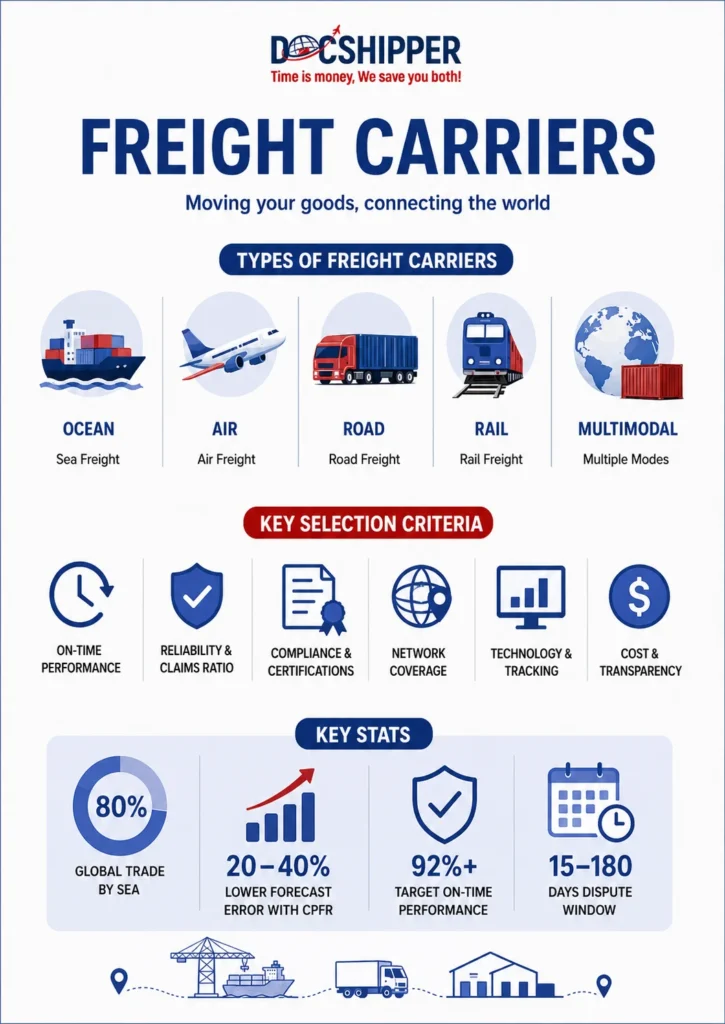
The freight carrier landscape divides into five primary categories, each governed by distinct operational frameworks and regulatory requirements. Understanding these classifications enables informed carrier selection aligned with shipment characteristics.
Ocean carriers dominate international cargo volume, transporting approximately 80% of global trade by weight. These operators manage container vessels (FCL/LCL services), bulk carriers, and specialized ro-ro ships. Major alliances like 2M, Ocean Alliance, and THE Alliance control pricing and capacity through vessel-sharing agreements. Shippers must understand carrier allotment systems, demurrage policies, and detention charges. At DocShipper, we negotiate directly with ocean carriers to secure competitive rates and priority space allocation during peak seasons.
Air freight carriers provide expedited transportation for high-value, time-sensitive, or perishable goods. Dedicated cargo airlines (Cargolux, Atlas Air) and passenger airlines with belly-hold capacity operate under IATA regulations. Air carriers classify shipments by commodity codes, applying specific handling requirements for dangerous goods, pharmaceuticals, and live animals. Service tiers include express, standard, and deferred options with corresponding rate structures.
Road freight operators execute first-mile pickup and last-mile delivery in domestic and cross-border operations. Full Truckload (FTL) and Less Than Truckload (LTL) services cater to different volume requirements. European road transport operates under CMR Convention standards, while North American carriers follow FMCSA regulations. Temperature-controlled (reefer) trucks, flatbeds, and specialized heavy-haul vehicles address diverse cargo specifications.
Rail freight companies offer cost-effective alternatives for bulk commodities and intermodal containers. The Trans-Siberian Railway and China-Europe freight trains exemplify growing Eurasian rail corridors. Rail carriers excel in environmental efficiency, consuming 75% less fuel per ton-kilometer than road transport. However, infrastructure limitations and longer transit times restrict their applicability for urgent shipments.
Multimodal transport operators (MTOs) integrate multiple transportation modes under single-contract responsibility. These carriers manage door-to-door services, coordinating sea-air combinations or rail-truck transfers. MTOs assume liability across the entire journey, simplifying claims processes and documentation requirements for shippers.
Selection Criteria & Performance Data
Carrier evaluation requires systematic analysis of operational metrics, financial stability, and service capabilities. The following framework establishes objective selection parameters beyond price comparison.
| Evaluation Criterion | Key Metrics | Industry Benchmark |
|---|---|---|
| On-Time Performance | Delivery within scheduled window | ≥92% for ocean, ≥95% for air |
| Claims Ratio | Damage/loss incidents per 1,000 shipments | ≤3 incidents (ocean), ≤1 (air) |
| Financial Solvency | Credit rating, operational history | Minimum BBB rating, 5+ years operational |
| Network Coverage | Direct routes, transshipment points | Direct service to 80% of target markets |
| Technology Integration | API connectivity, real-time tracking | EDI/API capability, GPS tracking |
Transit time consistency outweighs nominal speed in most commercial scenarios. A carrier delivering 95% of shipments within a 10-day window proves more reliable than one averaging 8 days with 30% variance. Analyzing historical performance data across similar trade lanes provides predictive accuracy.
Customs clearance proficiency significantly impacts total delivery time. Carriers with established customs brokerage partnerships or in-house clearance teams reduce border delays. AEO (Authorized Economic Operator) certified carriers receive expedited processing at EU customs checkpoints.
Case Study: A European electronics importer switching from a low-cost ocean carrier to a premium service provider reduced total landed costs by 8% despite a 12% higher freight rate. The premium carrier’s superior container handling eliminated $47,000 in annual product damage claims and reduced customs delays from an average of 4.2 days to 1.1 days.
Equipment availability determines carrier suitability for specialized cargo. Reefer container capacity, hazmat certifications, oversized cargo handling, and livestock transport capabilities require verification during carrier qualification. DocShipper maintains a pre-vetted carrier network with verified equipment specifications for immediate deployment.
Insurance adequacy protects against carrier liability limitations. Standard carrier liability covers approximately $2-3 per kilogram for ocean freight and $20 per kilogram for air freight under international conventions. Shippers must arrange supplementary all-risk cargo insurance for high-value goods.
Conclusion
Freight carrier selection represents a strategic decision that balances cost efficiency with operational reliability. Systematic evaluation of carrier capabilities, financial stability, and service infrastructure ensures optimal supply chain performance.
Need expert guidance on carrier selection for your specific shipping requirements? Contact DocShipper for customized freight solutions and negotiated carrier rates across all transportation modes.
📚 Quiz
Test Your Knowledge: Freight Carriers
1. What is the primary role of a freight carrier in international trade?
2. Under international maritime law (Hague-Visby Rules), what is the standard carrier liability limitation for ocean freight?
3. Your electronics shipment requires temperature-controlled transport from Shanghai to Rotterdam with a 7-day delivery window. Which carrier selection criterion should take priority?
🎯 Your Result
📞 Free Quote in 24hFAQ | Freight Carriers: Definition, Types & Selection Criteria
A freight carrier physically transports goods using owned or leased vehicles (ships, aircraft, trucks). A freight forwarder acts as an intermediary, arranging transportation by contracting with carriers but not owning transport assets. Forwarders consolidate shipments, negotiate rates, and manage documentation across multiple carriers to provide door-to-door service.
Carriers use dimensional weight (volumetric calculation) and actual weight, charging whichever is greater. Ocean freight rates apply per container (FCL) or per cubic meter/ton (LCL). Air freight uses the chargeable weight formula (actual vs. dimensional: length × width × height ÷ 6000 for cm³). Additional surcharges include fuel adjustments, peak season fees, security charges, and destination handling.
Ocean carriers operate under the Hague-Visby Rules or Hamburg Rules, limiting liability to approximately SDR 2-3 per kilogram ($2.50-4.00). Air carriers follow the Montreal Convention, capping liability at SDR 19 per kilogram (~$26). Road transport in Europe adheres to CMR Convention limits of SDR 8.33 per kilogram. These limits apply unless higher value is declared and additional freight charges paid.
Carriers are generally not liable for delays caused by customs inspections, regulatory holds, or documentation issues unless they provided customs brokerage services and committed errors. Importers bear responsibility for accurate commodity classification, proper documentation, and duty payment. Force majeure clauses in carrier contracts typically exclude liability for government actions.
Carrier allotment refers to guaranteed container space reserved by freight forwarders or large shippers through contractual agreements. During peak seasons or on capacity-constrained routes, allotment holders receive priority booking. Spot market shippers without allotments may face rollover (denied boarding), requiring shipment on later vessels and causing delivery delays.
Check ocean carriers through the Paris MOU or Tokyo MOU port state control databases for vessel detention records. Air carriers must hold IATA IOSA certification and relevant national aviation authority licenses. U.S. trucking companies can be verified via FMCSA's Safety Measurement System (SMS). European road carriers should have valid operator licenses under EU Regulation 1071/2009.
Demurrage charges apply when importers exceed free time for unloading containers at port terminals (typically 3-7 days). Detention fees accrue when containers remain outside the terminal beyond the allowed period before return. Rates often start at $75-150 per day and escalate progressively. Carriers enforce these charges to maintain container circulation and equipment availability.
Yes, carriers maintain prohibited and restricted cargo lists based on safety regulations, liability concerns, and operational capabilities. Common restrictions include hazardous materials without proper certifications, perishables without temperature control arrangements, high-value items without declared value, and items violating international conventions (ivory, certain chemicals). Always verify carrier acceptance before booking.
A carrier's lien grants legal right to retain possession of goods until freight charges and related fees are paid. This maritime law principle applies when shippers fail to pay agreed transportation costs. Carriers can exercise liens at destination ports, preventing cargo release until settlement. In extreme cases, carriers may auction goods to recover unpaid charges after proper legal notice.
Ocean carrier alliances (2M, Ocean Alliance, THE Alliance) share vessel space and coordinate schedules across major trade routes. This cooperation increases service frequency and port coverage but reduces direct carrier competition on alliance routes. Shippers benefit from more departure options but may experience standardized pricing among alliance members. Non-alliance carriers often offer competitive alternatives on the same routes.
A Vessel Operating Common Carrier (VOC) owns or operates ships, providing ocean transportation services. A Non-Vessel Operating Common Carrier (NVOCC) issues bills of lading and assumes carrier liability without owning vessels, contracting space from VOCs. NVOCCs consolidate multiple shippers' cargo into full containers, offering competitive LCL rates and flexible service options for smaller shipments.
Multi-carrier shipment visibility requires integration of different tracking systems. Container tracking uses unique numbers searchable on carrier websites or aggregator platforms. Air waybill numbers enable tracking through airline cargo portals. Advanced solutions employ API integrations that consolidate tracking data from multiple carriers into unified dashboards, providing real-time status updates and exception alerts throughout the transportation chain.
Need Help with
Logistics or Sourcing ?
First, we secure the right products from the right suppliers at the right price by managing the sourcing process from start to finish. Then, we simplify your shipping experience - from pickup to final delivery - ensuring any product, anywhere, is delivered at highly competitive prices.


Fill the Form
Prefer email? Send us your inquiry, and we’ll get back to you as soon as possible.
Contact us




