


In short ⚡
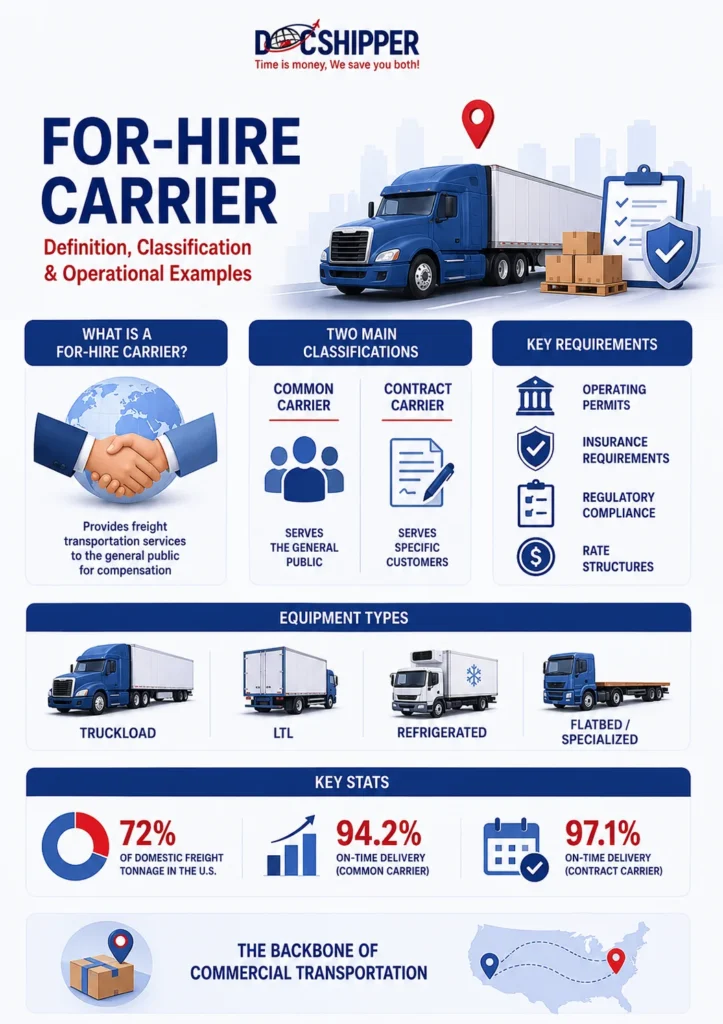
A for-hire carrier is a transportation company that provides freight services to the general public for compensation. Unlike private carriers that transport their own goods, for-hire carriers offer professional logistics services to multiple shippers under regulatory oversight, operating as common carriers or contract carriers depending on their service agreements and legal obligations.
Introduction
Many businesses confuse for-hire carriers with private fleets or freight brokers. This distinction matters. Choosing the wrong carrier type can expose your company to regulatory penalties, insurance gaps, or service failures.
For-hire carriers form the backbone of commercial transportation. They move 72% of domestic freight tonnage in the United States alone. Understanding how these carriers operate helps importers and exporters optimize costs, ensure compliance, and select reliable partners.
- Legal authority: Must obtain operating permits from transportation authorities (DOT, FMCSA in the US)
- Public service obligation: Common carriers must serve all customers without discrimination
- Insurance requirements: Mandated minimum liability coverage ($750,000+ for interstate freight)
- Rate structures: May file tariffs or negotiate individual contracts based on carrier classification
- Operational scope: Can operate locally, regionally, nationally, or internationally depending on licensing
Regulatory Framework & Operational Models
The for-hire carrier category splits into two primary classifications: common carriers and contract carriers. This legal distinction determines service obligations, pricing flexibility, and liability exposure.
Common carriers operate under the highest regulatory scrutiny. They must serve the general public without refusal, publish rate schedules, and maintain strict liability standards. These carriers cannot reject shipments based on customer preference. Think of established LTL (less-than-truckload) networks or national parcel services.
Contract carriers work under specific agreements with limited customers. They negotiate individualized rates and services. This model offers flexibility but requires written contracts for each client relationship. Most dedicated fleet operators fall into this category.
Beyond classification, equipment type further defines for-hire operations. Truckload carriers handle full trailer shipments. LTL carriers consolidate multiple shippers’ freight. Specialized carriers operate refrigerated, flatbed, or hazmat-certified equipment. According to the U.S. Bureau of Transportation Statistics, specialized carriers command 15-30% premium rates due to equipment investments.
At DocShipper, we verify carrier authority through the FMCSA database before assigning freight. This prevents shipment delays from unlicensed operators and ensures proper insurance coverage throughout transit.
For-hire carriers must also maintain Hours of Service compliance, electronic logging devices, and driver qualification files. These operational requirements separate professional carriers from informal transportation providers. The regulatory burden increases carrier costs but protects shippers from liability exposure.
Practical Examples & Industry Data
Understanding for-hire carriers becomes clearer through real-world scenarios. Consider a furniture manufacturer in North Carolina shipping to retailers nationwide. They face three options:
| Carrier Type | Cost Structure | Service Level | Best For |
|---|---|---|---|
| Common Carrier LTL | $0.45-0.75/mile | 5-7 day transit | Small shipments, multiple destinations |
| Contract Truckload | $1.85-2.20/mile | 2-3 day transit | Full loads, predictable volume |
| Private Fleet | $2.50-3.10/mile | 1-2 day transit | High control needs, dedicated routes |
The manufacturer chooses a contract carrier with refrigerated trailers. They sign a 12-month agreement guaranteeing 40 loads monthly at $2.05 per mile. This arrangement saves 18% versus spot market rates while ensuring capacity during peak seasons.
International scenarios add complexity. A Seattle-based coffee importer receives containers from Colombia. They need drayage from the port to their warehouse. For-hire drayage carriers specialize in short-haul container movement, typically charging $150-350 per container based on distance and chassis requirements.
Industry data reveals significant operational differences. Common carriers average 94.2% on-time delivery rates according to DAT Freight & Analytics. Contract carriers achieve 97.1% through dedicated lanes and pre-scheduled pickups. However, common carriers offer broader geographic coverage with 15,000+ terminal locations nationwide.
Cost efficiency varies by shipment characteristics. For-hire LTL carriers become economical below 10,000 pounds. Above that threshold, truckload carriers offer better per-pound rates. A 24,000-pound shipment from Chicago to Los Angeles costs approximately $3,200 via truckload versus $4,800 through LTL consolidation.
At DocShipper, we analyze these trade-offs daily. Our logistics specialists compare carrier quotes, transit times, and service histories to match shippers with optimal for-hire partners. This eliminates the guesswork from carrier selection and reduces transportation spend by an average of 12-19%.
Conclusion
For-hire carriers provide essential transportation services under strict regulatory oversight. Understanding the distinction between common and contract carriers helps businesses select appropriate partners while managing costs and compliance risks.
Need assistance selecting the right carrier for your shipments? Contact DocShipper for expert freight management solutions.
📚 Quiz
Test Your Knowledge: For-Hire Carrier
What defines a for-hire carrier's primary business model?
What is the key operational difference between common carriers and contract carriers?
A furniture manufacturer needs to ship 8,500 pounds from Chicago to Los Angeles. Which for-hire carrier type would be most cost-effective?
🎯 Your Result
📞 Free Quote in 24hFAQ | For-Hire Carrier: Definition, Classification & Operational Examples
A for-hire carrier transports goods for multiple customers as its primary business, operating under federal transportation authority. A private carrier moves only its own company's products using its own fleet. For-hire carriers require DOT operating authority and commercial insurance. Private carriers face fewer regulatory requirements but cannot legally transport goods for other companies for compensation.
Yes. International for-hire carriers must obtain additional authorizations beyond domestic permits. US carriers crossing into Mexico need CAAT permits and Mexican liability insurance. Canadian cross-border operations require NSC safety fitness certificates. Ocean freight forwarders need FMC licensing. Each country maintains distinct requirements for foreign carriers entering their borders, including cabotage restrictions that limit domestic transportation by foreign operators.
Interstate for-hire carriers must carry minimum $750,000 liability insurance for general freight and $5 million for hazardous materials. These requirements come from FMCSA regulations (49 CFR 387). Cargo insurance is not federally mandated but strongly recommended. Many shippers require carriers to maintain $100,000-500,000 cargo coverage as a contractual condition. State requirements may exceed federal minimums for intrastate operations.
It depends on carrier classification. Common carriers cannot refuse shipments that fall within their operating authority without valid reason (safety concerns, prohibited items, capacity limits). Contract carriers can selectively choose customers and commodities through their service agreements. Both carrier types may refuse hazardous materials without proper certifications, overweight freight exceeding equipment limits, or goods requiring specialized equipment they don't possess.
Common carriers historically filed tariff rates with regulatory agencies, though most now use published class-based pricing for LTL shipments. Contract carriers negotiate individual rates based on shipment volume, lane density, equipment needs, and service requirements. Key factors include distance, freight class, weight, accessorial services (liftgate, inside delivery), fuel surcharges, and market capacity conditions. Truckload rates fluctuate more than LTL due to spot market dynamics.
Check the FMCSA SAFER System database at safer.fmcsa.dot.gov using the carrier's DOT number or MC number. This database shows operating authority status, insurance coverage, safety ratings, and inspection history. Verify the carrier holds active "Common" or "Contract" authority matching your shipping needs. Also confirm their insurance certificates are current and meet your coverage requirements before tendering freight.
Common carriers operate under "strict liability" — they are responsible for cargo loss or damage regardless of fault, except for acts of God, shipper negligence, or inherent product defects. Contract carriers negotiate liability terms in their service agreements, potentially limiting their exposure. Both must still maintain federal minimum insurance. This liability distinction makes common carriers preferable for high-value shipments requiring maximum protection.
Yes, but with restrictions. For-hire carriers may use subcontracted capacity (often called "brokering") if their operating authority includes broker authority. However, they must disclose this arrangement to shippers. The primary carrier remains legally responsible for shipment performance and claims. Many large carriers use third-party capacity during peak seasons or for lanes outside their core network. Shippers can prohibit subcontracting through contractual terms.
File a formal claim with the carrier within the timeframe specified in their terms and conditions (typically 9 months). Provide proof of loss through delivery receipts, photos, and invoicing. The carrier must acknowledge claims within 30 days and settle or deny within 120 days under federal regulations. If denied, you may pursue arbitration or litigation. Maintaining proper freight insurance through a third-party provider protects against carrier claim disputes or insufficient coverage.
Peak seasons (November-December retail, August-September back-to-school) create capacity shortages that increase rates 20-45% above baseline. Contract carriers with dedicated agreements offer more stable pricing but may include seasonal adjustment clauses. Common carrier LTL rates remain more consistent due to tariff structures, though fuel surcharges and accessorial fees fluctuate. Forward planning and early carrier commitment help secure capacity and mitigate peak season premiums.
Most carriers now provide GPS tracking, electronic proof of delivery, and real-time status updates through web portals or EDI integration. Advanced carriers offer API connections for direct TMS integration, predictive ETA calculations using machine learning, and automated exception notifications. Electronic logging devices (ELDs) mandated since 2017 enable precise location tracking. These technologies improve visibility but vary significantly between large national carriers and smaller regional operators.
FMCSA assigns safety ratings (Satisfactory, Conditional, Unsatisfactory) based on compliance reviews and crash data. Carriers with "Unsatisfactory" ratings lose operating authority. "Conditional" carriers face increased scrutiny and potential restrictions. "Satisfactory" ratings indicate compliance with safety regulations. However, carriers without ratings may be new operators or those not yet reviewed. Check inspection records, out-of-service percentages, and crash rates in the SAFER database for comprehensive safety assessment beyond basic ratings.
Need Help with
Logistics or Sourcing ?
First, we secure the right products from the right suppliers at the right price by managing the sourcing process from start to finish. Then, we simplify your shipping experience - from pickup to final delivery - ensuring any product, anywhere, is delivered at highly competitive prices.


Fill the Form
Prefer email? Send us your inquiry, and we’ll get back to you as soon as possible.
Contact us




