


In short ⚡
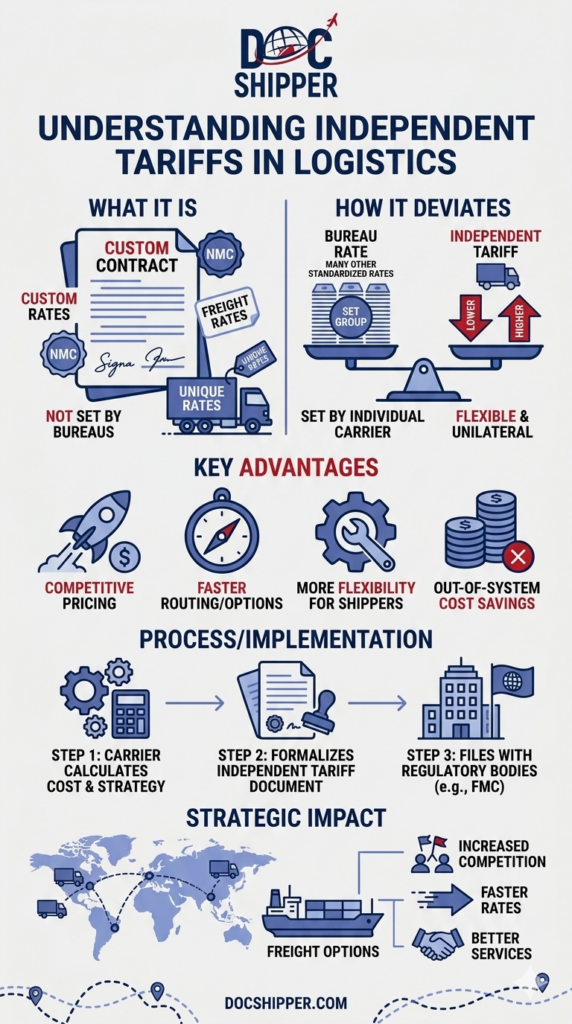
An independent tariff is a customs duty structure unilaterally established by a country without bilateral or multilateral trade agreements. Unlike preferential tariffs negotiated through FTAs, independent tariffs reflect sovereign trade policy and can be adjusted based on national economic priorities, protectionist objectives, or strategic industries.
Introduction
Importers often confuse independent tariffs with MFN (Most Favored Nation) rates, yet they represent distinct trade mechanisms. While MFN rates apply uniformly under WTO rules, independent tariffs allow countries full discretion to set customs duties outside any international framework.
This distinction becomes critical when calculating landed costs for goods entering markets like the United Kingdom post-Brexit, where the UK Global Tariff replaced EU rates as the new independent baseline. Understanding these structures prevents costly classification errors and enables strategic sourcing decisions.
Key characteristics of independent tariffs include:
- Unilateral determination – No negotiation with trading partners required
- Flexible adjustment – Can be modified rapidly in response to economic conditions
- Sectoral variation – Different rates for strategic vs. non-strategic goods
- Default applicability – Apply when no preferential agreement exists
- Political leverage – Used as bargaining chips in trade negotiations
Mechanisms & Trade Policy Expertise
Independent tariffs function as a baseline customs duty schedule that applies when preferential or reciprocal agreements are absent. Countries publish these rates in national tariff schedules, typically organized using the Harmonized System (HS) classification. Each product category receives a specific duty percentage, reflecting domestic industrial protection needs.
The legal foundation differs fundamentally from treaty-based tariffs. While WTO members commit to “bound rates” (maximum ceilings), independent tariffs represent the “applied rates” that may be lower than bound commitments but are set at the government’s discretion. This flexibility allows protectionist measures during economic downturns or subsidies phases-out.
Three operational mechanisms define independent tariffs:
Ad valorem duties – Calculated as a percentage of customs value (CIF price). For example, a 12% independent tariff on furniture means an importer pays $1,200 duty on a $10,000 shipment.
Specific duties – Fixed amounts per unit (€5 per kilogram), common in agricultural sectors where value fluctuates significantly. These protect domestic producers from price volatility.
Compound duties – Combine both methods (10% + €2/kg), creating dual protection layers for sensitive industries like textiles or chemicals.
At DocShipper, we maintain updated databases of independent tariff schedules for 157 jurisdictions worldwide, ensuring classification accuracy before shipment departure. This proactive verification prevents detention at destination ports due to underpaid duties.
The WTO Tariff Analysis Online provides transparency tools, but interpreting national schedules requires specialized knowledge of exemption clauses, temporary suspensions, and anti-dumping overlays that modify published rates.
Concrete Examples & Comparative Data
Independent tariffs vary dramatically across economies and product categories. The following table illustrates actual rates for identical goods under different national schedules:
| HS Code | Product | UK Independent Tariff | USA Independent Tariff | India Independent Tariff |
|---|---|---|---|---|
| 8517.62 | Smartphones | 0% | 0% | 20% |
| 6203.42 | Cotton trousers | 12% | 16.5% | 20% |
| 8703.23 | Passenger vehicles (1500-3000cc) | 10% | 2.5% | 125% |
| 0901.21 | Roasted coffee | 0% | 0% | 100% |
Case Study: Electronics Importer to India
A German company ships 1,000 smartphones (HS 8517.62) with a CIF value of $300,000 to Mumbai. Under India’s independent tariff:
- Basic Customs Duty (BCD): 20% = $60,000
- Social Welfare Surcharge: 10% on BCD = $6,000
- Total Import Duty: $66,000
Had the same goods entered the UK, duty would be $0 due to zero independent tariff. This $66,000 differential directly impacts retail pricing and competitive positioning. At DocShipper, we model these scenarios during feasibility studies, comparing 16+ destination markets to identify optimal entry points.
Five Critical Factors Influencing Independent Tariff Rates:
- Domestic production capacity – Higher tariffs protect nascent industries (e.g., India’s automotive sector)
- Revenue objectives – Developing nations rely heavily on import duties for fiscal income
- Strategic trade leverage – Tariffs signal negotiating priorities in FTA discussions
- Environmental/health standards – Differential rates discourage harmful products
- Historical economic policy – Post-colonial nations often maintain protectionist legacies
Conclusion
Independent tariffs represent a fundamental tool of sovereign trade policy, enabling countries to balance domestic protection with international competitiveness. Accurate classification and duty calculation prevent supply chain disruptions and unexpected cost escalations.
Need expert guidance navigating independent tariff structures for your shipments? Contact DocShipper for comprehensive customs compliance solutions tailored to your trading routes.
📚 Quiz
Test Your Knowledge: Independent Tariff
What defines an independent tariff?
What is the relationship between independent tariffs and MFN (Most Favored Nation) rates?
A German electronics company ships smartphones (HS 8517.62) valued at $300,000 CIF to Mumbai. India's independent tariff is 20% with a 10% social welfare surcharge on customs duty. What is the total import duty?
🎯 Your Result
📞 Free Personalized QuoteFAQ | Independent Tariff: Definition, Calculation & Concrete Examples
Independent tariffs are unilaterally set by a nation without regard to WTO commitments, while MFN (Most Favored Nation) rates are the maximum duties a WTO member applies to imports from other members under non-discriminatory principles. Independent tariffs may exceed or fall below MFN rates depending on national policy. Countries outside WTO frameworks rely exclusively on independent tariffs.
Yes. Governments may adjust independent tariffs through executive orders or budget legislation, sometimes with limited advance notification. Protectionist measures during economic crises often trigger rapid revisions. Importers should monitor official gazette publications and maintain relationships with customs brokers who track regulatory changes in real-time across multiple jurisdictions.
Identify your product's 6-digit HS code using the Harmonized System nomenclature, then consult the destination country's national tariff schedule. Most customs authorities publish searchable databases online. However, classification disputes are common—professional verification ensures you reference the correct subheading and applicable rate, avoiding penalties for underdeclared duties.
Almost always. Preferential tariffs result from bilateral or regional trade agreements offering reduced or zero duties. Independent tariffs serve as the default "baseline" rate applied when no preferential relationship exists. The gap between the two creates strong incentives for businesses to leverage FTAs, Rules of Origin compliance, and proof-of-origin documentation to access lower rates.
Virtually all nations maintain independent tariff schedules as their foundational customs framework. Even EU member states, which apply the Common Customs Tariff internally, reference independent schedules for trade with non-EU partners. The degree of reliance varies—highly integrated trading blocs use independent tariffs less frequently, while isolated economies depend on them for revenue generation and industrial policy.
Rarely. Independent tariffs primarily govern imports. Export duties exist in specific scenarios—raw material conservation (timber, minerals) or agricultural supply management—but represent a distinct policy tool. Most nations avoid export tariffs to remain competitive globally, though some developing countries use them to encourage domestic value-added processing before goods leave the country.
Anti-dumping duties are additional charges imposed on specific products from specific countries found guilty of selling below fair market value. They layer on top of independent tariffs, creating cumulative duty burdens. For example, Chinese steel entering the USA might face a 25% independent tariff plus a 150% anti-dumping duty, totaling 175% of declared value in combined charges.
Customs authorities will either demand supplementary payment (if underpaid) or process a refund (if overpaid). Underpayment triggers penalties, interest charges, and potential shipment detention. Overpayment requires filing post-clearance adjustments within statutory deadlines. Professional customs brokers minimize these risks through pre-shipment classification audits and binding tariff rulings from destination authorities.
Most countries publish tariff schedules through official government portals or customs websites. However, amendments may occur via annual budget laws or emergency decrees. Subscription services and trade intelligence platforms aggregate these updates, but real-time monitoring remains challenging across dozens of jurisdictions. Importers should verify rates 30 days before shipment departure to account for recent policy shifts.
Individual companies cannot negotiate rates—independent tariffs apply uniformly to all importers within the same product category. However, businesses can influence rates indirectly through industry associations lobbying for tariff reductions or by relocating production to countries with preferential access. Governments occasionally grant temporary exemptions for strategic projects or foreign direct investment commitments.
Goods stored in Free Trade Zones (FTZs) or Special Economic Zones (SEZs) remain outside the customs territory, deferring independent tariff payment until the goods enter the domestic market. If goods are re-exported from the zone, tariffs never apply. This mechanism enables importers to defer duty costs, perform value-added processing, and optimize cash flow without immediate tariff liability.
Governments may temporarily reduce or eliminate independent tariffs on specific goods to address supply shortages, humanitarian crises, or industrial policy goals. These suspensions typically have fixed durations (6-24 months) and apply to narrowly defined product categories. Once the suspension expires, the original independent tariff rate resumes automatically, requiring importers to adjust pricing and sourcing strategies accordingly.
Need Help with
Logistics or Sourcing ?
First, we secure the right products from the right suppliers at the right price by managing the sourcing process from start to finish. Then, we simplify your shipping experience - from pickup to final delivery - ensuring any product, anywhere, is delivered at highly competitive prices.


Fill the Form
Prefer email? Send us your inquiry, and we’ll get back to you as soon as possible.
Contact us




