


In short ⚡
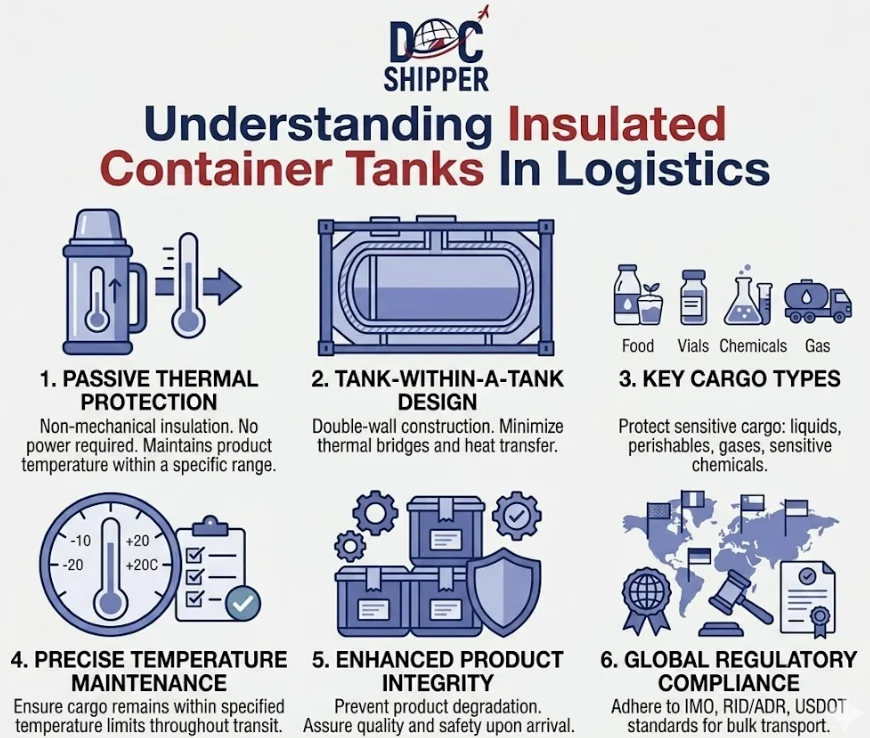
An Insulated Container Tank is a specialized ISO container designed to transport temperature-sensitive liquids and gases by maintaining thermal stability through insulation layers. These tanks combine structural integrity with thermal protection, preventing heat transfer between cargo and external environment during international shipping operations.
Introduction
Many shippers confuse insulated container tanks with refrigerated containers, leading to costly mistakes in temperature-sensitive cargo transport. While reefers actively cool products, insulated tank containers passively maintain temperature through barrier materials alone.
In international logistics, these specialized units solve a critical challenge: transporting liquid chemicals, food-grade products, and industrial fluids across climate zones without active refrigeration. Their importance grows as global supply chains demand cost-effective solutions for non-hazardous temperature-sensitive shipments.
- Thermal retention capacity: Maintains internal temperature for 24-72 hours depending on insulation grade
- ISO standardization: Complies with ISO 1496-3 specifications for tank containers
- Versatile cargo compatibility: Handles liquids from -40°C to +80°C operational range
- Cost efficiency: Eliminates ongoing refrigeration energy costs during transit
- Multi-modal capability: Seamlessly transfers between ship, rail, and truck transport
Technical Specifications & Insulation Systems
Insulated container tanks employ polyurethane foam insulation or mineral wool layers, typically 50-100mm thick, sandwiched between the stainless steel inner tank and outer shell. This construction creates a thermal barrier that slows heat exchange dramatically compared to standard tanks.
The tank structure consists of a cylindrical pressure vessel mounted within a rectangular ISO frame. Common capacities range from 21,000 to 26,000 liters, with maximum gross weights of 36,000 kg for standard 20-foot units. The double-wall design prevents condensation and maintains cargo integrity across temperature variations.
Regulatory compliance involves multiple certifications. These tanks must meet IMDG Code requirements for maritime transport, ADR/RID standards for road/rail movement, and ASME or CSC approval for pressure vessel safety. According to ISO 1496-3 specifications, all tank containers require periodic testing every 2.5 to 5 years depending on cargo classification.
Three insulation grades dominate the market. Standard insulation provides 24-hour temperature maintenance suitable for short-haul shipments. Enhanced insulation extends this to 48 hours for intercontinental voyages. Cryogenic-grade insulation, the most advanced option, maintains ultra-low temperatures for specialized chemical transport requiring -40°C or below.
At DocShipper, we coordinate insulation grade selection with cargo requirements and transit duration to ensure optimal thermal performance throughout your supply chain. Our technical team evaluates temperature sensitivity against route-specific climate data before recommending appropriate tank specifications.
Modern tanks incorporate advanced monitoring systems including temperature sensors, pressure gauges, and GPS tracking. These telemetry devices provide real-time cargo condition data, enabling proactive intervention if thermal thresholds approach critical limits during international movements.
Industry Applications & Performance Data
Insulated container tanks serve diverse industries requiring passive temperature control without active refrigeration costs. The food and beverage sector represents the largest user segment, followed by chemical manufacturing and pharmaceutical logistics.
| Cargo Type | Temperature Range | Insulation Duration | Typical Volume |
|---|---|---|---|
| Fruit Juice Concentrate | 0°C to +5°C | 48 hours | 24,000 liters |
| Liquid Chocolate | +40°C to +50°C | 72 hours | 21,000 liters |
| Industrial Latex | +15°C to +25°C | 36 hours | 26,000 liters |
| Pharmaceutical Glycerin | +2°C to +8°C | 24 hours | 20,000 liters |
| Vegetable Oil | -5°C to +30°C | 48 hours | 25,000 liters |
Case Study: European Juice Concentrate Export
A German beverage manufacturer needed to ship 72,000 liters of orange concentrate to Singapore. Using three insulated container tanks with enhanced insulation, the cargo maintained +4°C throughout the 28-day voyage without refrigeration. This approach saved €1,200 per container compared to reefer alternatives, while eliminating power dependency risks at transshipment ports.
Performance metrics demonstrate clear advantages. Industry data shows insulated tanks reduce temperature variance by 85% compared to standard tanks during tropical crossings. Energy cost savings average 40-60% versus active refrigeration over typical Asia-Europe routes.
DocShipper manages comprehensive tank logistics including pre-trip heating or cooling, cargo loading supervision, and customs documentation for temperature-sensitive shipments. Our network includes certified tank cleaning facilities at major ports to ensure food-grade compliance between shipments.
Market trends show growing adoption in emerging economies. Southeast Asian palm oil exports increasingly utilize insulated tanks to prevent solidification during winter shipments to Europe. Latin American wine concentrate producers similarly rely on these containers to maintain quality during Panama Canal transits.
Operational considerations include pre-conditioning requirements. Most food-grade liquids require heating or cooling the tank before loading to match cargo temperature, minimizing thermal shock. This process typically takes 6-12 hours depending on ambient conditions and desired temperature differential.
Conclusion
Insulated container tanks represent a cost-effective solution for temperature-sensitive liquid transport, combining passive thermal protection with ISO standardization for seamless global logistics. Their ability to maintain cargo integrity without active energy inputs makes them indispensable for food-grade, chemical, and industrial fluid shipments.
Need expert guidance on selecting the right insulated tank solution for your cargo? Contact DocShipper’s specialized team for personalized logistics planning and end-to-end tank container management.
📚 Quiz
Test Your Knowledge: Insulated Container Tank
What is the primary function of an insulated container tank?
A shipper believes insulated container tanks can maintain precise temperature control indefinitely during transit. Is this understanding correct?
Your company needs to ship 24,000 liters of fruit juice concentrate from Europe to Asia at +4°C for a 28-day voyage. Which solution is most appropriate?
🎯 Your Result
📞 Free Quote in 24hFAQ | Insulated Container Tank: Definition, Types & Practical Applications
Insulated container tanks use passive thermal barriers to slow temperature change, maintaining pre-loaded cargo temperature for 24-72 hours without power. Refrigerated tanks actively cool or heat cargo using electric or diesel-powered systems. Insulated tanks cost 40-60% less to operate but require cargo pre-conditioning before loading, while reefers provide active temperature control throughout transit regardless of initial cargo temperature.
Duration depends on insulation grade and external conditions. Standard insulation maintains temperature for 24 hours in moderate climates, enhanced insulation extends this to 48 hours, and cryogenic-grade insulation can preserve ultra-low temperatures for 72+ hours. Tropical ambient temperatures reduce effectiveness by 20-30%, while arctic conditions improve thermal retention significantly.
Ideal cargo includes temperature-sensitive non-hazardous liquids like fruit juice concentrates, liquid chocolate, vegetable oils, latex, glycerin, and wine. Products requiring stable temperatures between -40°C and +80°C without strict precision control (±2°C variance acceptable) work best. Hazardous materials require specialized certified tanks with additional safety features.
Yes, all reputable insulated tanks carry ISO 1496-3 certification, IMDG Code approval for maritime transport, and ADR/RID compliance for road/rail movement. ASME or CSC pressure vessel certification is mandatory, with periodic testing every 2.5-5 years. Always verify current certification dates before booking, as expired certificates void insurance and cause customs delays.
Absolutely. Many products like liquid chocolate, palm oil, and sulfur require heating to 40-80°C to maintain liquid state. Insulated tanks effectively retain heat during transport, preventing solidification. Pre-trip heating brings the tank to cargo temperature, then insulation maintains thermal stability. Some advanced tanks include optional heating coils for extended voyages or extreme cold conditions.
Standard 20-foot insulated tanks hold 21,000-26,000 liters depending on insulation thickness and shell construction. The insulation layer reduces capacity by approximately 2,000-4,000 liters compared to non-insulated equivalents. Maximum gross weight typically reaches 36,000 kg, with tare weight around 3,800-4,500 kg for the empty container.
Rates vary by route, but insulated tanks typically cost 15-25% more than standard dry containers due to specialized equipment. However, they cost 40-60% less than refrigerated containers over equivalent distances. A typical Asia-Europe shipment ranges from $3,500-$5,500 including tank rental, positioning, and ocean freight, versus $6,000-$8,500 for reefer alternatives.
Yes, food-grade cargo requires thorough cleaning at certified facilities between loads to prevent contamination. Cleaning involves hot water washing, steam sterilization, and drying, costing $200-$600 depending on previous cargo. Chemical-grade cleaning with solvents costs more. Certificates of cleanliness must accompany tanks for customs clearance and meet importing country health regulations.
Insulated container tanks are designed exclusively for maritime, road, and rail transport. They are not certified for air freight due to weight and pressure vessel regulations. For air transport of temperature-sensitive liquids, specialized aviation containers or intermediate bulk containers (IBCs) in temperature-controlled cargo holds are required instead.
Modern insulated tanks with telemetry systems alert shippers when temperatures approach threshold limits. If detected early, cargo can be transferred to refrigerated storage at the next port. However, passive insulation cannot recover temperature once exceeded. Comprehensive cargo insurance typically covers temperature deviation losses, but documentation from monitoring systems is essential for claims processing.
Most tank operators offer flexible rental periods from single voyages (4-6 weeks minimum) to multi-year leases. Short-term rentals cost $150-$300 per day including positioning fees, while long-term leases reduce daily rates to $80-$150. Availability varies by region, with major European and Asian ports offering better selection than emerging markets.
Customs typically inspect documentation including tank certificates, cargo manifests, and temperature logs rather than physically opening tanks. When physical inspection is required, authorities coordinate with specialized terminals equipped for safe discharge and reloading. Temperature-sensitive cargo receives priority processing at most major ports to minimize thermal exposure during customs holds.
Need Help with
Logistics or Sourcing ?
First, we secure the right products from the right suppliers at the right price by managing the sourcing process from start to finish. Then, we simplify your shipping experience - from pickup to final delivery - ensuring any product, anywhere, is delivered at highly competitive prices.


Fill the Form
Prefer email? Send us your inquiry, and we’ll get back to you as soon as possible.
Contact us




