


In short ⚡
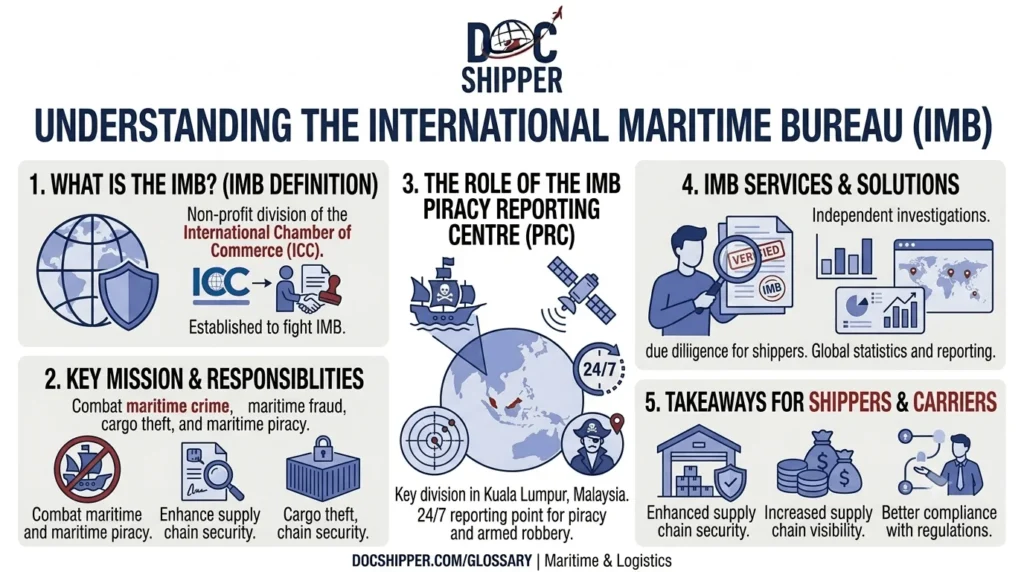
The International Maritime Bureau (IMB) is a specialized division of the International Chamber of Commerce (ICC) established in 1981 to combat maritime fraud, piracy, and armed robbery against ships. Operating 24/7 from its Piracy Reporting Centre in Kuala Lumpur, the IMB monitors global shipping lanes, investigates crimes, and provides real-time alerts to protect international trade and seafarers worldwide.
Introduction
Maritime commerce faces invisible threats that cost the global economy billions annually. From cargo fraud to vessel hijackings, criminal activities at sea jeopardize supply chains and human lives. Understanding the role of the International Maritime Bureau is essential for importers, exporters, and logistics professionals who depend on secure maritime routes.
As a non-governmental organization dedicated to maritime security, the IMB serves as the industry’s frontline defense mechanism against criminal activity. Its intelligence gathering and reporting systems influence insurance premiums, routing decisions, and international security policies.
The IMB’s core functions include:
- 24/7 Piracy Reporting Centre (PRC) tracking incidents worldwide
- Maritime fraud investigation protecting cargo interests and charter parties
- Global ship tracking databases identifying high-risk vessels and areas
- Industry advisory services for best security practices and risk mitigation
- Collaboration with naval forces and law enforcement agencies globally
Operational Framework & Expertise
The IMB operates through two primary mechanisms: the Piracy Reporting Centre and the Commercial Crime Services division. The PRC, established in 1992, maintains continuous surveillance of maritime incidents through satellite tracking, direct ship-to-shore communications, and collaborative intelligence networks with international naval forces.
When a piracy or robbery incident occurs, ship masters can contact the IMB PRC via emergency hotlines. The Centre immediately alerts nearby vessels, coastal authorities, and naval patrols. This rapid response capability has proven instrumental in preventing escalations and coordinating rescue operations.
The IMB’s legal authority stems from its ICC affiliation, though it possesses no enforcement powers. Instead, it functions as an intelligence and coordination hub, bridging the gap between commercial shipping interests and governmental security forces. According to the International Chamber of Commerce, the Bureau maintains confidential databases on fraudulent companies, suspicious vessels, and known criminal networks operating in maritime trade.
The organization classifies maritime crimes into distinct categories: piracy (attacks in international waters), armed robbery (attacks in territorial waters), cargo theft, documentary fraud, and charter party fraud. Each classification triggers different response protocols and involves distinct legal jurisdictions.
At DocShipper, we systematically consult IMB reports when planning shipping routes for our clients, particularly for high-value cargo transiting through historically vulnerable regions. This proactive approach minimizes insurance complications and ensures compliance with carrier security requirements.
The Bureau’s quarterly reports influence maritime insurance premiums, as underwriters adjust rates based on documented threat levels. Vessels transiting through IMB-designated high-risk areas may face premium increases of 0.05% to 0.5% of cargo value, directly impacting landed costs for importers.
Concrete Examples & Data
The IMB’s annual Piracy and Armed Robbery Report provides quantitative evidence of global maritime security trends. Recent data reveals significant geographical shifts in criminal activity and the effectiveness of international countermeasures.
| Region | 2023 Incidents | Primary Threat Type | IMB Risk Level |
|---|---|---|---|
| Gulf of Guinea | 23 incidents | Kidnapping for ransom | High |
| Southeast Asian Waters | 55 incidents | Cargo theft at anchor | Medium |
| Somalia Coast | 3 incidents | Attempted hijacking | Low (improved) |
| South American Ports | 31 incidents | Armed robbery in port | Medium |
Use Case: Electronics Shipment from Asia to Europe
A manufacturer shipping $2 million worth of electronics from Singapore to Rotterdam must decide between two routes. The Suez Canal route passes through the Gulf of Aden, while the alternative routes around Africa’s southern tip.
Consulting the IMB’s latest regional assessment reveals zero piracy incidents in the Gulf of Aden corridor in the past 18 months, thanks to coordinated naval patrols. The shipper selects the Suez route, saving 12 days transit time and $45,000 in fuel costs, while maintaining standard insurance rates. Without IMB intelligence, the shipper might have paid premium war risk insurance unnecessarily.
Key operational insights from IMB data:
- Timing matters: 68% of Southeast Asian incidents occur between midnight and 6 AM during low-tide anchorage
- Vessel type vulnerability: Product tankers and bulk carriers account for 43% of all reported attacks
- Response effectiveness: Incidents with immediate IMB PRC reporting show 34% faster naval response times
- Fraud prevention: IMB’s documentary fraud database prevented an estimated $127 million in losses in 2023
- Insurance impact: Vessels following IMB best practices qualify for 15-25% reductions in war risk premiums
Conclusion
The International Maritime Bureau remains the definitive authority for maritime security intelligence, directly influencing routing decisions, insurance costs, and cargo protection strategies in global trade. Its real-time reporting and historical data empower logistics professionals to make informed risk assessments that balance cost efficiency with security requirements.
Need expert guidance on securing your maritime shipments through high-risk regions? Contact DocShipper for comprehensive logistics solutions that integrate IMB intelligence into your supply chain strategy.
📚 Quiz
Test Your Knowledge: International Maritime Bureau (IMB)
What is the primary function of the International Maritime Bureau (IMB)?
According to IMB classification, what distinguishes piracy from armed robbery in maritime incidents?
A shipping company receives an IMB alert about elevated risk in the Gulf of Guinea. What is the most appropriate operational response?
🎯 Your Result
📞 Get Your Free Quote in 24hFAQ | IMB (International Maritime Bureau): Definition, Role & Concrete Examples
The IMB follows UNCLOS definitions: piracy occurs in international waters (beyond 12 nautical miles from shore), while armed robbery happens in territorial waters or ports. This legal distinction affects jurisdiction, insurance claims, and which authorities respond. Piracy typically involves vessel hijacking or crew kidnapping, whereas armed robbery often targets cargo or ship equipment during port operations or anchorage.
The IMB PRC operates 24/7 with average response times under 3 minutes for emergency calls. Upon receiving a distress signal, the Centre immediately broadcasts alerts to vessels within a 200-nautical-mile radius and notifies relevant coastal authorities and naval forces. This rapid coordination has been credited with preventing hijackings and facilitating rescue operations, particularly in Southeast Asian waters where response times directly correlate with incident outcomes.
Yes, demonstrating compliance with IMB security recommendations can reduce war risk and kidnap-and-ransom insurance premiums by 15-25%. Insurers evaluate whether vessels follow IMB best practices such as avoiding high-risk areas during vulnerable times, maintaining proper watch schedules, and reporting suspicious approaches. Shipowners who integrate IMB routing advisories and implement recommended security measures qualify for preferential underwriting terms from major maritime insurers.
Yes, the IMB PRC hotline (+60 3 2031 0014) is accessible to all vessels regardless of size or ownership structure. While some IMB investigative services require membership fees, the core piracy reporting and alert system remains free to the entire maritime community. Small operators benefit equally from real-time incident broadcasts, regional risk assessments, and access to the IMB's suspicious vessel database through their online portal.
Essential reporting elements include vessel name and IMO number, exact position coordinates, incident time (UTC), number of attackers and weapons observed, and immediate threat status. Additional valuable information includes attacker vessel descriptions, stolen items, crew injuries, and whether authorities have been notified. The IMB treats all reports confidentially unless the reporting party authorizes public disclosure, ensuring cooperation without commercial repercussions.
The IMB maintains investigative teams specializing in documentary fraud, phantom ships, and fraudulent charter agreements. Investigations typically begin with analysis of bills of lading, certificates of origin, and vessel documentation against proprietary databases. The Bureau collaborates with port authorities, ship registries, and INTERPOL to verify vessel ownership and cargo legitimacy. Results are shared confidentially with affected parties and contribute to the IMB's fraud alert system used by banks and cargo insurers.
As of 2024, the Gulf of Guinea maintains the highest risk designation despite declining incident numbers, primarily due to sophisticated kidnapping-for-ransom operations targeting crew members. Southeast Asian waters, particularly the Singapore Strait and Indonesian archipelago, show elevated cargo theft risks during anchorage. The IMB publishes quarterly risk assessments that consider incident frequency, attack severity, and regional law enforcement effectiveness, which directly influence routing decisions and insurance requirements.
No, the IMB possesses no arrest or prosecution powers. As a non-governmental organization, it functions exclusively as an intelligence-gathering and coordination entity. The Bureau works closely with national coast guards, naval forces, and INTERPOL to facilitate enforcement actions. When IMB investigations identify criminal networks or fraudulent operations, evidence is forwarded to appropriate legal authorities who conduct prosecutions under their respective jurisdictions.
IMB quarterly and annual reports inform policy decisions at the International Maritime Organization (IMO), regional security initiatives like the Djibouti Code of Conduct, and national maritime security strategies. Statistical trends documented by the IMB have led to expanded naval patrol areas, revised best management practices for transiting high-risk areas, and adjustments to ISPS Code implementation. Insurance industry associations also reference IMB data when establishing premium structures and coverage requirements.
The IMB facilitates recovery efforts by coordinating with law enforcement and providing investigative intelligence, but does not conduct direct recovery operations. For cargo theft, the Bureau's global network often identifies stolen goods in secondary markets and alerts authorities. In hijacking cases, the IMB works with specialized negotiators and naval forces to support resolution efforts while maintaining continuous communication with vessel owners and flag state authorities throughout the crisis.
Professional freight forwarders and ship operators integrate IMB risk assessments into routing software and voyage planning systems. When IMB issues area warnings or elevates risk levels, carriers may implement route deviations, increase transit speeds through affected zones, or require additional security personnel. These decisions directly impact delivery schedules and freight costs. Major shipping lines subscribe to IMB's enhanced reporting services to receive real-time updates that inform dynamic route adjustments.
DocShipper integrates IMB data into our comprehensive risk assessment protocols for maritime shipments. We monitor regional threat levels, verify vessel security compliance, and adjust routing recommendations based on current IMB advisories. For high-value or time-sensitive cargo, we coordinate with carriers implementing IMB best practices and ensure insurance coverage aligns with documented risk levels. This proactive approach protects our clients from unexpected delays, additional security costs, and insurance claim complications.
Need Help with
Logistics or Sourcing ?
First, we secure the right products from the right suppliers at the right price by managing the sourcing process from start to finish. Then, we simplify your shipping experience - from pickup to final delivery - ensuring any product, anywhere, is delivered at highly competitive prices.


Fill the Form
Prefer email? Send us your inquiry, and we’ll get back to you as soon as possible.
Contact us




:%20Definition,%20Role%20&%20Concrete%20Examples)